

Cryptocurrency is digital money that isn’t held by a bank. Every coin and every payment is recorded on a public ledger that thousands of computers keep in sync, and the only thing that proves a coin is yours is a secret key that you (or a company you trust) control.
That’s the core idea. This guide unpacks it without the jargon: what actually happens when you send crypto, why anyone thinks it’s worth something, where your coins “live”, what using them costs, and the risks worth understanding before you put in a single dollar.
Crypto in 60 seconds
If you only remember four things, make it these:
- The ledger. A shared record of who owns what, called a blockchain. Anyone can read it, and no single company can quietly edit it.
- The keys. Your “account” is really a pair of cryptographic keys. The private key authorizes payments, and whoever holds it controls the coins.
- The network. Thousands of independent computers, called nodes, check every transaction against the same rules and agree on what gets added next.
- The coin. A unit of value tracked by that ledger: bitcoin on the Bitcoin network, ether on Ethereum, and thousands of others.
Notice what’s missing: there’s no bank in the middle. That’s the whole point of crypto, and it’s also the source of most of its risks.
What actually happens when you send crypto
Abstract explanations only go so far, so let’s follow one payment. Say Sam wants to send $50 worth of bitcoin to his friend Priya.
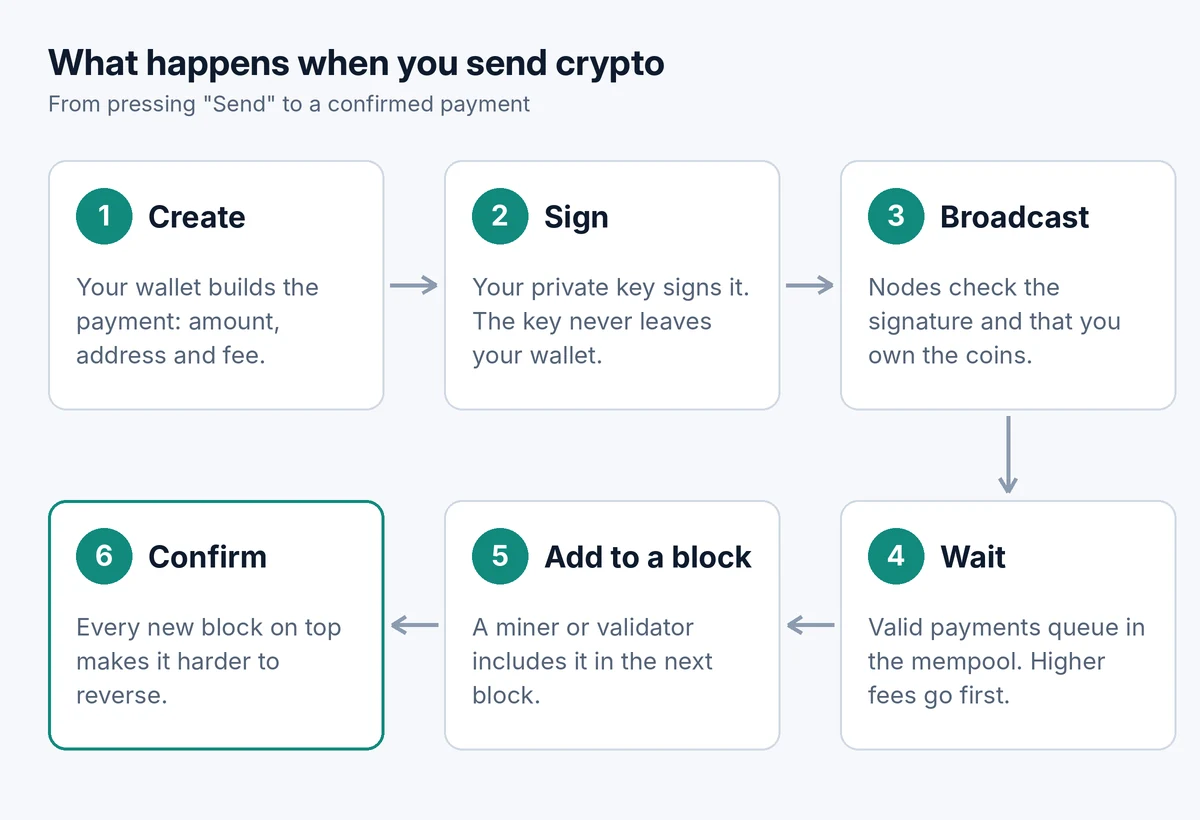
- Sam’s wallet creates the transaction. It says, in effect, “move this amount from Sam’s address to Priya’s address”, and it attaches a fee.
- The wallet signs it with Sam’s private key. The signature proves Sam authorized the payment without revealing the key itself.
- The transaction is broadcast to the network. Nodes check it: is the signature valid, does Sam’s address really hold those coins, and hasn’t he already spent them?
- It waits in a queue called the mempool. Valid transactions sit there until they’re picked for a block. Transactions offering higher fees are usually picked first.
- It’s added to a block. On Bitcoin, a new block is added roughly every 10 minutes. On Ethereum, it’s about every 12 seconds.
- Confirmations stack up. Each new block added on top makes the payment harder to reverse. That’s why exchanges wait for a set number of confirmations before crediting a deposit.
Two things in that process surprise most beginners. First, there’s no undo button. Once a payment is confirmed, nobody can reverse it, including the person who sent it. Second, the fee doesn’t depend on how much you send but on how busy the network is, so moving $10 can cost as much as moving $10,000. Our guide to why gas fees spike explains this in detail, and if a payment ever seems stuck at step 4, see what to do when a Bitcoin transaction is unconfirmed.
The three ideas that make it work
Everything above rests on three building blocks. You don’t need the math behind them, but knowing what each one does makes the rest of crypto much easier to follow.
A ledger nobody owns
Transactions are grouped into blocks, and each block contains a digital fingerprint (a “hash”) of the block before it. Change one old entry and its fingerprint changes, which breaks the link to every block that came after. On top of that, thousands of nodes each keep their own copy, so a cheater would have to convince most of the network to accept a fake history. That’s what people mean when they say a blockchain is tamper-resistant. For a visual walkthrough, read how blockchain works.
Keys instead of usernames
Your public address works like an account number: you can share it so people can pay you. Your private key is closer to a signature and a password rolled into one, and it should never be shared with anyone.
Wallet apps handle the keys for you and give you a recovery phrase (also called a seed phrase), usually 12 or 24 words that can rebuild your keys on any compatible wallet. There’s no “forgot password” link in crypto. If you lose the phrase and the device, the coins are gone for good, which is why storing your seed phrase safely matters more than any other security step.
Agreement without a boss
Someone has to decide which transactions go into the next block, and the network needs a fair way to choose who. This is called a consensus mechanism, and there are two main kinds:
- Proof of work (Bitcoin). Miners compete to solve a puzzle using specialized hardware and electricity. The winner adds the next block and earns newly created bitcoin plus the transaction fees.
- Proof of stake (Ethereum and many newer networks). Validators lock up coins as collateral. If they try to cheat, they can lose part of it. Ethereum switched to this model on 15 September 2022, a change that cut its energy use by roughly 99.95%.
The trade-offs between the two are covered in proof of work vs proof of stake.
Why a digital coin is worth anything
The honest answer: a coin is worth what people are willing to pay for it. Crypto doesn’t produce earnings like a company or pay interest like a bond. Its value comes from a mix of scarcity, usefulness and belief that others will want it later.
Different coins lean on different parts of that mix:
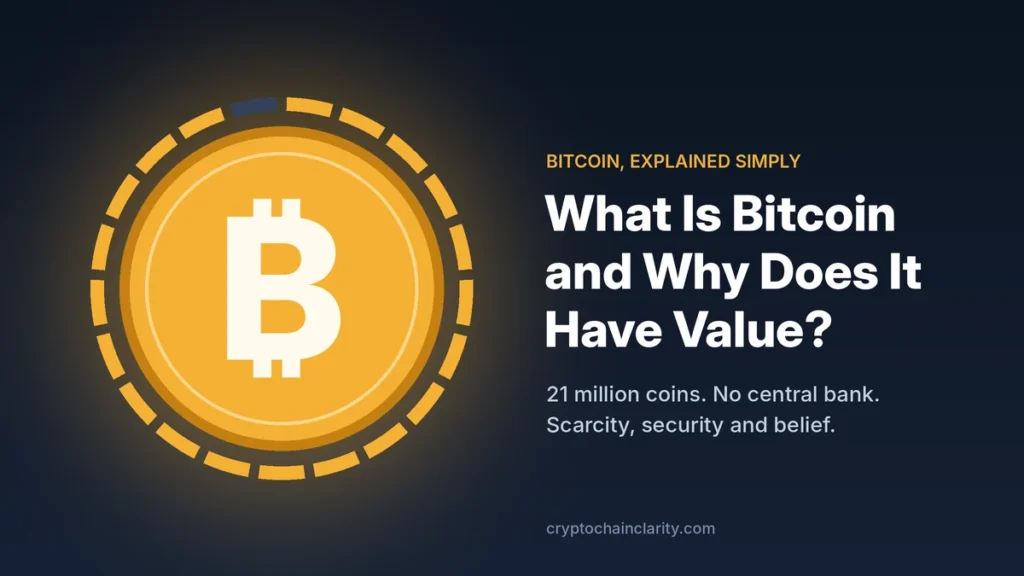
- Bitcoin relies on scarcity. Its code caps the supply at 21 million coins, and the rate of new issuance is cut in half roughly every four years in an event called the halving. Supporters treat it as digital gold. What is Bitcoin and why does it have value? goes deeper.
- Ether draws value from use. You need ETH to pay for transactions and apps on Ethereum, so demand for the network creates demand for the coin. See Bitcoin vs Ethereum for how the two differ.
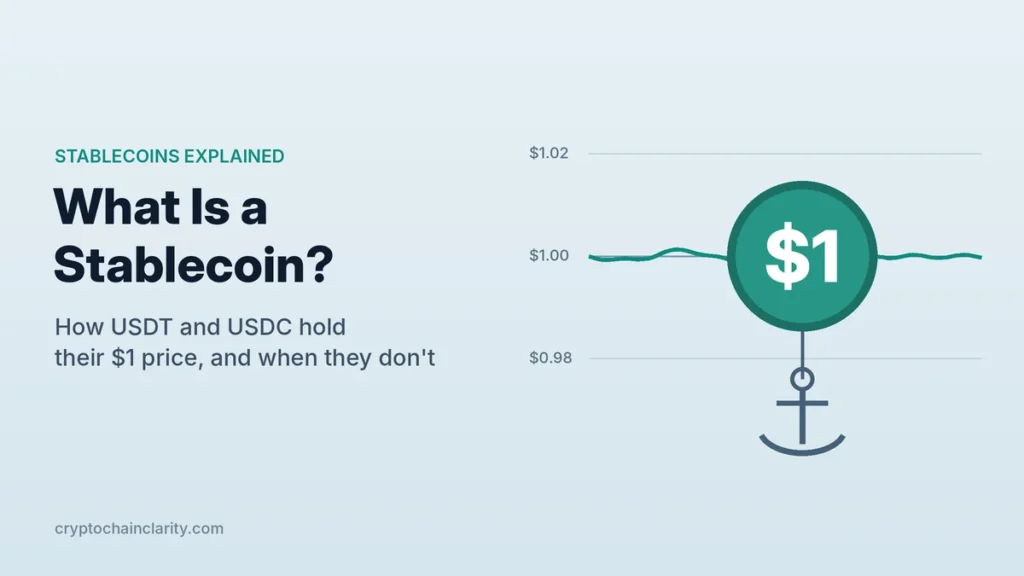
- Stablecoins don’t try to gain value at all. They’re designed to stay at $1 by holding reserves, which makes them useful for moving dollars on a blockchain. How stablecoins keep their price explains the mechanics and the risks.
Because the market is young, trades 24 hours a day and runs largely on sentiment, prices swing far more than stocks. Bitcoin has fallen more than 70% from a peak more than once and recovered afterwards, but smaller coins often never do. One more trap to avoid: a coin priced at a fraction of a cent isn’t “cheap”. What matters is the total value of all its coins, which is explained in crypto market cap.
The main types of crypto
“Crypto” covers very different things. Before buying anything, it helps to know which bucket it falls into.
| Type | What it’s for | Examples | What a beginner should know |
|---|---|---|---|
| Bitcoin | Store of value and payments | BTC | The oldest and simplest. Limited supply, slower and more expensive to use directly. |
| Smart contract platforms | Running apps and other tokens | Ethereum (ETH), Solana (SOL) | Fees on these networks are paid in their own coin. |
| Stablecoins | Holding dollars on a blockchain | USDC, USDT | Built to stay at $1, but only as safe as the issuer’s reserves. |
| Altcoins and tokens | Specific projects and apps | Thousands | Quality varies enormously, and many projects fail. |
| Memecoins | Speculation and online communities | DOGE and countless newer coins | Price is driven almost entirely by attention. |
If a project’s main selling point is that the price will go up, treat that as a warning sign. Our guide to telling real altcoins from hype coins gives you a checklist. And if all you want is exposure to Bitcoin’s price without managing keys, Bitcoin ETFs bought through a regular brokerage are another route.
Where your crypto actually lives
Your coins never leave the blockchain. What you actually hold is the key that can move them. So the real question isn’t “where are my coins?” but “who holds the key?”
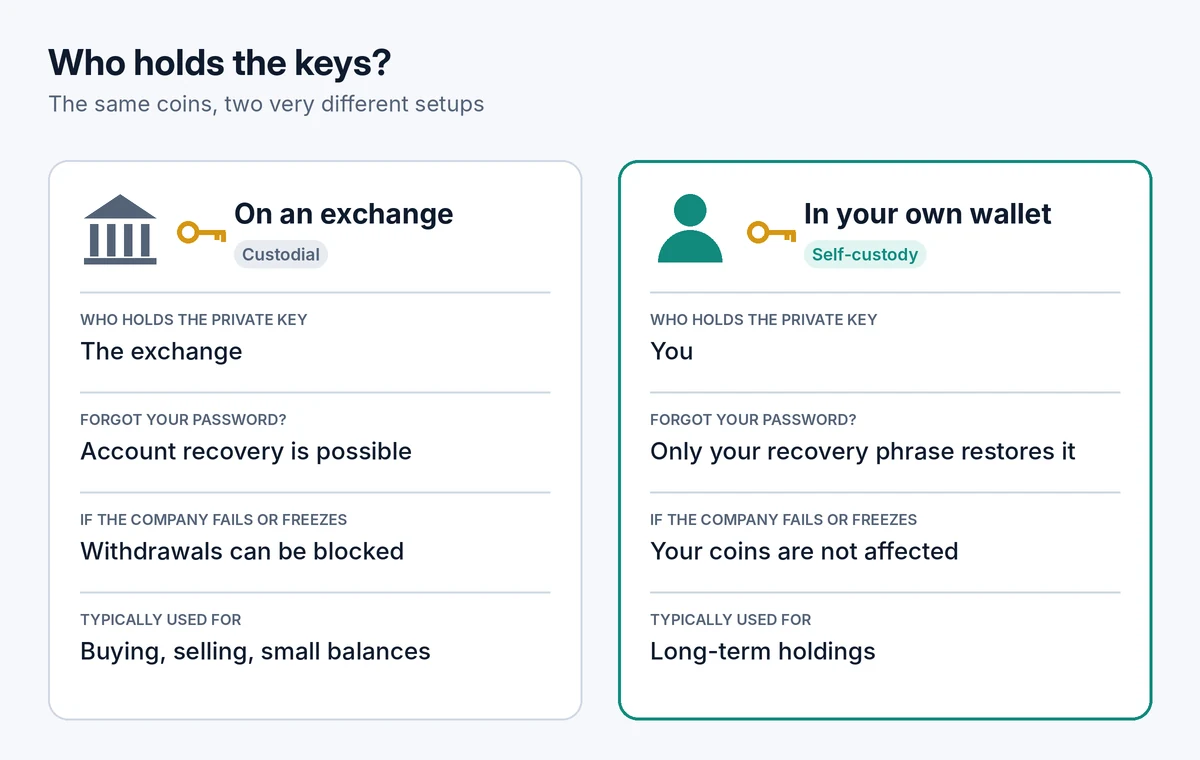
On an exchange (custodial). When you buy on Coinbase, Kraken or similar, the exchange holds the keys for you. It’s convenient and you can reset a forgotten password, but you’re trusting a company. If it’s hacked, freezes withdrawals or goes bankrupt, your access depends on what happens to that company. Customers of FTX learned this the hard way when the exchange collapsed in 2022. Read is it safe to keep crypto on an exchange? before leaving a large balance there.
In your own wallet (self-custody). You hold the keys, either in a software wallet (an app on your phone or computer) or a hardware wallet (a small device that keeps keys offline). Nobody can freeze your coins, but nobody can recover them for you either.
A common middle ground is to keep a small amount on an exchange for buying and selling, and move longer-term holdings to a hardware wallet. Start with crypto wallets explained, compare devices in Ledger vs Trezor, and follow this step-by-step transfer guide when you’re ready.
What it costs to buy and use crypto
The fee an exchange advertises is rarely the whole cost. A typical purchase and transfer can involve four separate charges:
- Spread: the gap between the price you buy at and the price you could sell at. One-click “simple buy” screens often have a wider spread than the exchange’s trading screen.
- Trading fee: a percentage the exchange charges on each trade.
- Network fee: paid to the miners or validators who process your transaction, and higher when the network is busy.
- Withdrawal fee: some exchanges charge extra when you move coins out to your own wallet.
The practical habit: before your first purchase, work out the total cost of buying $100 and withdrawing it, not just the headline fee. Crypto exchange fees explained shows how to calculate it, and there are country-specific comparisons for the US and the UK.
The risks to understand first
Volatility. Losing half your money’s value in a few months is a normal crypto event, not a rare one. Only invest money you could lose without it affecting your bills or savings.
Mistakes are permanent. Send coins to the wrong address or the wrong network and there’s usually no one to call. Always send a small test amount first. If it has already happened, see sent crypto to the wrong network and crypto sent to the wrong address.
Scams. Crypto is a favorite tool for fraudsters precisely because payments can’t be reversed. The US Federal Trade Commission points out that crypto payments typically aren’t reversible and don’t come with the legal protections of credit or debit cards, and that no legitimate business will demand payment in crypto upfront. Learn the patterns in 10 common crypto scams.
Losing access. A lost recovery phrase, a forgotten PIN or a broken device without a backup can lock you out permanently. It’s worth planning for this, including how your family would access your crypto if something happened to you.
Taxes. In the US, the IRS treats digital assets as property, not currency, so selling, swapping or spending crypto can create a taxable gain. The UK applies Capital Gains Tax in a similar way, as set out in HMRC’s cryptoassets guidance. Swapping one coin for another counts too, which catches many beginners out. Start with what triggers a taxable event, then read the rules for the US or the UK.
A sensible first step
If you’ve read this far and still want to try crypto, this order keeps the risk small while you learn:
- Set your limit. Pick an amount you could lose entirely without it mattering, and stick to it.
- Choose a regulated exchange in your country. In the US, that means one registered with FinCEN and licensed in your state. In the UK, look for FCA registration, and in Canada, FINTRAC registration. Our complete guide to buying crypto safely walks through the process, and Coinbase vs Kraken compares two common starting points.
- Secure the account before you deposit. Use a unique password and app-based two-factor authentication rather than SMS codes where possible.
- Start with a small purchase. If you plan to use your own wallet, do a small test withdrawal before moving anything larger.
- Consider buying in regular amounts. Spreading purchases over time, known as dollar-cost averaging, takes the pressure off trying to time the market.
- Keep records from day one. Note the date, amount and price of every buy, sell and swap. Your future tax return will need them, as explained in how to report crypto on your tax return.
Quick answers to common beginner questions
Do I need to buy a whole bitcoin?
No. One bitcoin divides into 100 million smaller units called satoshis, so you can buy $10 or $20 worth. The same applies to most other coins.
Is crypto anonymous?
Not really. Every transaction is visible on the public ledger forever, and regulated exchanges verify your identity when you sign up. That means activity can often be linked back to you. “Pseudonymous” is a more accurate word.
Can Bitcoin be hacked?
The Bitcoin network itself has proven very resilient. Most losses happen around the edges: hacked exchanges, phishing sites, fake apps and stolen recovery phrases. Protecting your own keys and logins is where your effort pays off.
Is crypto legal?
Owning and trading crypto is legal in the US, UK, Canada and Australia, but each country has its own rules for exchanges, advertising and tax. A few countries restrict or ban it, so check your local rules if you live elsewhere.
Where to go from here
If you want to understand the technology better, read how blockchain works next. If you’re ready to buy, start with how to buy crypto safely and decide where you’ll keep your coins with crypto wallets explained. And whenever you hit an unfamiliar term, the crypto glossary explains it in one sentence.
This guide is for educational purposes only and isn’t financial, investment or tax advice.
Pingback: What Is Bitcoin and Why Does It Have Value? Explained Simply
Pingback: What Happens When All 21 Million Bitcoin Are Mined?
Pingback: What Is Crypto Staking? How It Works and Is It Safe for Beginners