

The safest way to store a seed phrase is offline, on paper or a steel backup plate, in at least two secure places, and never anywhere a computer, phone or other person can see it. That means no photos, no screenshots, no cloud notes, no emails, and never typing it into a website or giving it to anyone who claims to be “support”.
Those rules sound simple, yet broken versions of them are behind a large share of crypto thefts. Below you’ll find why the phrase matters so much, where to keep it, how to write it down correctly, and the specific mistakes scammers count on.
Why your seed phrase matters more than your device
A seed phrase (also called a recovery phrase or secret recovery phrase) is a list of usually 12 or 24 ordinary words that your wallet generates when you set it up. Those words are a human-readable version of the master key to your wallet. Most wallets follow a shared standard, known as BIP-39, which picks the words from a fixed list of 2,048.
Two facts follow from that:
- The phrase can rebuild your wallet anywhere. If your phone or hardware wallet is lost, broken or stolen, you can type the words into a new compatible wallet and get everything back. That’s what makes it your backup.
- Anyone who has the phrase has your coins. They don’t need your device, your PIN or your password. They just type the words into their own wallet and send everything out. There’s no bank to call and no way to reverse it.
So your seed phrase isn’t a password you can reset. It is your money. If you’re new to how wallets work, crypto wallets explained covers the basics.
The two risks you’re protecting against
Good storage is a balancing act between two opposite dangers: losing the phrase, and someone else finding it.
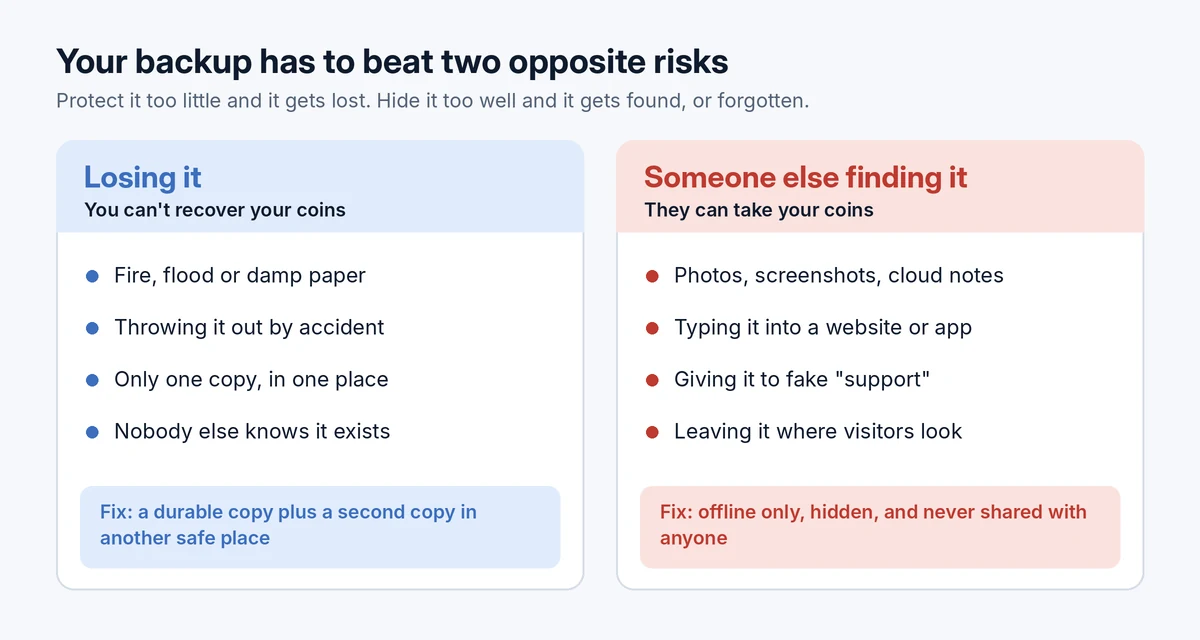
Many people focus on one and forget the other. A phrase locked in a safe nobody knows about can be lost forever if you die or forget the combination. A phrase saved to the cloud “so it can’t get lost” can be stolen by anyone who gets into that account. The aim is a setup that’s both durable and private.
Where to keep it
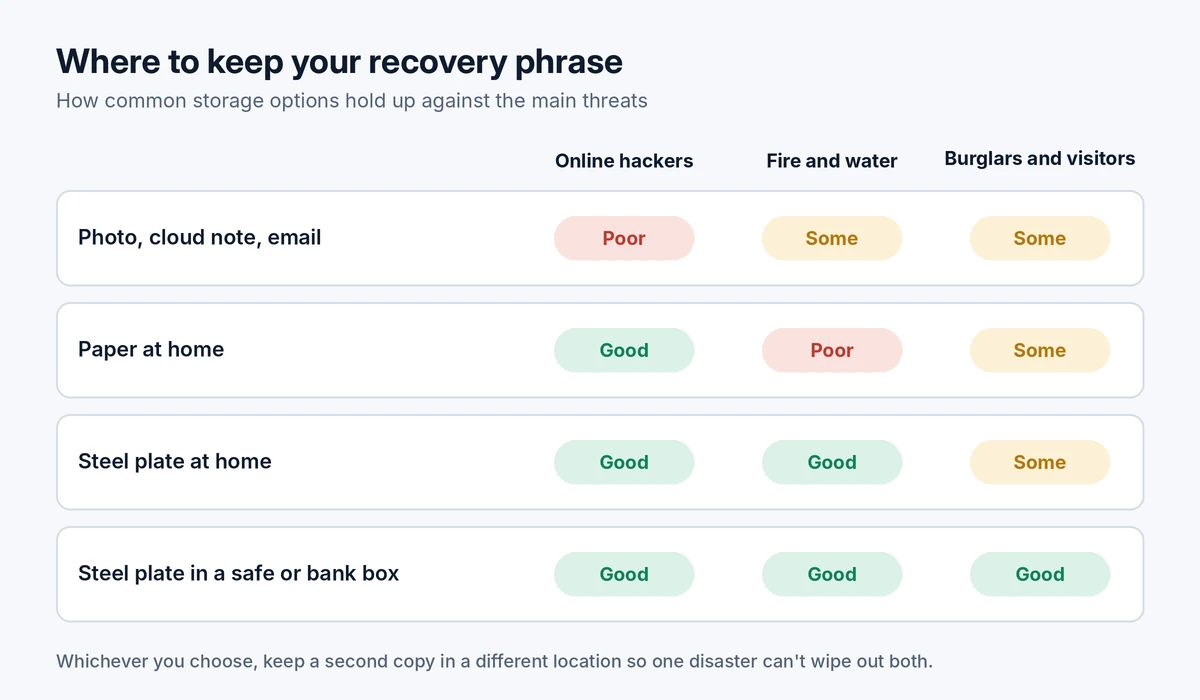
Paper: fine to start, not for the long term
Writing the words on the card that comes with your wallet is the normal first step. Paper keeps the phrase offline, which protects you from hackers. But paper burns, soaks through, fades and gets thrown away by mistake. If you use paper, use pencil or archival ink, keep it in a sealed bag inside something fireproof, and treat it as a temporary solution.
A steel backup: the long-term standard
Steel or titanium backup plates let you stamp, engrave or slot in the letters of each word. They survive house fires and floods that would destroy paper. They cost roughly the same as a cheap hardware wallet, and for any amount you’d be upset to lose, they’re worth it. Most of them only need the first four letters of each word, since every word in the standard list is uniquely identified by those four.
Where to put the backup
- A home safe protects against casual discovery and, if fire-rated, adds a layer against fire. It’s also the first place a burglar looks.
- A bank safe deposit box is well protected from theft and disasters, but you can only reach it during opening hours, and access depends on the bank.
- A trusted relative’s home or a second property gives you a copy in a different location, so one fire or burglary can’t take everything.
A sensible setup for most people: one steel backup at home, hidden or in a safe, and a second copy in another location you trust. Two copies in two places protects you from losing access, as long as both places are secure.
How to write it down correctly
- Do it alone, offline and unhurried. Make sure nobody can see your screen and no camera, smart speaker or video call is running.
- Write each word in order and number it. The order matters: the same words in the wrong order won’t restore your wallet.
- Write clearly in capitals. Words like “tree” and “three” or “cat” and “act” are easy to mix up when you’re stressed months later.
- Double-check every word against the screen. Most wallets then ask you to confirm some of them. Take it seriously.
- Don’t add anything else to the card, such as “crypto wallet” or the exchange name. If someone finds it, the less it explains, the better.
- Test the backup. When your wallet holds only a small amount, check that the phrase restores it, either with the wallet’s built-in check or by restoring on a second device you control. A backup you’ve never tested is an assumption, not a backup.
The mistakes that get people robbed
Almost every seed phrase theft comes from one of the patterns below. None of them requires an attacker to break any encryption: they rely on getting you to reveal the words.
Storing it digitally
Photos, screenshots, notes apps, password managers synced to the cloud, emails to yourself and documents in online storage all put the phrase within reach of anyone who breaks into those accounts. Phones also back up photos automatically, so a picture you took “just for a minute” can end up on a server for years. Keep the phrase completely off every connected device.
Giving it to “support”
Scammers pose as wallet companies, exchanges or helpful community members, especially on social media and in chat groups. They offer to fix a problem and then ask for your phrase to “verify” or “sync” your wallet. No genuine company will ever ask for your seed phrase, for any reason. Anyone who does is trying to steal from you.
Typing it into a website or app
Phishing emails and fake sites tell you your wallet is “blocked”, “out of date” or “about to be suspended” and ask you to re-enter your phrase. The US Federal Trade Commission has warned about exactly these urgent fake wallet emails. The only time you should ever enter your phrase is when you’re restoring your wallet on a device you trust, using an app you downloaded yourself from the official source.
Falling for fake letters or “replacement devices”
Some customers of hardware wallet companies have received physical letters or even devices in the post asking them to enter their phrase for a “security upgrade”. They’re scams. If a message arrives, however official it looks, ignore it and check the company’s real website directly.
Buying a pre-configured wallet
If a hardware wallet arrives with a seed phrase already written on a card, the seller knows it and can empty the wallet whenever you add funds. Only use devices that generate a new phrase in front of you, and buy them from the manufacturer or an authorized seller. Our Ledger vs Trezor comparison covers buying safely.
Splitting the words in half
Some people store words 1–12 in one place and 13–24 in another, thinking that’s safer. It actually weakens your security, because someone who finds half the words has a much smaller puzzle to solve. If you want to split your backup, use a method designed for it, such as a wallet’s multi-share backup feature or a multisig setup.
Telling people or leaving clues
The fewer people who know you hold crypto, the fewer who might look for your backup. That includes social media posts, conversations with acquaintances and obvious labels on safes or envelopes.
More scam patterns are covered in 10 common crypto scams and how to spot them.
Extra protection: the passphrase
Many wallets let you add an optional passphrase, sometimes called a “25th word”. It works like an extra word that only you know. Combined with your seed phrase, it opens a completely separate wallet. Someone who finds your seed phrase alone gets nothing useful.
It’s a strong defense against physical theft, but it adds a new way to lose everything: forget the passphrase and your coins are gone, even if you still have the seed phrase. If you use one, back it up separately from the seed phrase, with the same care. For most beginners, solid storage of the seed phrase alone is enough to start with.
Planning for the people you leave behind
A perfectly hidden phrase is a problem if you’re the only person who knows it exists. Without a plan, your coins can be lost forever if something happens to you. That doesn’t mean telling family the words today. It means leaving clear instructions about where the backup is and how to use it, through a will or a trusted arrangement. How to pass crypto to your family explains the options.
Quick answers
Is it safe to store my seed phrase in a password manager?
It’s better than a notes app or a photo, but it still puts the phrase on internet-connected devices and depends on one account’s security. For anything beyond small amounts, an offline backup is the safer choice.
What if I lose my seed phrase but still have my wallet?
Your coins are fine for now, but you have no backup. Create a new wallet with a new phrase, back that one up properly and move your coins to it as soon as possible. Don’t simply write down the old phrase again if you’re not sure who might have seen it.
What if someone else might have seen my phrase?
Treat the wallet as compromised. Create a new wallet with a new phrase and move your funds immediately, before anyone else does.
Do I need a seed phrase if I keep crypto on an exchange?
No. On an exchange, the company holds the keys, and you protect your account with a strong password and two-factor authentication instead. The trade-off is explained in is it safe to keep crypto on an exchange?
I lost my hardware wallet. Are my coins gone?
Not if you have your seed phrase. See what happens if you lose your hardware wallet and forgot your crypto wallet PIN.
This guide is for educational purposes only and isn’t financial or security advice tailored to your situation.
Pingback: 10 Common Crypto Scams and How to Spot Them (2026)
Pingback: How to Move Crypto From Coinbase to a Hardware Wallet (Step by Step)
Pingback: Best Crypto Wallets for Beginners (2026): 7 Options Compared
Pingback: Ledger vs Trezor: Which Hardware Wallet Is Better for Beginners?
Pingback: What Happens When All Bitcoin Is Mined? Life After 21 Million
Pingback: How Do Bitcoin ETFs Work? ETF vs Buying Bitcoin for Beginners
Pingback: Crypto for Beginners: How It Actually Works (Plain English)
Pingback: Crypto Wallets Explained: Hot vs Cold, Custodial vs Self-Custody