

Crypto staking means locking up coins to help run a proof-of-stake blockchain, such as Ethereum or Solana, in exchange for rewards paid in that same coin. Think of it as putting down a security deposit: the network trusts validators because they have money at stake, and pays them for doing the work honestly.
Is it safe for beginners? Staking a well-established coin through a reputable, regulated exchange is one of the lower-risk things you can do in crypto. It still isn’t risk-free: you can lose money if the coin’s price falls (which matters far more than the reward), if the platform holding your coins fails, or, with some methods, if your coins are locked when you want to sell. This guide explains how staking works, the four main ways to do it and how to start without taking risks you didn’t sign up for.
How crypto staking works
Blockchains need a way to decide who adds the next block of transactions. Bitcoin uses miners who spend electricity. Proof-of-stake networks use validators instead: participants who lock up coins as collateral and take turns proposing and checking blocks. If you want the full comparison, read proof of work vs proof of stake.
Validators who do their job correctly earn rewards. Validators who go offline earn less and may lose a small amount, and those who try to cheat can have part of their stake destroyed, a penalty called slashing. That’s what keeps the system honest: cheating costs more than it earns.
When you “stake” as an individual, you’re usually not running a validator yourself. You’re adding your coins to one, directly or through a service, and receiving a share of its rewards.
Where staking rewards come from
Rewards aren’t interest paid by a bank or a company. They come from two sources:
- Newly created coins. Most proof-of-stake networks issue new coins to validators. This is the largest part of most staking rewards.
- Transaction fees and tips paid by people using the network.
The first point matters more than it seems. If a network creates new coins to pay stakers, everyone who doesn’t stake sees their share of the total shrink slightly. Part of what staking does, then, is keep you from falling behind, rather than making you money from nowhere.
Reward rates vary by coin and change over time. For Ethereum, ethereum.org’s staking page showed a rate of about 2.5% a year at the time of writing. Other networks advertise higher rates, often because they issue more new coins. A high advertised rate is not the same as a high real return. And if a platform promises double-digit returns on a major coin, ask where that extra money comes from, because it’s usually lending or something riskier than staking.
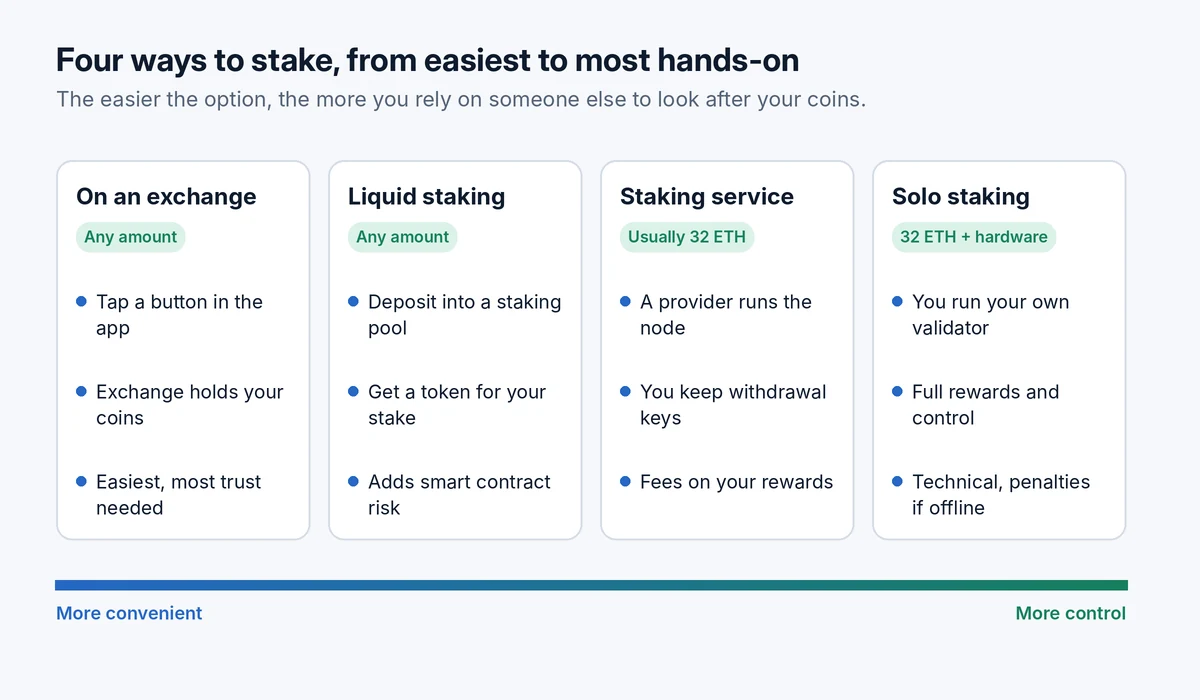
The four ways to stake
1. On an exchange
Most beginners start here. You buy a coin on an exchange, tap “stake” or “earn”, and the exchange handles everything. You can usually stake any amount.
The trade-off is trust. The exchange holds your coins, takes a cut of the rewards and decides its own terms, including how quickly you can unstake. If the exchange fails or freezes withdrawals, your staked coins are caught up with everything else. Is it safe to keep crypto on an exchange? covers that risk.
2. Liquid staking
You deposit coins into a staking pool run by smart contracts and receive a separate token that represents your stake plus rewards. You can hold that token or sell it whenever you want, which is why it’s called “liquid”.
The extra flexibility comes with extra layers of risk: a bug in the pool’s code, the pool’s choice of validators, and the chance that the liquid token trades below the value of the coins it represents during market stress. It’s a step up in complexity, best left until you’re comfortable with your own wallet and how smart contracts work.
3. A staking service
A provider runs the validator hardware for you, while you typically keep control of the address your coins return to. On Ethereum, this usually requires 32 ETH, so it’s aimed at people with larger holdings. You pay the provider a share of your rewards.
4. Solo staking
You run your own validator on your own computer. On Ethereum, that means 32 ETH, a machine that stays online around the clock and some technical skill. You keep full control and full rewards, but if your setup goes offline or is misconfigured, you lose rewards or face penalties. It’s the gold standard for the network, but not a sensible first step.
What can go wrong
Here are the real risks, roughly from most to least likely to affect a beginner:
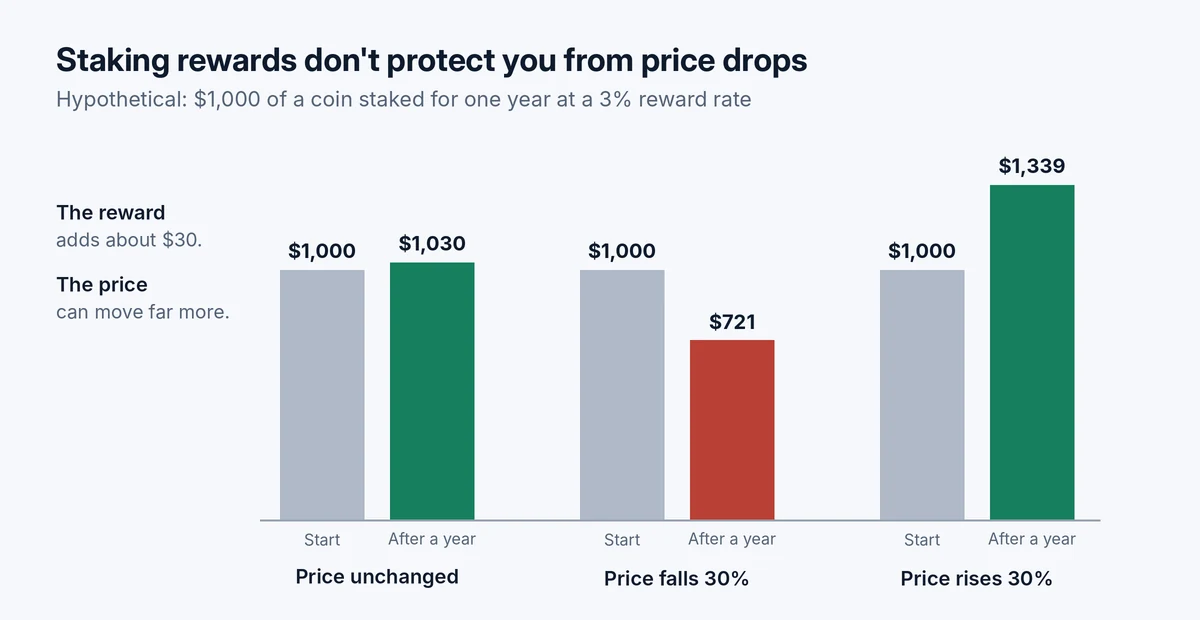
- The price falls. Rewards are paid in the same coin you staked. If the coin drops 30% in a year, a 3% reward barely dents the loss. This is the biggest risk by far, and staking does nothing to reduce it.
- You can’t sell when you want to. Many networks and platforms have an unstaking period, from a few days to several weeks, during which your coins earn nothing and can’t be sold. In a falling market, that wait can be costly.
- The platform fails. If you stake through a company, you’re exposed to that company. Several crypto lending platforms that offered high “earn” yields, such as Celsius, went bankrupt in 2022, freezing customers’ funds. Staking and lending aren’t the same thing, but the lesson is the same: know who holds your coins.
- Smart contract bugs. Liquid staking and other on-chain services can be hacked or fail if their code has a flaw.
- Slashing and penalties. Rare for people staking through a large provider, which usually absorbs or insures against them, but real for solo stakers.
- Scams. Fake “staking” sites and apps promising fixed high returns are common. Real staking rewards are never guaranteed. See 10 common crypto scams.
Is crypto staking right for you?
Staking tends to make sense if you already plan to hold a proof-of-stake coin for the long term and you’re comfortable with its price risk. In that case, the coins would otherwise sit idle, and staking lets them earn a modest reward.
It doesn’t make sense if you’re buying a coin because of its staking rate. That’s letting the smaller number drive a decision dominated by the bigger one: the price. It also doesn’t suit money you might need at short notice, because of unstaking delays.
Note that bitcoin can’t be staked natively, because Bitcoin uses proof of work. Products that offer “bitcoin yield” are doing something else, usually lending, with different and often higher risks.
How to start staking safely
- Pick an established coin you’d hold anyway. Ethereum is the most common choice. Bitcoin vs Ethereum explains what you’d be holding.
- Use a regulated exchange you trust and check whether staking is offered in your country. Rules differ, and some exchanges limit staking for certain regions. Our guide to buying crypto safely covers choosing a platform.
- Read the terms before you click. Look for the fee the platform takes from rewards, the unstaking period and what happens if a validator is penalized.
- Start small. Stake part of your holding first, and do a test unstake so you know how long it actually takes.
- Turn on strong account security, including app-based two-factor authentication.
- Record every reward with its date and value. You’ll need it for your tax return.
Staking and tax
In most countries, crypto staking rewards are treated as income when you receive them, and you may owe capital gains tax again when you later sell. In the US, the IRS confirmed in Revenue Ruling 2023-14 that rewards count as income in the year you gain control of them, valued at their market price at that moment. The UK, Canada and Australia generally tax rewards as income too, with their own rules. Frequent small rewards add up to a lot of records, so a tracking tool can save hours. The details for each country are in do you pay tax on crypto staking rewards?, and crypto tax software compares the tools.
Quick answers
Can I lose my staked coins?
Through staking itself, losses are usually small and rare, such as penalties when a validator misbehaves. The bigger risks are the coin’s price falling and the platform holding your coins running into trouble.
Can I unstake at any time?
It depends on the coin and the platform. Some exchanges let you unstake quickly, others make you wait days or weeks. Liquid staking tokens can be sold at any time, but the price may be slightly below the value of the underlying coins.
Is staking the same as “earn” or “savings” products?
Not always. Some “earn” products are staking, while others lend your coins to borrowers. Lending carries the risk that borrowers don’t pay back. If a platform doesn’t clearly say how the yield is generated, assume it’s riskier than staking.
Does staking give me voting rights?
On some networks, staked coins can be used to vote on changes. On Ethereum, staking secures the network but doesn’t give you a formal vote.
If you’re still learning the basics, start with our plain-English guide to how crypto works.
This article is for educational purposes only and isn’t financial, investment or tax advice.

Pingback: Bitcoin vs Ethereum: The Real Difference for Beginners