

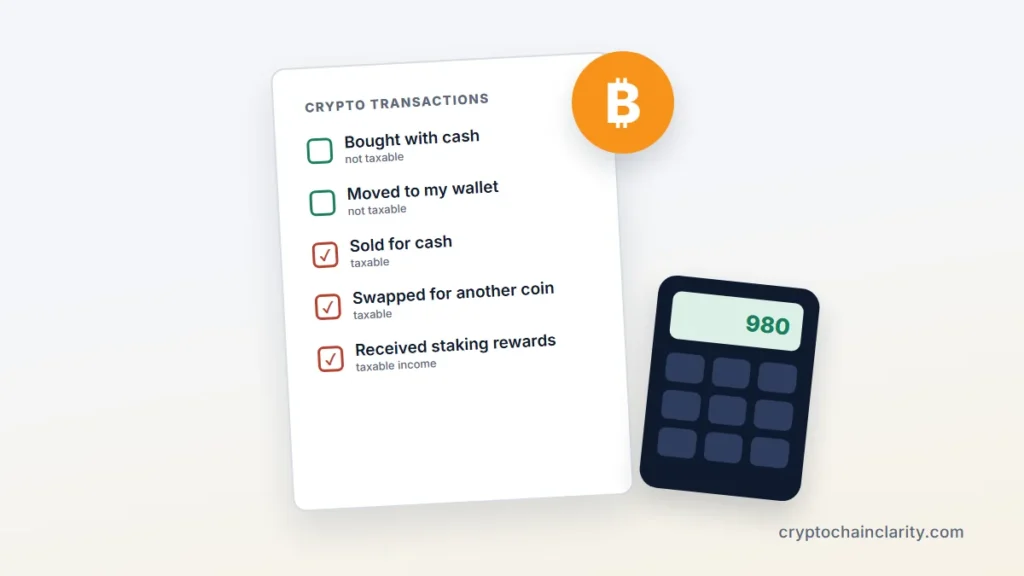
To report crypto on your tax return, you list every sale, swap or purchase made with crypto during the year, with its cost and proceeds, and add up the gains and losses. You report crypto you earned, such as staking rewards, as income. In the US that means Form 8949, Schedule D, Schedule 1 for income, and the digital asset question on Form 1040. The hard part is rarely the forms themselves. It’s collecting complete records from every exchange and wallet you used.
Below is the process step by step for US filers, including the new Form 8949 boxes for digital assets, followed by where crypto goes on UK, Canadian and Australian returns.
General information, not tax advice. If your situation is complex, a tax professional who knows crypto is worth the fee.
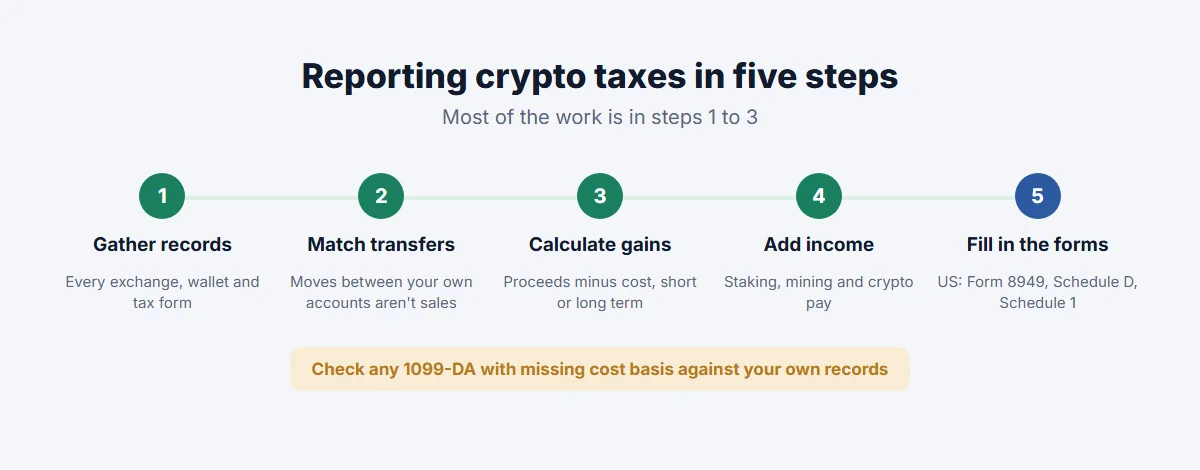
Step 1: Gather records from every platform
Download the full transaction history for the tax year, and ideally from the very start, from:
- every exchange you’ve used, including ones you’ve closed (do this before closing an account),
- every wallet you control, using a block explorer or your wallet app’s export,
- tax forms your exchanges sent you: in the US, Form 1099-DA for sales and Form 1099-MISC for rewards of $600 or more.
You’ll need the dates, amounts, values in dollars and fees for each transaction. If you’re missing old purchase records, exchange emails and bank statements can help reconstruct them.
Step 2: Match transfers between your own accounts
Moving crypto from an exchange to your own wallet isn’t a sale, but on separate exports it looks like coins left one place and appeared in another. Match those transfers so they aren’t treated as disposals, and so the original cost basis follows the coins.
This step matters more than ever because of Form 1099-DA. An exchange only knows the cost of coins you bought there. If you transferred coins in from another wallet, the form may show the sale proceeds with no cost basis, and you’ll need to supply it from your own records.
Step 3: Calculate gains and losses
For every disposal (sale, swap, or purchase paid in crypto):
- Proceeds: what you received, in dollars.
- Cost basis: what you paid, including fees.
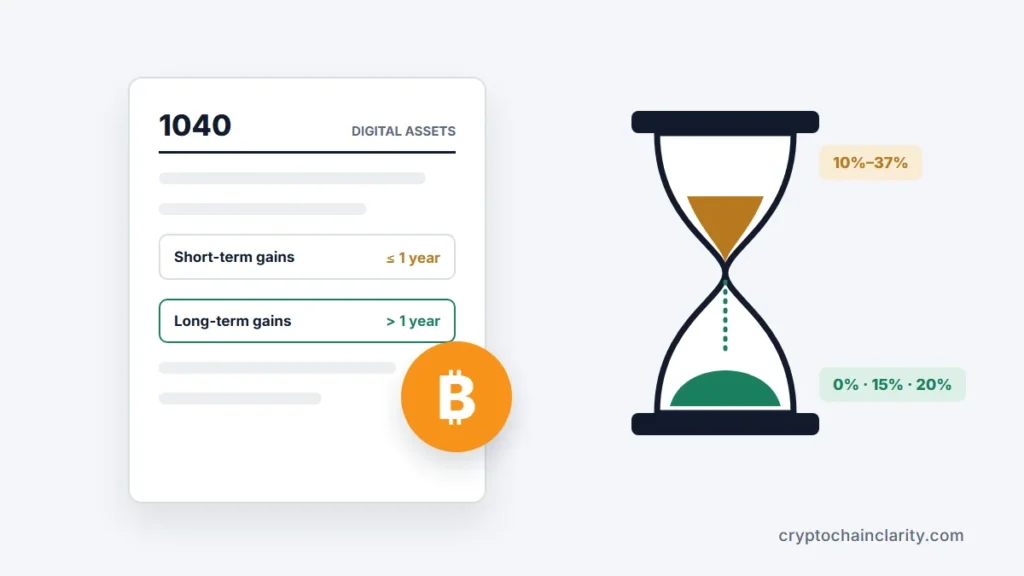
- Holding period: one year or less is short-term; more than a year is long-term.
When you’ve bought the same coin at different prices, choose a consistent method for which units you sold. In the US, you can identify specific units if your records support it; otherwise first-in, first-out applies. How is crypto taxed in the US? explains the rates that apply to each type of gain.
With more than a handful of transactions, this is where crypto tax software saves hours. Best crypto tax software compares the main tools, which import your exchanges and wallets and produce a completed Form 8949.
Step 4: Total up crypto income
Separately, list crypto you received rather than bought:
- staking rewards,
- mining rewards,
- crypto paid for work,
- some airdrops.
Each is income at its dollar value when you received it. That value is also the cost basis for when you later sell those coins. Tax on crypto staking rewards covers the details.
Step 5: Fill in the forms (US)
The digital asset question
Near the top of Form 1040, every taxpayer must answer whether, during the year, they received digital assets as a reward or payment, or sold, exchanged or otherwise disposed of them. If you only bought crypto with dollars and held it, the answer is generally no. If you sold, swapped, spent or earned crypto, it’s yes.
Form 8949: one line per disposal
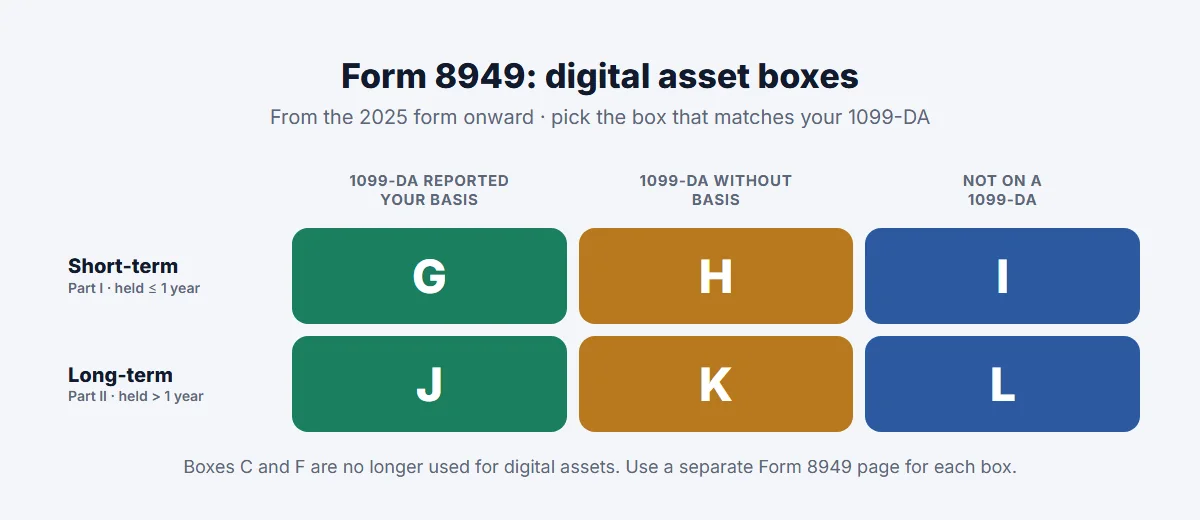
Form 8949 lists each sale or swap with its description, dates, proceeds, cost basis and gain or loss. Starting with the 2025 form, the IRS instructions for Form 8949 add separate boxes for digital assets:
| Basis reported on 1099-DA | Basis not reported | Not on a 1099-DA | |
|---|---|---|---|
| Short-term (Part I) | Box G | Box H | Box I |
| Long-term (Part II) | Box J | Box K | Box L |
Use a separate Form 8949 page for each box that applies. If the exchange’s 1099-DA shows a cost basis that’s wrong or missing, enter the correct basis from your records; the form allows adjustments with an explanation code.
Crypto tax software generates these pages for you, and most tax filing programs accept them as an attachment or import.
Schedule D
The totals from Form 8949 carry to Schedule D, which combines your short-term and long-term gains and losses with any from stocks and funds. Net losses can offset up to $3,000 of other income a year, with the rest carried forward.
Schedule 1 or Schedule C for crypto income
Staking, mining and similar income usually goes on Schedule 1 as other income. If it’s a business, such as a mining operation, it goes on Schedule C, and self-employment tax may apply.
Then file as normal. Keep your detailed records for at least as long as the IRS can audit the return, and longer for coins you still hold, since you’ll need their cost basis when you sell.
How to report crypto on your tax return in the UK, Canada and Australia
United Kingdom. Disposals go on the capital gains pages of your Self Assessment return (SA108), which now has its own section for cryptoassets. If you’re not otherwise in Self Assessment, HMRC’s real-time Capital Gains Tax service is an alternative. Income from staking or mining goes in the income section. See crypto tax in the UK.
Canada. Capital gains from crypto go on Schedule 3 of your T1 return, with the taxable half carried to line 12700. If your activity is a business, profits go on Form T2125 instead. The CRA explains this in its guide to reporting capital gains as a crypto-asset user. See crypto tax in Canada.
Australia. Crypto disposals go in the capital gains section of your tax return, with the 50% discount applied to assets held more than 12 months. Income from staking goes in the income section. See crypto tax in Australia.
Common reporting mistakes
- Treating transfers between your own wallets as sales, which inflates your gains.
- Accepting a 1099-DA with missing basis and reporting the full proceeds as profit.
- Forgetting crypto-to-crypto swaps because no money reached your bank.
- Leaving out small staking rewards because no 1099-MISC was issued.
- Answering “no” to the digital asset question after selling or swapping.
- Not reporting losses, which could have reduced your tax this year or in future years.
If you missed crypto on a past return, correcting it with an amended return before the tax authority contacts you is usually far better than waiting. A professional can help you decide how. For the background on what’s taxable in the first place, see crypto taxes explained.
Pingback: Best Crypto Tax Software: Koinly vs CoinLedger vs CoinTracker