This crypto glossary explains 100 of the most common crypto terms in one plain-English sentence each, in alphabetical order. It’s meant for quick look-ups: when a word in an article, an app or a conversation stops you, find it here, then follow the link to a full guide where there is one.
If you’re completely new, start with the ten terms below, then come back to the full list as you need it.
Crypto glossary: ten terms to learn first
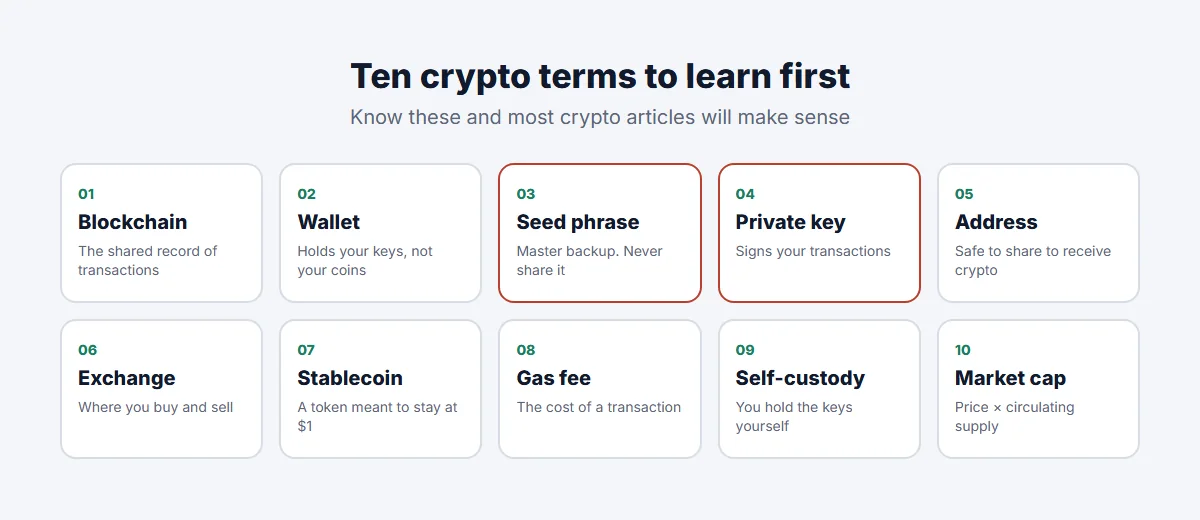
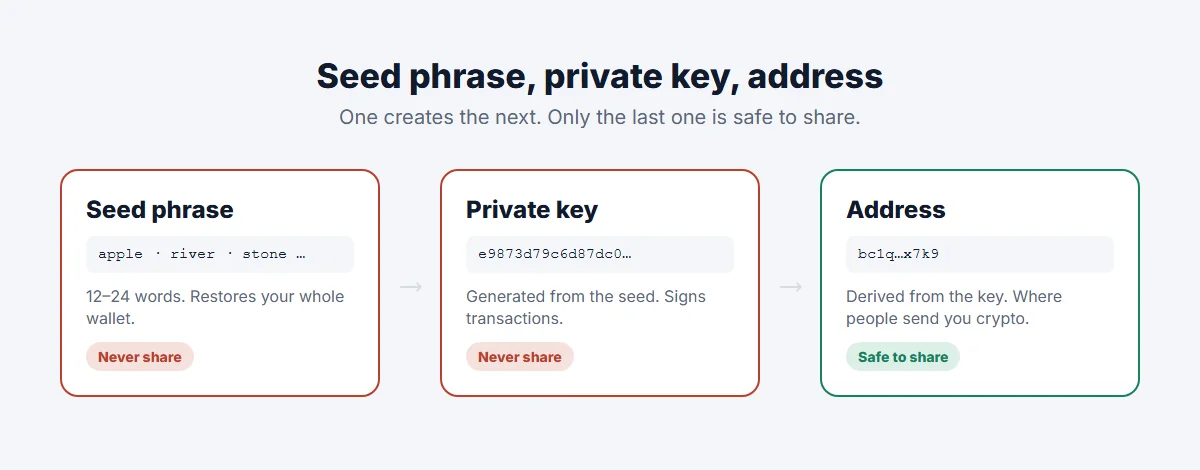
Blockchain, wallet, seed phrase, private key, address, exchange, stablecoin, gas fee, self-custody and market cap. Each is defined in the list below. Three of them work together and confuse many beginners, so here’s how they relate:
A–C
- Address: a string of characters, like an account number, that others use to send crypto to you.
- Airdrop: free tokens sent to many wallets, usually to promote a new project, and sometimes used as bait by scammers.
- All-time high (ATH): the highest price a coin has ever reached.
- Altcoin: any cryptocurrency other than bitcoin; see what are altcoins.
- AML / KYC: anti-money-laundering and “know your customer” checks that regulated exchanges must carry out on their users.
- API key: a code that lets an app, such as tax software, read data from your exchange account.
- Ask: the lowest price at which someone is currently willing to sell.
- Base fee: the part of an Ethereum transaction fee set by the network and burned; see what are gas fees.
- Bear market: a prolonged period of falling prices.
- Bid: the highest price someone is currently willing to pay.
- Bitcoin (BTC): the first cryptocurrency, launched in 2009, with a fixed maximum supply of 21 million coins; see what is Bitcoin.
- Block: a batch of transactions added to a blockchain at one time.
- Block explorer: a website that lets anyone look up transactions, addresses and blocks on a blockchain.
- Block reward: the new coins plus fees a miner or validator earns for adding a block.
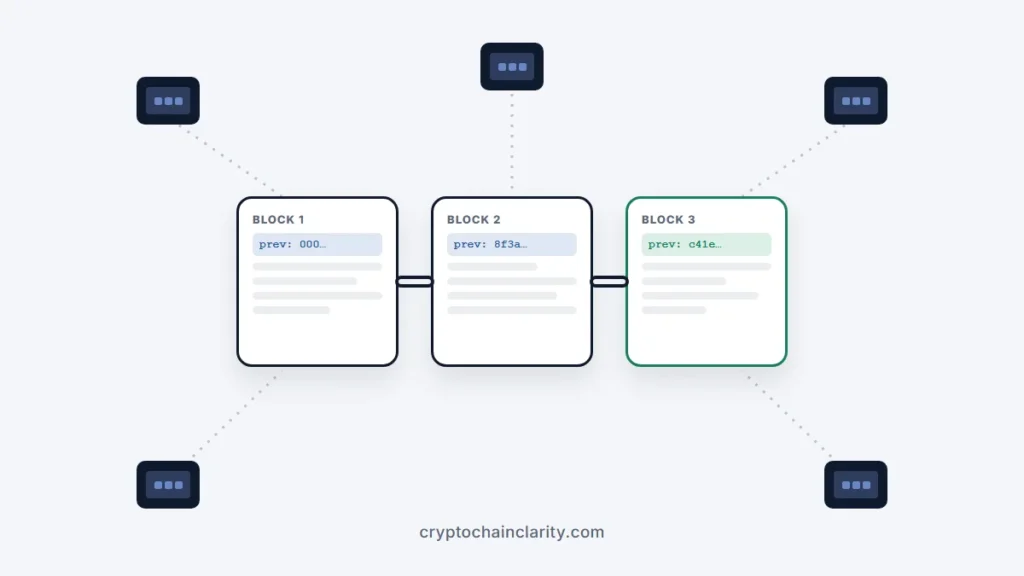
- Blockchain: a shared, append-only record of transactions kept by many computers; see how blockchain works.
- Bridge: a service that moves tokens from one blockchain to another, and a frequent target of hacks.
- Bull market: a prolonged period of rising prices.
- Burn: permanently removing tokens from circulation by sending them to an address nobody can use.
- CEX (centralized exchange): a company-run platform, such as Coinbase or Kraken, where you trade crypto through an account.
- Cold storage / cold wallet: keeping private keys on a device that isn’t connected to the internet.
- Confirmation: each block added after the one containing your transaction, making it harder to reverse.
- Consensus mechanism: the rules a blockchain uses to agree on which blocks are valid, such as proof of work or proof of stake.
- Cost basis: what you paid for a crypto asset, including fees, used to calculate gains for tax.
- Custodial wallet: a wallet where a company holds the private keys on your behalf.
D–H
- DAO: a decentralized autonomous organization, a group run by rules in smart contracts and token-holder votes.
- dApp: a decentralized application that runs on smart contracts rather than a company’s servers.
- DCA (dollar-cost averaging): buying a fixed amount at regular intervals regardless of price; see dollar-cost averaging in crypto.
- DeFi: decentralized finance, financial services like lending and trading built on smart contracts.
- DEX (decentralized exchange): a platform where you swap tokens directly from your wallet through smart contracts.
- Difficulty adjustment: Bitcoin’s automatic change to mining difficulty, about every two weeks, to keep blocks around 10 minutes apart.
- ETF (exchange-traded fund): a fund traded on a stock exchange, such as a spot bitcoin ETF that holds bitcoin; see how bitcoin ETFs work.
- ERC-20: the standard most tokens on Ethereum follow, so wallets and exchanges can handle them the same way.
- Ether (ETH): the native currency of the Ethereum network, used to pay fees and for staking.
- Ethereum: a blockchain that runs smart contracts, launched in 2015.
- Exchange: a platform where you buy, sell or swap crypto.
- Fiat: government-issued money such as dollars, pounds or euros.
- FOMO: fear of missing out, the urge to buy because prices are rising fast.
- Fork: a change to a blockchain’s rules; a hard fork can split one chain into two.
- Gas: the unit measuring the computing work a transaction needs on Ethereum.
- Gas fee: the total fee paid for a transaction on Ethereum and similar networks.
- Gwei: one-billionth of an ether, the unit gas prices are usually quoted in.
- Halving: the event, about every four years, when Bitcoin’s block reward is cut in half; see bitcoin halving explained.
- Hardware wallet: a small physical device that keeps your private keys offline and signs transactions; see Ledger vs Trezor.
- Hash: a fixed-length fingerprint of data that changes completely if the data changes.
- Hash rate: the total computing power miners devote to a proof-of-work network.
- HODL: crypto slang for holding long term instead of selling.
- Hot wallet: a wallet whose keys are on an internet-connected device, such as a phone app.
I–N
- Layer 1: a base blockchain such as Bitcoin or Ethereum.
- Layer 2: a network built on top of a layer 1 to make transactions faster and cheaper; see what is a layer 2.
- Lightning Network: a layer 2 for fast, cheap bitcoin payments through payment channels.
- Limit order: an order to buy or sell only at a price you set or better.
- Liquidity: how easily an asset can be bought or sold without moving its price.
- Liquidity pool: tokens locked in a smart contract so others can trade against them on a DEX.
- Liquid staking: staking that gives you a tradable token representing your staked coins.
- Maker fee: the trading fee for an order that adds liquidity to the order book, usually a limit order.
- Market cap: a coin’s price multiplied by its circulating supply; see crypto market cap explained.
- Market order: an order to buy or sell immediately at the best available price.
- Mempool: the waiting area for transactions that have been broadcast but not yet added to a block.
- Meme coin: a token driven mainly by jokes, communities and hype rather than a product.
- Mining: using computers to secure a proof-of-work blockchain in exchange for rewards.
- Multisig: a wallet that needs more than one key to approve a transaction.
- NFT: a non-fungible token, a unique token that represents ownership of a specific item.
- Node: a computer that keeps a copy of a blockchain and checks its rules.
- Non-custodial wallet: a wallet where only you hold the keys.
O–R
- On-ramp / off-ramp: services that turn regular money into crypto, or crypto back into regular money.
- Oracle: a service that feeds outside data, such as prices, into smart contracts.
- Order book: the live list of buy and sell orders on an exchange.
- Passphrase: an optional extra word added to a seed phrase that creates a separate hidden wallet.
- Phishing: tricking people into revealing passwords or seed phrases through fake sites or messages.
- Private key: the secret number that proves ownership of crypto and signs transactions.
- Proof of reserves: an attestation that an exchange holds enough assets to cover customer balances.
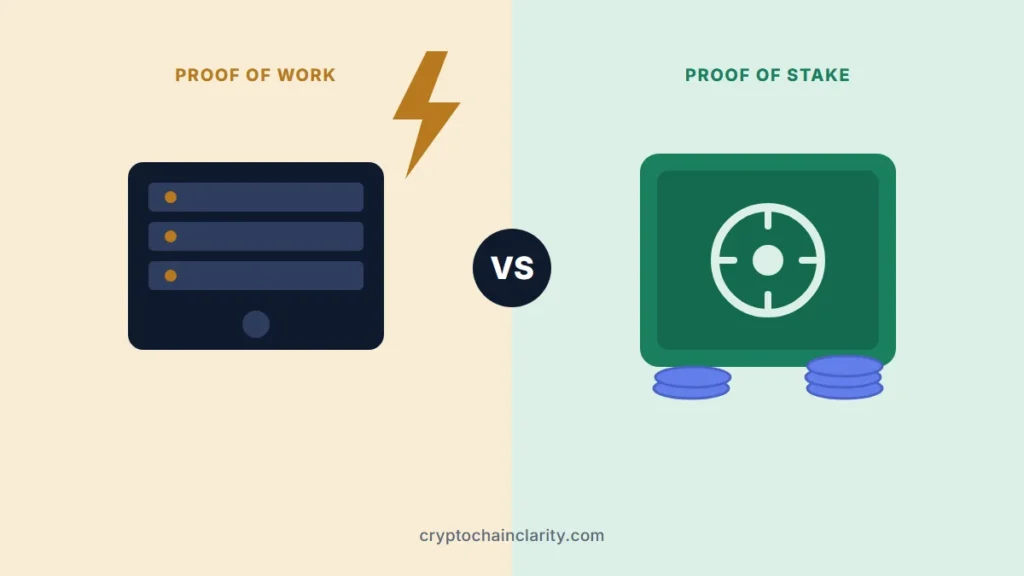
- Proof of stake: a consensus mechanism where validators lock coins to earn the right to add blocks; see proof of work vs proof of stake.
- Proof of work: a consensus mechanism where miners compete with computing power to add blocks.
- Public key: the key derived from a private key, from which your address is created.
- Pump and dump: a scheme where a token’s price is pushed up with hype so insiders can sell to latecomers.
- Rug pull: a scam where a project’s creators disappear with investors’ money.
S–Z
- Satoshi (sat): the smallest unit of bitcoin, one hundred-millionth of a bitcoin.
- Seed phrase: the 12 to 24 words that back up and restore your whole wallet; see how to store a seed phrase.
- Self-custody: holding your own crypto in a wallet where you control the keys.
- Slashing: a penalty that removes part of a validator’s stake for misbehaviour.
- Slippage: the difference between the expected price of a trade and the price you actually get.
- Smart contract: a program on a blockchain that runs automatically when its conditions are met; see what is a smart contract.
- Spread: the gap between the buy and sell price, often part of an exchange’s hidden fee.
- Stablecoin: a token designed to keep a steady value, usually one US dollar; see what is a stablecoin.
- Staking: locking coins to help secure a proof-of-stake network in return for rewards; see what is crypto staking.
- Taker fee: the trading fee for an order that fills immediately against the order book.
- Token: a crypto asset created on an existing blockchain rather than being its native coin.
- Token approval: permission you give a smart contract to spend tokens from your wallet.
- Tokenomics: the supply, distribution and incentives of a token.
- TVL (total value locked): the value of crypto deposited in a DeFi app or network.
- Two-factor authentication (2FA): a second login step, ideally an authenticator app, that protects your account.
- Validator: a participant that proposes and checks blocks on a proof-of-stake network.
- Volatility: how sharply and quickly a price moves up and down.
- Wallet: software or hardware that stores your keys and lets you send and receive crypto; see crypto wallets explained.
- Wallet drainer: a malicious contract or site that empties a wallet once the owner signs a transaction.
- Whale: a person or entity holding a very large amount of a coin.
- Whitepaper: the document describing a crypto project’s design and goals, like the original Bitcoin white paper.
- Wrapped token: a token that represents another asset on a different blockchain, such as wrapped bitcoin on Ethereum.
- Yield: the return earned on crypto through staking, lending or other activities.
- Zero-knowledge proof: a way to prove a statement is true without revealing the underlying data.
Where to go from here
A glossary helps with words; the guides help with decisions. If you’re just starting out, crypto for beginners walks through the basics in order, and how to buy crypto safely for the first time covers your first purchase. If a term you need is missing from this crypto glossary, it may be covered in one of our guides on common crypto scams or crypto taxes.