

Crypto taxes catch many beginners off guard because the taxable moment usually isn’t when they cash out. In the US, UK, Canada and Australia, tax authorities treat crypto as property, not money. That means tax can apply whenever you dispose of it: when you sell it, but also when you swap it for another coin or spend it. Separately, crypto you receive as payment or rewards is usually taxed as income.
Buying crypto with your own money, holding it, and moving it between your own wallets generally isn’t taxable. This guide explains which transactions count, how the gain is worked out, and how the main English-speaking countries differ.
This is general information, not tax advice. Rules change and depend on your circumstances, so check with your tax authority or a qualified professional before filing.
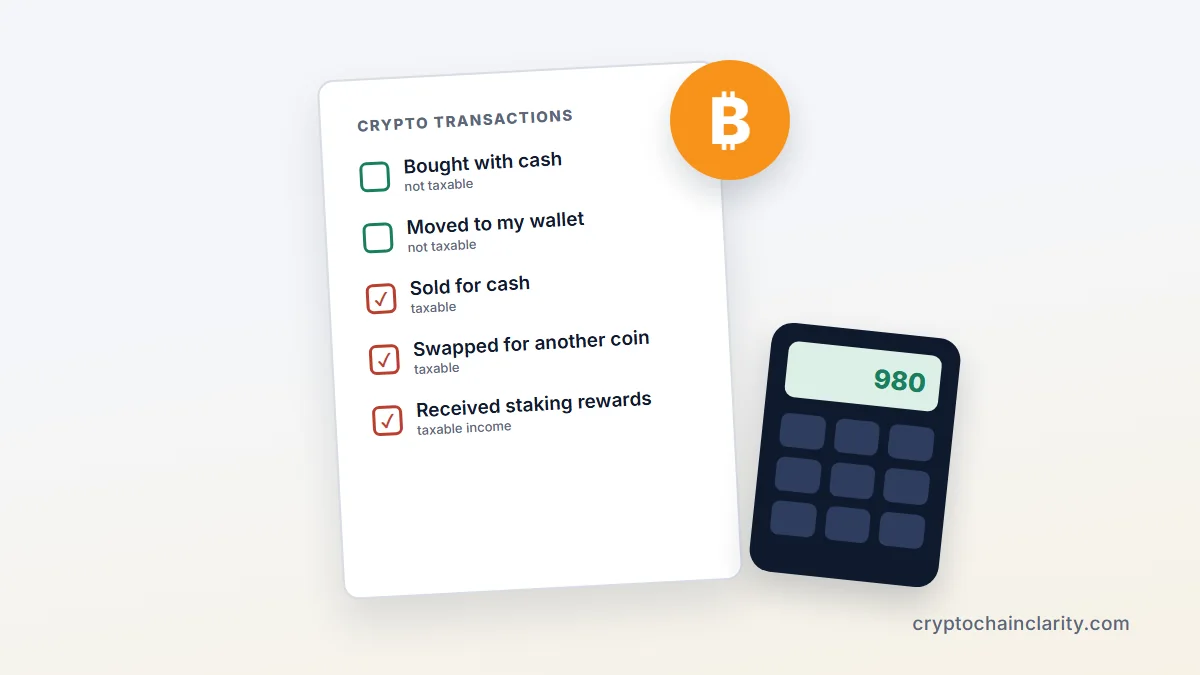
What triggers a taxable event
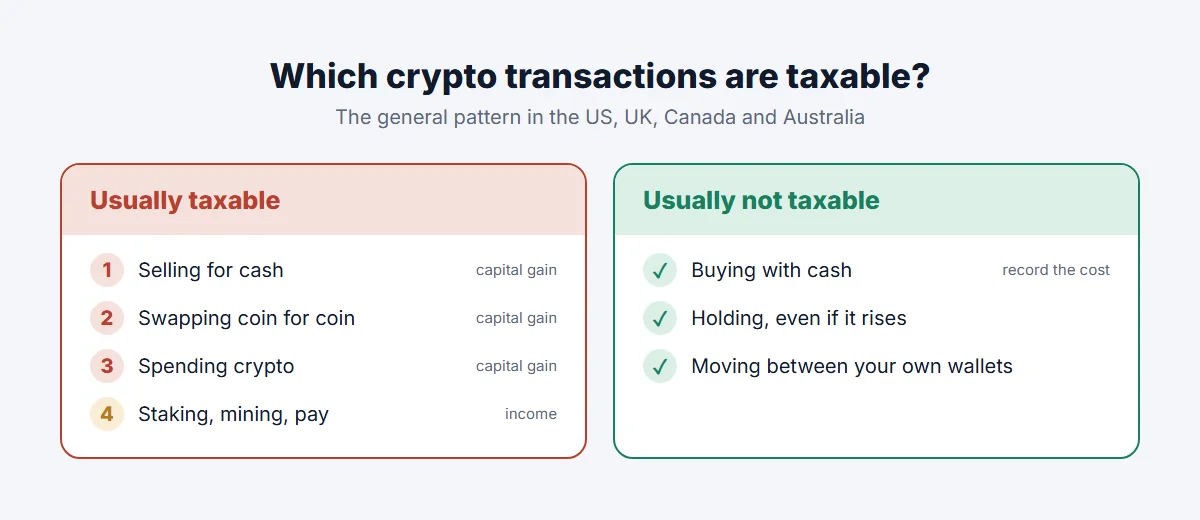
| Transaction | Usually taxable? | Type of tax |
|---|---|---|
| Buying crypto with dollars, pounds or other currency | No | Nothing yet; record the cost |
| Holding crypto, even if its value rises | No | None until you dispose of it |
| Moving crypto between your own wallets or exchange accounts | No | None, but keep records |
| Selling crypto for currency | Yes | Capital gains (or loss) |
| Swapping one crypto for another, including stablecoins | Yes | Capital gains on the coin you gave up |
| Spending crypto on goods or services | Yes | Capital gains on the coin you spent |
| Giving crypto away | Depends on country | Can be a disposal (UK) or a gift for gift-tax purposes (US) |
| Receiving crypto as pay, mining or staking rewards, or some airdrops | Yes | Income tax on its value when received |
The US Internal Revenue Service lists the same kinds of transactions on its digital assets page: selling, exchanging, spending and receiving digital assets must be reported, while buying with currency, holding and moving between your own wallets don’t.
The two that surprise people most
Crypto-to-crypto swaps. Trading bitcoin for ether, or any coin for a stablecoin like USDC, is treated as disposing of the first coin at its market value. If it had risen since you bought it, you have a taxable gain even though no money reached your bank.
Spending crypto. Paying for something with crypto is, for tax purposes, a sale of that crypto followed by a purchase. A small coffee is technically a disposal.
How a crypto gain is calculated
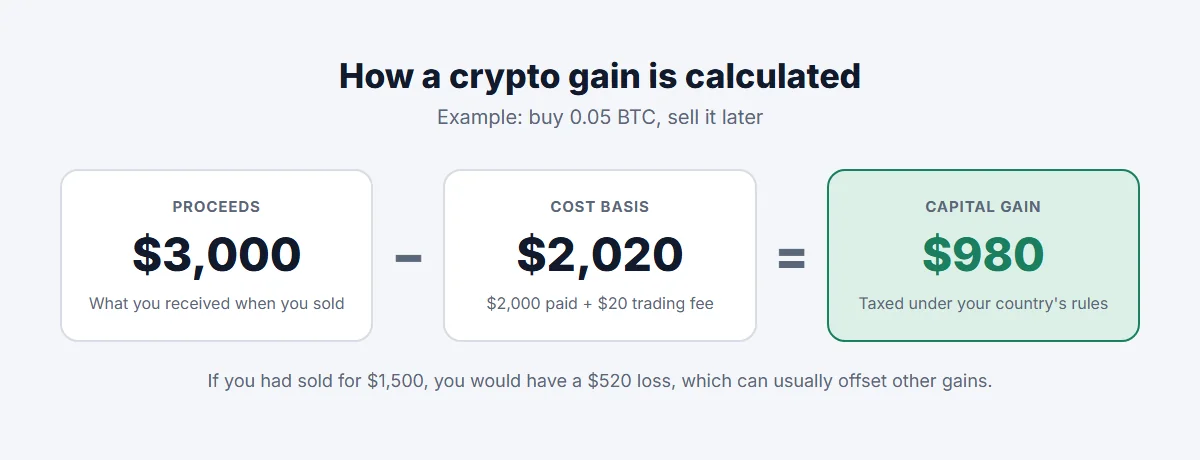
The basic formula is the same everywhere:
Gain or loss = proceeds − cost basis
- Proceeds are what you received: the cash from a sale, or the market value of what you got in a swap or purchase.
- Cost basis is what you paid for the crypto you disposed of, usually including trading fees.
For example, you buy 0.05 BTC for $2,000 plus a $20 fee, then later sell it for $3,000. Your gain is $3,000 − $2,020 = $980. If you’d sold for $1,500, you’d have a $520 loss, which can usually offset other gains.
When you’ve bought the same coin several times at different prices, the method for deciding which coins you sold matters. Each country has its own rules: the US lets you identify specific units if you keep adequate records (otherwise first-in, first-out applies), the UK uses “pooling” with special same-day and 30-day rules, and Canada uses an average cost. This is where tax software or an accountant earns its fee.
Capital gains or income?
Most people who buy and hold crypto deal with capital gains, which are often taxed more lightly than income, especially on long-term holdings.
Crypto you receive without buying it is different. Staking rewards, mining rewards, crypto paid as salary, and some airdrops are generally taxed as income at their market value when you receive them. That value then becomes your cost basis, so when you later sell, only the change in value since you received it is a capital gain or loss. Do you pay tax on crypto staking rewards? covers this in detail.
Frequent, business-like trading can also be treated as business income rather than capital gains in some countries, notably Canada and Australia.
How crypto taxes differ in the US, UK, Canada and Australia
| Country | How gains are taxed | Main relief for small investors | More detail |
|---|---|---|---|
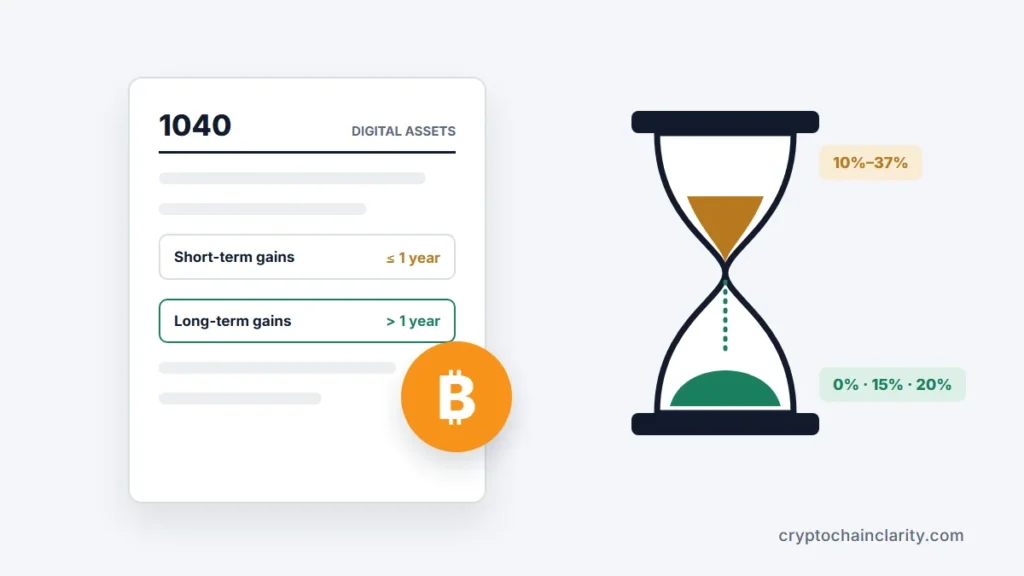
| United States | Short-term gains (held a year or less) at income tax rates; long-term gains at 0%, 15% or 20% depending on income | Long-term rates after holding more than a year | Crypto tax in the US |
| United Kingdom | Capital Gains Tax at 18% or 24%, depending on your income | Annual tax-free allowance for capital gains | Crypto tax in the UK |
| Canada | Half of a capital gain is added to your taxable income | Only 50% of the gain is taxable | Crypto tax in Canada |
| Australia | Capital gains added to your taxable income | 50% discount on assets held more than 12 months | Crypto tax in Australia |
Each authority publishes its own guidance: the IRS digital assets page, HMRC’s guide to tax when you sell cryptoassets, the CRA’s guide for crypto-asset users and the Australian Taxation Office’s crypto asset guidance.
Losses can reduce your crypto taxes
If you sell crypto for less than you paid, the loss can usually be set against gains, reducing your tax bill. Some countries let you carry unused losses forward to future years. Selling at a loss deliberately to use the loss, known as tax-loss harvesting, has its own rules and pitfalls, covered in crypto tax-loss harvesting.
Lost or stolen crypto is a harder case. Whether you can claim a loss depends on your country and the circumstances, and documentation is essential.
Exchanges now report to tax authorities
Tax authorities are getting much better information. In the US, brokers including crypto exchanges report sales to the IRS on the new Form 1099-DA, starting with gross proceeds for 2025 transactions and adding cost basis for assets acquired from 2026 onward. Other countries are adopting the international Crypto-Asset Reporting Framework, under which exchanges share customer data with tax authorities.
That doesn’t mean the exchange’s form is complete. If you moved coins between platforms or wallets, the exchange may not know what you paid, so your own records still matter.
Keep records from day one
For every transaction, keep:
- the date,
- what you bought, sold or received, and how much,
- its value in your local currency at the time,
- fees paid,
- which wallet or exchange it involved.
Download transaction histories from every exchange regularly, especially before closing an account. If you have many transactions, crypto tax software can import them and produce reports for your return: best crypto tax software compares the main options, and how to report crypto on your tax return walks through the filing step.
Crypto taxes: quick summary
- Buying and holding: not taxable. Moving between your own wallets: not taxable.
- Selling, swapping and spending: taxable disposals, with a gain or loss.
- Receiving crypto as pay or rewards: income, taxed when you receive it.
- Gain = what you got − what you paid, including fees.
- Keep records of everything, because the exchange’s tax form may not tell the whole story.
If you’re just starting out, it’s worth setting up a simple spreadsheet or tax tool before your first purchase. How to buy crypto safely for the first time covers the rest of the setup.
Pingback: How Is Crypto Taxed in Canada? CRA Rules for Beginners (2026)
Pingback: Crypto Tax in the UK: Capital Gains Allowance and How to Report It