

Bitcoin is digital money. Ethereum is a platform for running apps, and its coin, ether (ETH), is the fuel those apps run on. Bitcoin is built to do one job reliably: store and move value with a fixed supply of 21 million coins. Ethereum is built to be flexible. Stablecoins, tokens, lending apps and much of what people call “crypto” run on top of it.
For a beginner, that difference shapes the whole bitcoin vs Ethereum decision: how each coin is valued, how its supply works, what it costs to use and what can go wrong. Here’s a side-by-side look, followed by the details that matter if you’re deciding between them.
Bitcoin vs Ethereum at a glance
| Bitcoin (BTC) | Ethereum (ETH) | |
|---|---|---|
| Launched | January 2009 | July 2015 |
| Main purpose | Digital money and store of value | Platform for apps, tokens and stablecoins |
| Supply | Capped at 21 million | No fixed cap; new ETH is issued and some is burned |
| How the network is secured | Proof of work (miners) | Proof of stake (validators) |
| New block roughly every | 10 minutes | 12 seconds |
| Can you earn rewards by holding? | Not natively | Yes, by staking |
| How often the rules change | Rarely, and cautiously | Regular planned upgrades |
| Available as a US spot ETF | Yes, since January 2024 | Yes, since July 2024 |
The Ethereum community publishes its own comparison of Ethereum and Bitcoin, which is a useful read alongside this one, keeping in mind who wrote it.
The core difference: money vs platform
A simple way to picture it: Bitcoin is like a digital gold vault with a built-in payment system. Ethereum is more like a shared global computer that anyone can write programs for, where every action costs a small fee paid in ETH.
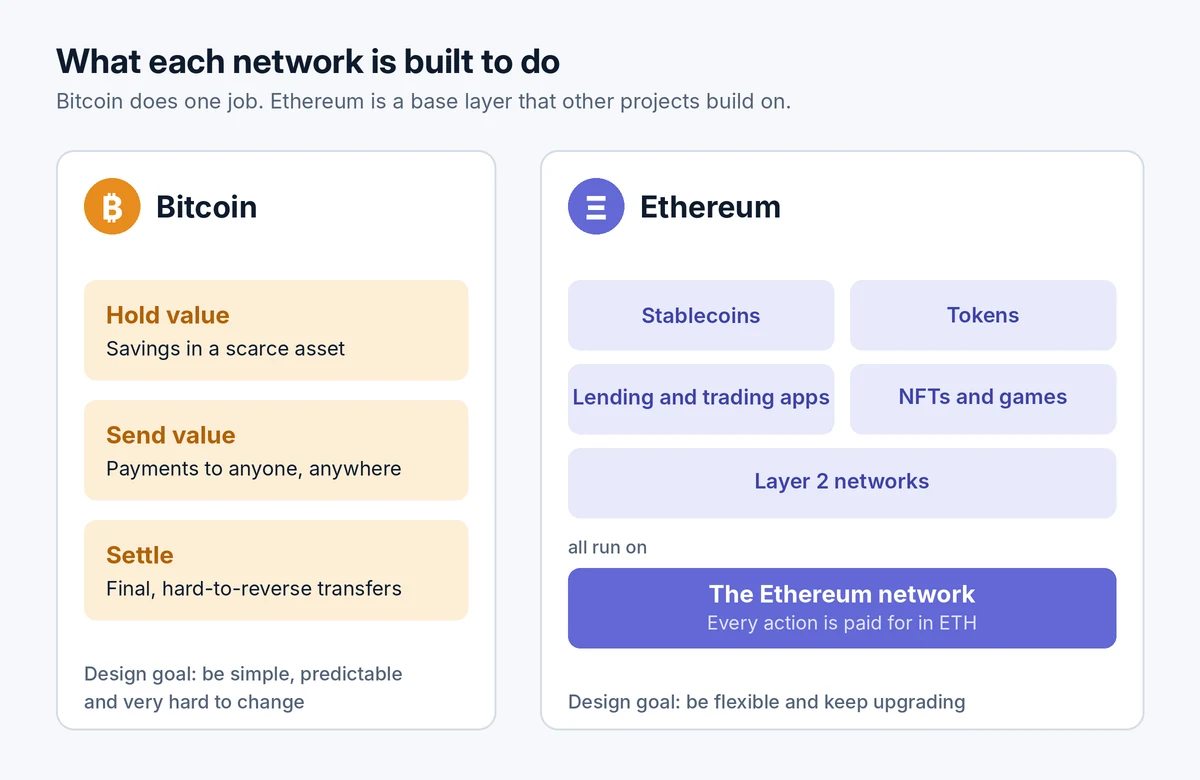
Those programs are called smart contracts: code that runs exactly as written once it’s on the blockchain. They’re what make Ethereum useful for things Bitcoin was never designed to do:
- Stablecoins like USDC are, for the most part, smart contracts running on Ethereum and similar networks. See what a stablecoin is.
- Tokens for thousands of other projects are created on Ethereum rather than on their own blockchains.
- Lending and trading apps let people borrow, lend and swap coins without a traditional company in the middle.
- Layer 2 networks process transactions more cheaply and then record the results on Ethereum. More on those in what a Layer 2 is.
Bitcoin’s developers have deliberately kept it simple. Fewer features mean fewer things that can break, and changes to the rules happen rarely and only with very broad agreement. Ethereum takes the opposite approach and upgrades regularly. The biggest example was the Merge in September 2022, when it switched from mining to staking. Neither approach is “right”. They reflect different priorities: Bitcoin values predictability, Ethereum values flexibility.
Why each coin has value
Because they do different jobs, people value them for different reasons.
Bitcoin’s value rests mainly on scarcity and trust. There will only ever be 21 million, it’s the oldest and most widely held cryptocurrency, and many owners treat it as a long-term store of value, like gold. We cover this in depth in what is Bitcoin and why does it have value.
Ether’s value rests more on use. Every transaction and app on Ethereum is paid for in ETH, and ETH is what validators lock up to secure the network. If more people use Ethereum, more ETH is needed and more is burned. If activity moves elsewhere, that demand weakens. That makes ETH a bet on a platform’s success as well as a form of money, closer to owning a stake in a busy digital economy than holding digital gold.
How their supply works
This is where the two differ most, and it’s often misunderstood.
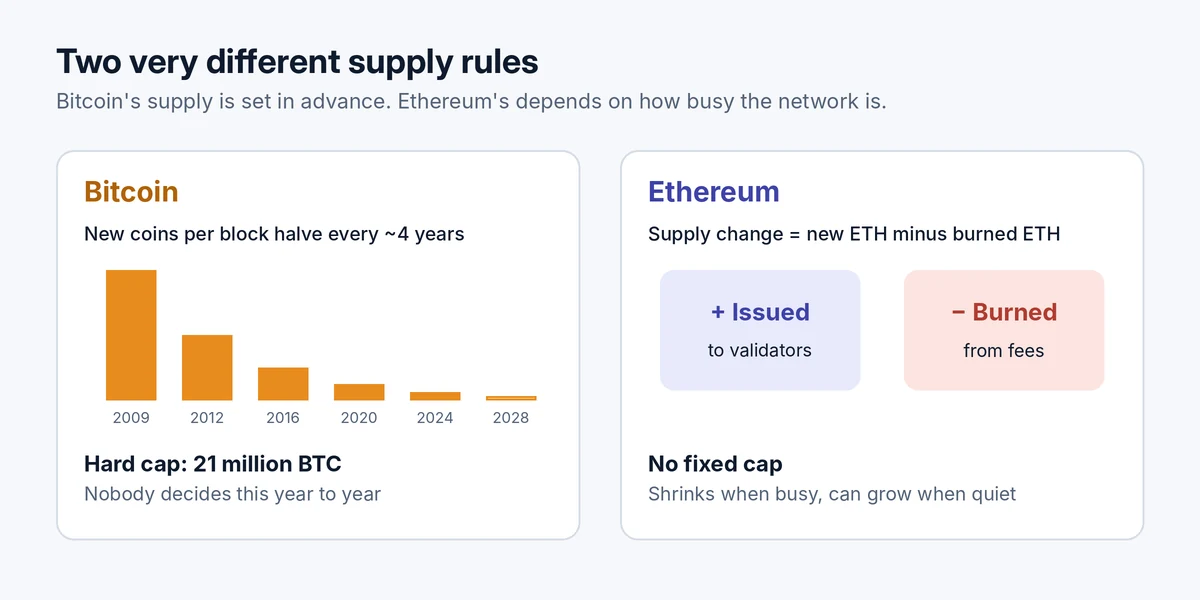
Bitcoin follows a schedule set at launch. New coins go to miners, the reward halves roughly every four years, and the total stops at 21 million. You can predict the supply decades ahead.
Ethereum has no fixed cap. New ETH is paid to validators, while part of every transaction fee is permanently destroyed, or “burned”. When the network is busy, more ETH can be burned than created and the supply shrinks. When it’s quiet, the supply grows slowly. Ethereum.org explains how ETH issuance and burning work, and the total currently sits at around 120 million ETH.
Which model is better is a long-running debate. Bitcoin supporters prefer a supply nobody can change. Ethereum supporters argue that a supply which adjusts to demand, with issuance kept low, works just as well in practice. As a beginner, the key point is that “no cap” doesn’t mean ETH is printed freely: issuance is small, and burning offsets part or all of it.
How each network stays secure
Bitcoin uses proof of work. Miners spend electricity and specialized hardware competing to add blocks, which makes rewriting history extremely expensive. Ethereum uses proof of stake. Validators lock up ETH as collateral and can lose part of it if they cheat. Proof of stake uses far less energy, while proof of work has a longer track record. Proof of work vs proof of stake explains the trade-offs.
For you as a holder, the most practical consequence is staking. You can lock up ETH, usually through an exchange or a staking service, and earn a share of the network’s rewards. Bitcoin has no equivalent built in. Staking carries its own risks, such as lock-up periods and relying on the provider, so read what crypto staking is and whether it’s safe before trying it. Staking rewards are also usually taxable: see tax on crypto staking rewards.
Speed and fees in real life
On paper, Ethereum is faster: it adds a block about every 12 seconds, against roughly 10 minutes for Bitcoin. In practice, both feel similar for everyday use, because exchanges often wait for several confirmations before crediting a deposit either way.
Fees are where you’ll notice the difference. Both networks charge more when they’re busy. On Ethereum, a simple transfer can be cheap one day and expensive the next, and interacting with an app costs more than a plain transfer because it uses more computing work. Many Ethereum users now do most of their activity on Layer 2 networks, where fees are usually a fraction of a cent to a few cents. Bitcoin has a comparable option for small, fast payments called the Lightning Network. Why fees swing so much is covered in what gas fees are.
One mistake to avoid: ETH and many tokens exist on several networks (Ethereum itself and various Layer 2s). Sending on the wrong one is a common way to lose funds. Always match the network on both sides, and if it’s already happened, read sent crypto to the wrong network.
Which is riskier?
Both are volatile and both can lose a large share of their value quickly. That said, they carry different kinds of risk:
- Bitcoin is the larger, older asset, and its price has historically swung less than ether’s. Its main risks are market cycles, regulation and whether demand for “digital gold” keeps growing.
- Ether has more ways to win and more ways to lose. Its value depends on Ethereum staying the leading platform as other blockchains compete for the same apps and users. The more complex the technology, the more there is to get right, from the core network to the apps built on it.
For a beginner, it’s also worth knowing that most crypto scams and hacks happen around apps and tokens, which mostly live on Ethereum and similar networks, not in plain bitcoin transfers. The network itself is rarely the weak point; risky apps, fake tokens and phishing links are. 10 common crypto scams shows what to watch for.
Bitcoin vs Ethereum: which should a beginner choose?
There’s no single right answer, but your reason for buying usually points the way:
| If your main goal is… | Bitcoin tends to fit when… | Ethereum tends to fit when… |
|---|---|---|
| A long-term holding | You want a simple, scarce asset and plan to hold it for years | You believe apps built on Ethereum will keep growing |
| Using crypto apps | Not the right tool for most apps | You need ETH to pay fees on Ethereum and many Layer 2s |
| Earning rewards | No native staking | You’re comfortable with the risks of staking |
| Keeping things simple | Fewer moving parts to understand | More to learn, from networks to wallets and tokens |
You don’t have to choose only one. Many people hold both, often with more in Bitcoin as the steadier of the two. Whatever you decide, the same rules apply: only invest what you can afford to lose, buy through a regulated exchange (see how to buy crypto safely), and consider spreading purchases over time with dollar-cost averaging.
If you’d rather not handle the coins yourself, both are available through exchange-traded funds in a normal brokerage account. How Bitcoin ETFs work explains that route and its trade-offs, which are similar for ether funds.
Common questions
Can I store Bitcoin and Ethereum in the same wallet?
Many wallets support both, but they’re separate networks with different address formats. You can’t send BTC to an Ethereum address or ETH to a Bitcoin address. Hardware wallets usually handle both; see crypto wallets explained.
Is Ethereum a newer version of Bitcoin?
No. Ethereum was inspired by Bitcoin but built for a different purpose. It isn’t a replacement or an upgrade, and the two run completely separately.
Can Ethereum overtake Bitcoin?
Some Ethereum supporters expect it to become the larger network by total market value one day. It hasn’t happened so far. Since nobody can predict it reliably, it’s not a good reason on its own to choose one over the other.
Do I need to buy a whole coin of either?
No. Both can be bought in tiny fractions, so you can start with a small amount of each. The price of one coin isn’t a sign of value; total market value is what counts, as explained in crypto market cap explained.
New to all of this? Start with our plain-English guide to how crypto works.
This article is for educational purposes only and isn’t financial, investment or tax advice.

Pingback: What Is Crypto Staking? How It Works and Is It Safe for Beginners
Pingback: What Happens When All 21 Million Bitcoin Are Mined?
Pingback: What Are Altcoins? How to Spot a Real Project vs a Hype Coin
Pingback: What Is Bitcoin and Why Does It Have Value? Explained Simply