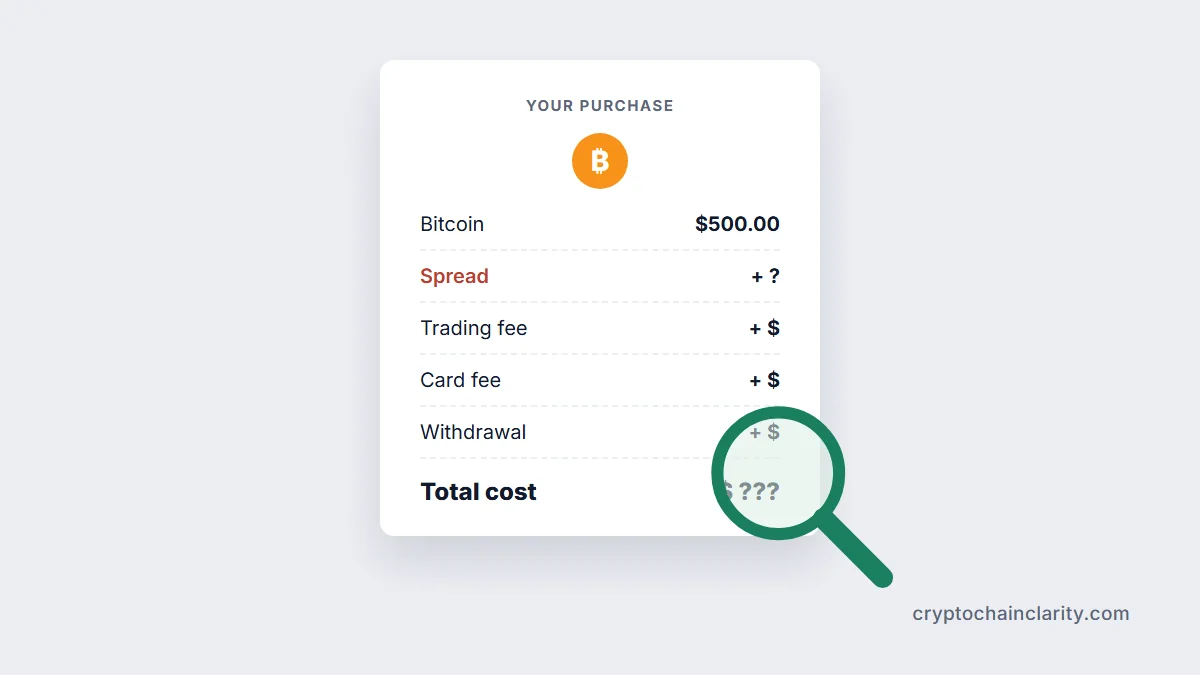
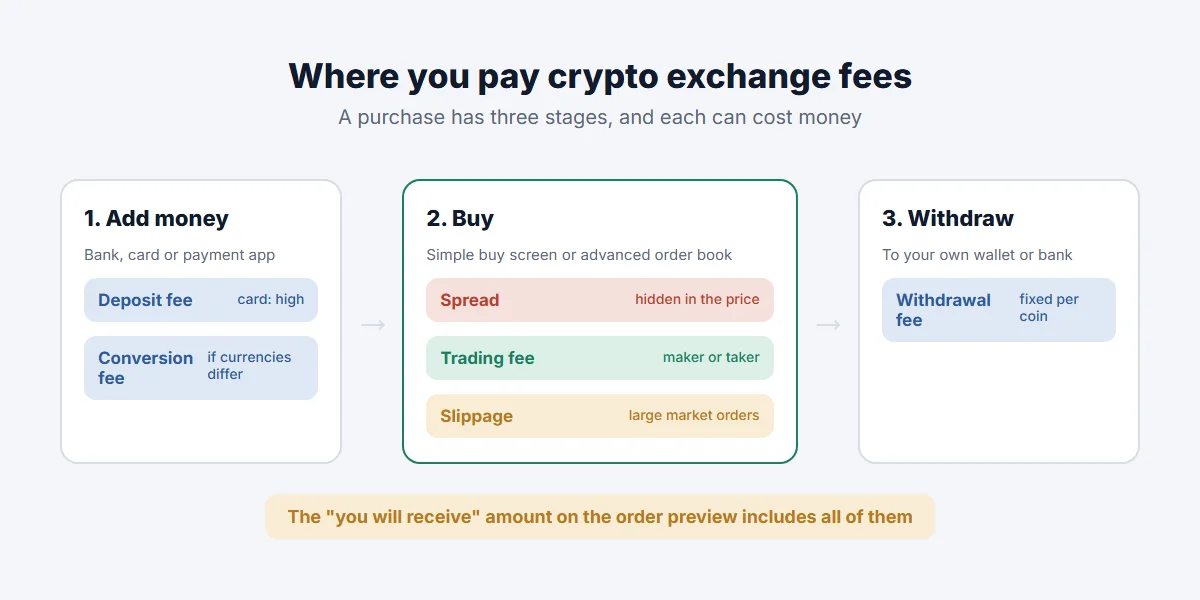
Crypto exchange fees come in up to five layers: a fee to deposit money, a spread hidden in the price, a trading fee (maker or taker), a fee to withdraw your coins, and sometimes a currency conversion charge. The fee an exchange advertises is usually just the trading fee. What you actually pay is all of them together, and on a small purchase made with the simple “Buy” button the hidden parts can cost more than the visible one.
This guide explains each fee in plain English, shows a worked example of the total, and lists the habits that cut costs the most.
The five crypto exchange fees and where you pay them
| Fee | When you pay it | Typical range | Easy to see? |
|---|---|---|---|
| Deposit fee | Adding money to the exchange | Often free by bank transfer; several percent by card | Yes, on the deposit screen |
| Spread | Every buy or sell | From almost nothing to a few percent | No, it’s built into the price |
| Trading fee | Every buy or sell | Roughly 0.1% to 1.5% for beginners | Yes, but split by order type |
| Withdrawal fee | Sending coins to your own wallet | A fixed amount of the coin | Yes, on the withdrawal screen |
| Conversion fee | Paying in a different currency | Often 1% to 3% from your bank or card | Usually on your bank statement |
The ranges are indicative. Each exchange publishes its own schedule, and the order preview shows the real total before you confirm.
Trading fees: maker vs taker
Most exchanges charge a percentage of each trade, and the rate depends on how your order interacts with the order book, the list of open offers to buy and sell.
- Taker fee: you place an order that fills immediately against an existing offer, usually a market order. You “take” liquidity from the book, and you pay the higher rate.
- Maker fee: you place a limit order at a price that isn’t immediately available, so it waits on the book until someone fills it. You “make” liquidity, and you pay the lower rate.
To give a real example, Kraken’s published fee schedule charges 0.40% maker and 0.80% taker at its entry tier on Kraken Pro. Both rates fall as your 30-day trading volume grows, which matters to active traders but rarely to someone buying once a month.
A limit order doesn’t have to be complicated. Setting a buy limit at, or just below, the current price often fills within minutes for major coins, and you pay the maker rate. The trade-off is that it may not fill if the price moves away.
What about “zero-fee” trading?
Some apps advertise no trading fees. They still earn money, usually through a wider spread or by routing your order in a way that pays them. Zero fee doesn’t mean zero cost: compare the final amount of crypto you receive, not the fee line.
The spread: the fee you don’t see
At any moment there are two prices: the highest price someone will pay (the bid) and the lowest price someone will sell at (the ask). The gap between them is the spread.
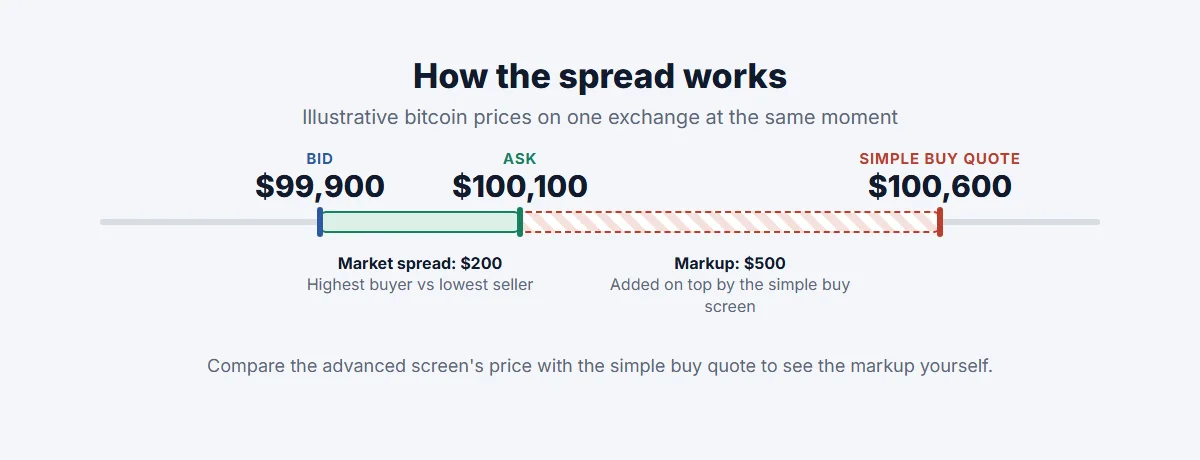
There are two kinds of spread to understand:
- The market spread on the order book. For bitcoin on a large exchange it’s usually tiny. For small, thinly traded coins it can be wide, so buying and selling straight away loses money even without fees.
- The markup on simple buy screens. When you tap “Buy” in an exchange or broker app, the quoted price usually sits above the market price. That markup is the exchange’s margin, and it’s often the largest cost of a small purchase. Kraken, for example, charges a 1% fee on instant buys with the spread included in the quoted price.
You can see the spread yourself: note the price on the advanced trading screen, then compare it with the price quoted on the simple buy screen at the same moment.
Slippage on large orders
If you place a large market order, it may fill against several offers at progressively worse prices. That difference is slippage. It rarely matters for beginner-sized orders in bitcoin or ether, but it can for large orders or small coins. A limit order prevents it, since you set the worst price you’ll accept.
Deposit and withdrawal fees
Deposits. Bank transfers are usually the cheapest way to fund an account, often free. Debit and credit cards, PayPal and similar options are faster but tend to carry fees of several percent. If you’re buying regularly, that alone can be the biggest cost you control.
Withdrawals of crypto. Sending coins to your own wallet costs a fee charged in the coin itself. Part of it pays the blockchain’s network fee; some exchanges add a margin. The key detail is that it’s usually a fixed amount, not a percentage. A fixed bitcoin withdrawal fee is negligible on a large transfer but can be a painful slice of a $50 one. That’s a reason to batch withdrawals instead of moving every small purchase.
Network choice matters too. Stablecoins such as USDC can often be withdrawn on several networks, with very different fees. Always choose a network your receiving wallet supports, or the funds can be lost. How to move crypto from Coinbase to a hardware wallet shows how to check this.
Withdrawals of cash. Selling crypto and withdrawing to your bank can also carry a fee, and banks sometimes treat incoming transfers from exchanges cautiously. How to withdraw crypto to your bank account covers that side.
A worked example: $500 of bitcoin, two ways
Here’s how crypto exchange fees add up on the same purchase made two different ways. The percentages are illustrative, based on typical published fees, and the withdrawal fee is an example amount.
| Cost | Simple “Buy” with a debit card | Advanced screen, bank transfer, limit order |
|---|---|---|
| Deposit | About 3% card fee: ~$15 | Bank transfer: $0 |
| Spread or markup | About 1%: ~$5 | Market spread only: under $1 |
| Trading fee | About 1%: ~$5 | 0.40% maker: $2 |
| Withdrawal to your wallet | Example network fee: ~$3 | Same: ~$3 (or $0 if you leave it) |
| Total cost | ~$28 (about 5.6%) | ~$5 to $6 (about 1%) |
The point isn’t the exact numbers, which vary by exchange and over time. It’s that the payment method and the screen you use matter more than which major exchange you pick. Coinbase vs Kraken compares two popular options side by side.
How to pay less in crypto exchange fees
- Fund by bank transfer, not card, whenever you can wait a day or two.
- Use the advanced trading screen instead of the simple buy button. Most large exchanges offer one for free.
- Use limit orders to pay the lower maker fee and avoid slippage.
- Buy less often, in larger amounts, if fixed fees are eating into small purchases. If you prefer regular buying, check the recurring-buy fee: dollar-cost averaging in crypto explains how to set it up sensibly.
- Batch withdrawals to your own wallet instead of moving every small purchase.
- Pick the cheapest supported network when withdrawing stablecoins, after checking your wallet supports it.
- Read the order preview. The final “you will receive” amount is the only number that includes everything.
Subscriptions that waive trading fees can make sense if you buy often, but only after comparing the monthly cost against what you actually pay now.
A note on fees and taxes
In many countries, trading fees can be added to your cost basis when you buy or deducted from the proceeds when you sell, which reduces the taxable gain. Keep the fee records your exchange provides. Our crypto taxes guide explains the basics, and a tax professional can confirm the rules where you live.
If you’re just getting started, how to buy crypto safely for the first time puts these fees in the context of the whole process.