

Crypto market cap matters more than price: a coin’s price on its own tells you almost nothing about whether it’s cheap or expensive. What matters is its market cap: the price of one coin multiplied by the number of coins in circulation. A coin selling for a fraction of a cent can be worth more in total than one selling for hundreds of dollars, simply because there are billions more of them.
That’s why “it’s only $0.0001, imagine if it hits $1” is one of the most expensive ideas in crypto. Below you’ll see how market cap is calculated, how to check whether a price target is even possible, what the other supply numbers on data sites mean and what market cap can’t tell you.
How crypto market cap is calculated
The formula is simple:
Market cap = current price × circulating supply
Circulating supply is the number of coins that exist and are available to trade right now. So if a coin trades at $25 and 40 million coins are in circulation, its market cap is $1 billion. Data sites such as CoinGecko and CoinMarketCap do this calculation for every coin they list. CoinGecko describes market cap as the total current value of all the coins in circulation.
Market cap works like the total value of a company’s shares in the stock market. Nobody judges a company by its share price alone: one company’s shares might cost $20 and another’s $900, and the cheaper one might be the bigger business. Crypto works the same way.
Why a low price doesn’t mean cheap
Picture two pizzas of exactly the same size. One is cut into 8 slices and the other into 40. A slice of the second pizza is much smaller, but nobody would say the second pizza is cheaper. Coins are the same: the price per coin depends on how many coins the total value is split into.
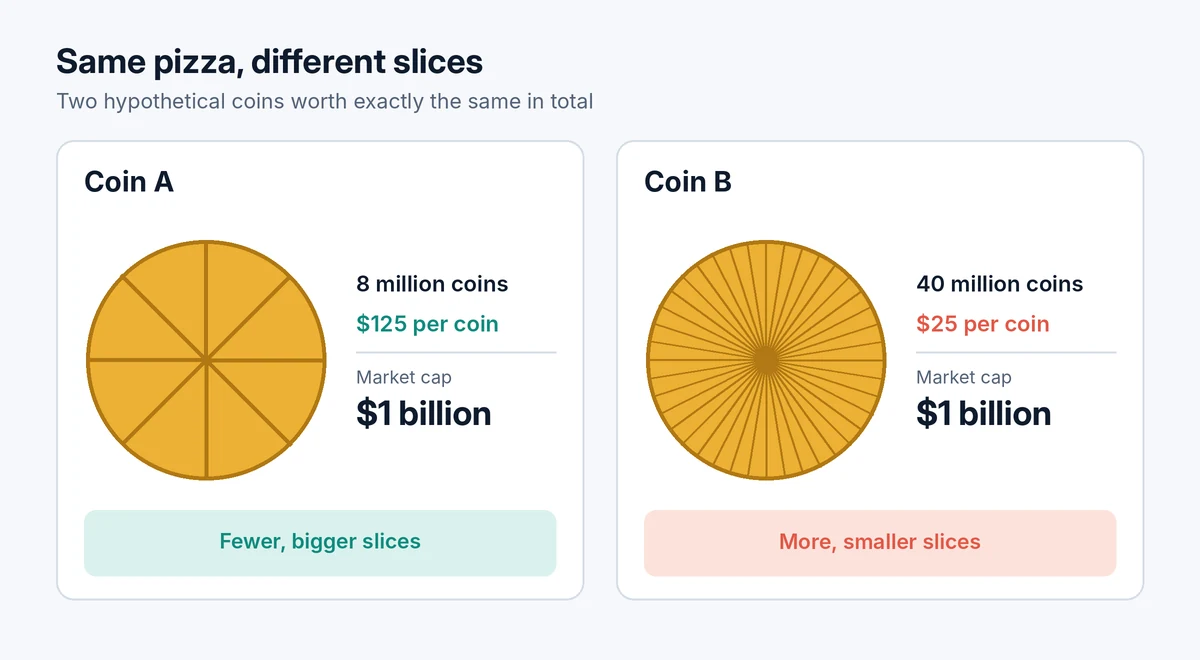
The tendency to feel that a low-priced coin is a better deal has a name: unit bias. Owning a million of something feels better than owning 0.01 of something, even if both cost the same $100. Projects know this, and many deliberately create huge supplies so that the price per coin looks tiny. It’s one of the reasons memecoins often have supplies in the hundreds of billions or more.
The flip side is that bitcoin’s high price doesn’t make it “too expensive”. You can buy any fraction of a coin, so what matters is how much the whole thing is worth and whether you think that’s justified. What is Bitcoin and why does it have value explains how people think about that for the largest coin.
The “what would it take?” test
Before getting excited about a price target, multiply it by the supply. This turns “it could go to $1” into a question you can actually judge: “could this project be worth that much?”
Take a hypothetical coin with 500 billion coins in circulation, trading at $0.0001. Its market cap is $50 million. Here’s what different prices would require:
| Price per coin | Market cap needed | Growth from today |
|---|---|---|
| $0.0001 (today) | $50 million | – |
| $0.001 | $500 million | 10× |
| $0.01 | $5 billion | 100× |
| $0.10 | $50 billion | 1,000× |
| $1 | $500 billion | 10,000× |
At $1, this coin would need to be worth $500 billion: more than almost every cryptocurrency in existence except the very largest. For a project with no product, that’s not a realistic target, it’s a fantasy. Run this test on any coin you’re considering: look up its circulating supply, multiply by the price you’re hoping for, and compare the result with the market caps of the biggest coins on a data site.
Circulating, total and maximum supply
Data sites usually show three supply figures, and the difference between them matters:
- Circulating supply: coins available to trade today. This is what market cap uses.
- Total supply: coins that exist now, including ones that are locked up or held by the project and not yet circulating.
- Maximum supply: the most coins that will ever exist, if there’s a limit. Bitcoin’s is 21 million. Some coins, such as ether, have no maximum.
A related number is fully diluted value (FDV): the price multiplied by the maximum or total supply. It shows what the project would be worth at today’s price if every coin were already out. When FDV is much higher than market cap, a lot of new supply is still to come, often from tokens set aside for the team and early investors. If demand doesn’t grow as those coins are released, the price tends to fall. We go through a worked example in how to tell a real project from a hype coin.
What market cap doesn’t tell you
Market cap is the best single number for comparing coins, but it has real limits.
It isn’t the money that’s been invested
Market cap applies the latest trading price to every coin in circulation, even though most of those coins weren’t bought at that price. In a coin with few buyers and sellers, one small trade can move the price and add millions to the market cap without much money coming in at all.
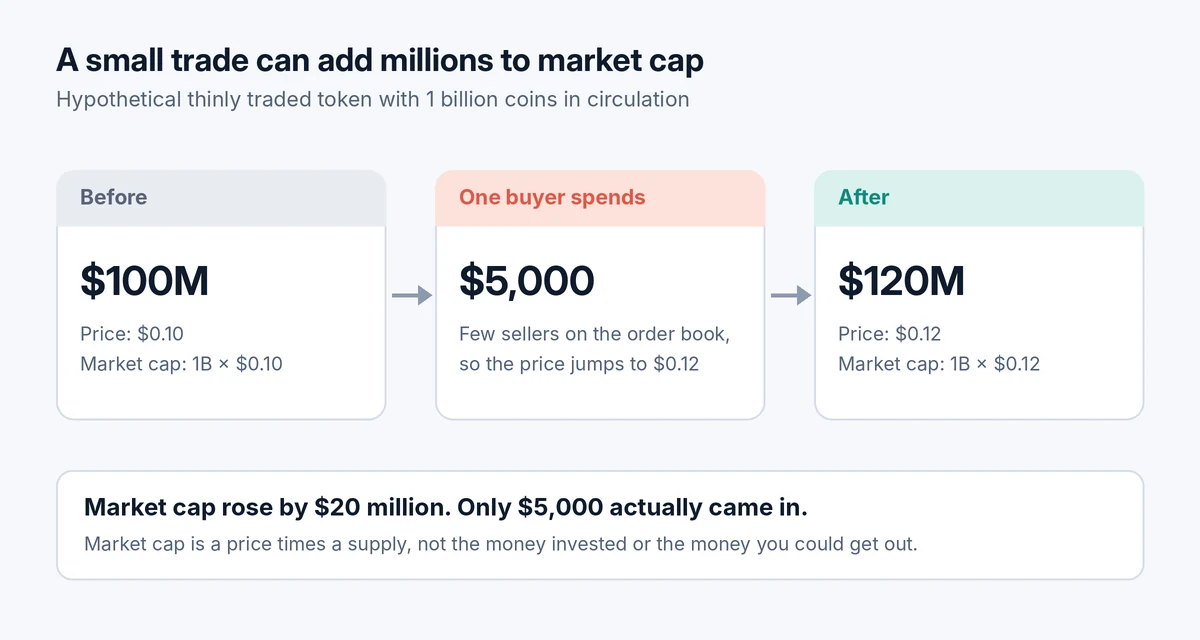
The same works in reverse. If holders tried to sell all at once, they couldn’t get anywhere near the market cap out, because the price would collapse as they sold.
It doesn’t measure how easy it is to trade
Check the 24-hour trading volume next to the market cap. A coin with a $200 million market cap but only a few thousand dollars traded each day is easy to manipulate and hard to sell without moving the price against you. As a rough guide, the smaller the volume relative to the market cap, the more careful you should be.
It doesn’t show who owns the coins
Two coins with the same market cap can be very different if one is spread across millions of holders and the other is mostly held by a few wallets. A blockchain explorer’s “holders” page shows this, and it’s covered step by step in our altcoin checklist.
It doesn’t tell you whether the price is justified
A large market cap shows that a lot of people currently value a coin highly, not that they’re right. Hype can push a weak project to a big valuation, at least for a while.
How to use market cap sensibly
- Compare coins by market cap, never by price. It’s the only fair way to see how big one is relative to another.
- Use it as a rough risk guide. In general, the smaller the market cap, the more volatile the coin and the more likely it is to fail. Large, established coins can still fall sharply, but small ones swing far more.
- Always check FDV and volume alongside it. A big gap to FDV means supply is coming. Low volume means the market cap is fragile.
- Run the “what would it take?” test on any price target you hear, especially on social media.
- Keep position sizes small for small coins. If you buy them at all, treat them as high-risk bets, and keep most of your crypto in larger, more established assets. Spreading purchases over time with dollar-cost averaging also helps with volatility.
Be especially wary when a promoter focuses on how cheap a coin is per unit, or how many coins your money will buy. That framing relies on unit bias, and it’s a common feature of pump-and-dump schemes. More warning signs are in 10 common crypto scams.
Quick answers
Is a higher market cap better?
Not better, just bigger. A higher market cap usually means a more established coin with more liquidity, but it also means less room for the dramatic growth that smaller coins sometimes see, and that most of them never achieve.
Can a coin’s market cap go above its maximum possible value?
Market cap has no ceiling: it’s whatever price people pay times the supply. The useful question is whether that value makes sense compared with what the project does and with other coins.
Why do different websites show different market caps for the same coin?
They may use slightly different prices or count circulating supply differently, for example by excluding coins held by the project. The differences are usually small for large coins and can be larger for new ones.
Does the total crypto market cap matter?
It’s a useful snapshot of how much the whole market is valued at and whether money is flowing in or out overall. It’s not much help in judging an individual coin.
New to crypto? Start with our plain-English guide to how crypto works, and look up any unfamiliar terms in the crypto glossary.
This article is for educational purposes only and isn’t financial or investment advice. All coins in the examples are hypothetical.


Pingback: 10 Common Crypto Scams and How to Spot Them (2026)
Pingback: What Are Altcoins? How to Spot a Real Project vs a Hype Coin
Pingback: What Is Bitcoin and Why Does It Have Value? Explained Simply