

What is Bitcoin? It’s a digital currency that runs on a global network of computers instead of a bank or government. It has value for the same basic reason gold or the dollar does: enough people trust it and want it. Bitcoin earns that trust differently, though. Its supply is capped at 21 million coins, no one can create more or freeze your balance, and the rules are enforced by code and by thousands of independent computers rather than by any company.
That’s the short answer. The rest of this article explains each part of it in plain terms, then looks at the serious arguments against Bitcoin, because you should hear both sides before deciding what it’s worth to you.
What is Bitcoin, exactly?
Bitcoin was described in a nine-page paper published on 31 October 2008 by someone using the name Satoshi Nakamoto, and the network went live in January 2009. Nobody has proven who Nakamoto is, and the creator stopped posting publicly in 2011. That matters less than it sounds, because no one, including the creator, controls Bitcoin today.
Part of what makes “what is Bitcoin?” confusing is that the word refers to two connected things:
- The network: thousands of computers around the world that keep identical copies of a public ledger (the blockchain) and check every transaction against the same rules.
- The coin: bitcoin (lowercase, ticker BTC), the unit of money recorded on that ledger.
You don’t need to buy a whole coin. Each bitcoin divides into 100 million units called satoshis, so you can own $20 worth just as easily as $20,000 worth. If you want to understand what happens behind the scenes when coins move, our plain-English guide to how crypto works walks through a payment step by step, and how blockchain works explains the ledger itself. You can also read the original Bitcoin whitepaper, which is shorter and more readable than most people expect.
Where Bitcoin’s value comes from
Bitcoin doesn’t pay dividends or interest, and no government stands behind it. Its value comes from a handful of properties that, together, make people willing to hold it. None of them alone explains the price, but each one is a reason someone might prefer bitcoin over an alternative.
1. A supply nobody can increase
Only 21 million bitcoin will ever exist. New coins are released as a reward to miners, and that reward is cut in half roughly every four years in an event called the halving. The most recent halving, in April 2024, reduced the reward from 6.25 to 3.125 bitcoin per block, and the next one is expected in 2028.
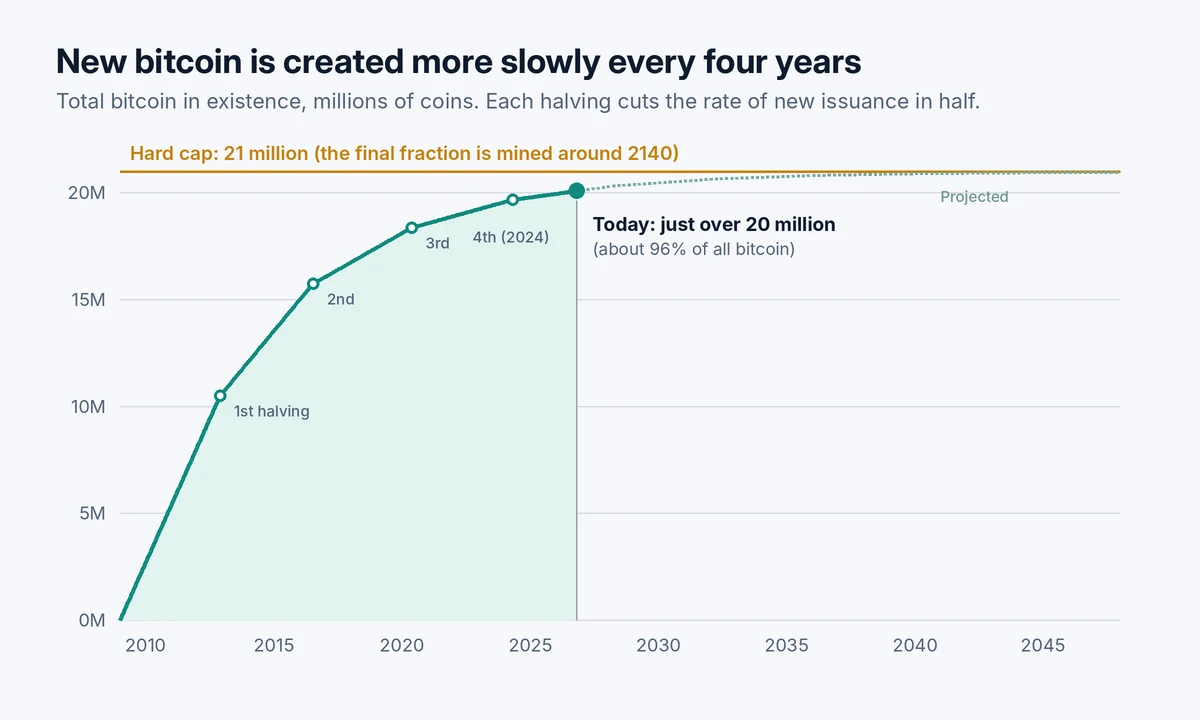
As the chart shows, just over 20 million bitcoin already exist, about 96% of the total. The remaining coins will trickle out over more than a century, with the last fraction expected around 2140. Compare that with a currency like the dollar, where the supply grows whenever a central bank decides it should. If you believe that over time money tends to lose purchasing power, a fixed supply is Bitcoin’s main attraction. More on the mechanics in what a Bitcoin halving is and what happens when all 21 million are mined.
A natural question is whether someone could simply change the code and raise the limit. Technically, anyone can propose a change. In practice, it would only take effect if the vast majority of people running the network chose to install it, and they hold bitcoin precisely because of the cap. That’s why most people treat the 21 million limit as fixed.
2. Expensive to attack, so hard to cheat
Adding a block to Bitcoin’s ledger requires real-world resources: specialized hardware and a lot of electricity. This system, called proof of work, means that rewriting past transactions would require out-spending the entire honest network. That cost isn’t what gives bitcoin value by itself (spending money on something doesn’t make it valuable), but it’s what makes the ledger trustworthy, and a ledger you can trust is the foundation everything else rests on. Proof of work vs proof of stake compares this approach with the one Ethereum uses.
3. Nobody can freeze or block it
If you hold your own bitcoin, no bank can freeze the account and no payment company can refuse the transfer. You can send it across borders at any hour without asking permission. For someone in a stable country with a working bank, that may sound abstract. For people facing high inflation, capital controls or an unreliable banking system, it can be the main reason to own it. This only applies if you hold the keys yourself, which is why how crypto wallets work is worth understanding early.
4. The network effect
Money becomes more useful the more people accept it. Bitcoin is the oldest and most widely recognized cryptocurrency, it trades on almost every exchange, and since January 2024 it has been available to ordinary investors through regulated funds: the US Securities and Exchange Commission approved the first spot bitcoin exchange-traded products on 10 January 2024. Each new group of holders makes it easier for the next one to buy, sell and accept it.
5. Shared belief, like every form of money
This is the part people find uncomfortable, but it applies to all money. A $20 bill is worth something because everyone expects everyone else to accept it. Gold is valuable partly because of its uses but mostly because people have trusted it for thousands of years. Bitcoin’s value also rests on a shared expectation that others will want it in the future. The difference is that Bitcoin’s track record is about 17 years long, not centuries, so that belief is still being tested.
Bitcoin, gold and the dollar compared
Bitcoin is often called “digital gold”. This comparison shows where the label fits and where it doesn’t.
| Property | Bitcoin | Gold | US dollar |
|---|---|---|---|
| Who controls the supply | Fixed by code, capped at 21 million | Mining, limited by geology and cost | The Federal Reserve |
| Can the supply grow? | Only on a set, shrinking schedule | Slowly, by about the rate of new mining | Yes, by policy decision |
| Easy to move long distances | Yes, in minutes | No, physical and heavy | Yes, through banks |
| Easy to divide into small amounts | Yes, down to one hundred-millionth | Hard | Yes, down to one cent |
| Easy to verify it’s real | Yes, any node can check | Requires testing | Yes, mostly |
| Price stability | Very volatile | Relatively stable | Stable, but loses value to inflation over time |
| Track record | Since 2009 | Thousands of years | Over two centuries |
Bitcoin beats gold on portability and divisibility, and beats the dollar on predictable supply. Where it clearly loses is price stability and history, and those two are exactly what critics focus on.
The case against Bitcoin
Plenty of well-informed people think bitcoin is overvalued or even worthless. Their main arguments deserve a fair hearing:
- It produces nothing. A company earns profits and a property earns rent. Bitcoin generates no income, so there’s no “fair value” to calculate. Its price is whatever the next buyer will pay.
- It’s too volatile to be money. Bitcoin has fallen more than 70% from a peak several times. It’s hard to price groceries or salaries in something that can halve in a few months.
- Regulators remain wary. Even when approving the bitcoin funds in 2024, the SEC’s then-chair described bitcoin as “primarily a speculative, volatile asset” that is also used for illicit activity.
- Energy use. Proof of work consumes a large amount of electricity, which draws criticism on environmental grounds.
- Nothing guarantees it stays on top. Bitcoin’s value depends on continued trust. Changes in regulation, a serious technical flaw or a shift in public opinion could reduce demand.
Supporters have answers to each point, from “gold doesn’t produce income either” to “volatility falls as adoption grows”. Whether those answers convince you is a personal judgment. What’s certain is that bitcoin is a high-risk asset, and anyone who tells you otherwise is selling something.
What actually moves the price
Because new supply is predictable, bitcoin’s price moves almost entirely with demand. The usual drivers are:
- Money flowing in or out of large buyers, such as bitcoin funds and companies that hold it on their balance sheets.
- Interest rates and the wider economy. When borrowing is cheap, investors tend to take more risk, and bitcoin has often benefited. When rates rise, it has often fallen.
- Regulation and news, from approvals and bans to exchange failures.
- Leverage. Traders who borrow to bet on price moves can be forced to sell when prices drop, which turns a dip into a crash, and the same happens in reverse on the way up.
- The halving cycle. Some investors expect prices to rise after each halving as new supply shrinks. It has happened before, but past patterns are no guarantee.
One practical consequence: trying to time these swings is extremely difficult. Many beginners find that buying a fixed amount at regular intervals, known as dollar-cost averaging, is less stressful than guessing the right moment.
Three things beginners often get wrong
“One bitcoin is too expensive for me.” You can buy a fraction of a coin for a few dollars. The price of one whole coin tells you nothing about whether it’s a good or bad buy, a point explained further in crypto market cap explained.
“Bitcoin and blockchain are the same thing.” Bitcoin was the first blockchain, but thousands now exist. Ethereum, for example, was built to run applications rather than to be digital money. See Bitcoin vs Ethereum for the differences.
“Bitcoin is anonymous.” Every transaction is public and permanent. Addresses aren’t labeled with names, but exchanges verify your identity, so activity can often be traced back to a person.
If you decide to own some
Owning bitcoin doesn’t have to be complicated, but a few decisions are worth making deliberately:
- Decide how much you could lose without it hurting. Treat that as your limit, whatever the price does.
- Choose how to hold it. You can buy actual bitcoin through a regulated exchange, or get price exposure through a fund in a normal brokerage account. How Bitcoin ETFs work explains the trade-offs.
- Buy carefully. Follow how to buy crypto safely and compare total costs with the cheapest ways to buy bitcoin in the US or in the UK.
- Protect it. For larger amounts, consider moving coins to a hardware wallet and storing your recovery phrase safely.
- Keep records for tax. Selling, swapping or spending bitcoin can create a taxable gain. Start with what triggers a taxable event.
Common questions
Who controls Bitcoin?
No single person or company. Developers propose changes, but each person running the software decides whether to adopt them. Miners process transactions but can’t change the rules or spend other people’s coins.
Can bitcoin go to zero?
In theory, yes. If people stopped wanting it, nothing would hold the price up. It has survived several crashes and many predictions of its death, but past survival isn’t a guarantee.
What happens to lost bitcoin?
Coins whose keys are lost stay on the ledger forever but can never be moved again. A meaningful share of all bitcoin is believed to be permanently lost this way, which makes the usable supply even smaller than 21 million.
Is bitcoin a good investment?
That depends on your finances, your time horizon and how much volatility you can handle. It has delivered large gains and large losses. Treat it as a high-risk part of your money, never as savings you’ll need soon.
This article is for educational purposes only and isn’t financial, investment or tax advice.

Pingback: What Happens When All Bitcoin Is Mined? Life After 21 Million
Pingback: Bitcoin vs Ethereum: The Real Difference for Beginners