

A spot Bitcoin ETF is a fund that buys and holds real bitcoin, then sells shares of itself on the stock market. When you buy a share, you get exposure to bitcoin’s price through your normal brokerage account, without opening a crypto exchange account or managing a wallet.
Should a beginner buy one instead of bitcoin? If your only goal is to own some bitcoin as a long-term investment, and especially if you’d hold it in a retirement or tax-advantaged account, an ETF is often the simpler and lower-stress choice. If you want to actually use bitcoin, send it, hold it yourself or avoid paying a yearly fee forever, buying the real thing makes more sense. The rest of this article explains how the funds work and helps you decide which camp you’re in.
How a spot Bitcoin ETF works
ETF stands for exchange-traded fund: a fund whose shares trade on a stock exchange, like shares of a company. Most ETFs hold stocks or bonds. A spot Bitcoin ETF holds bitcoin.
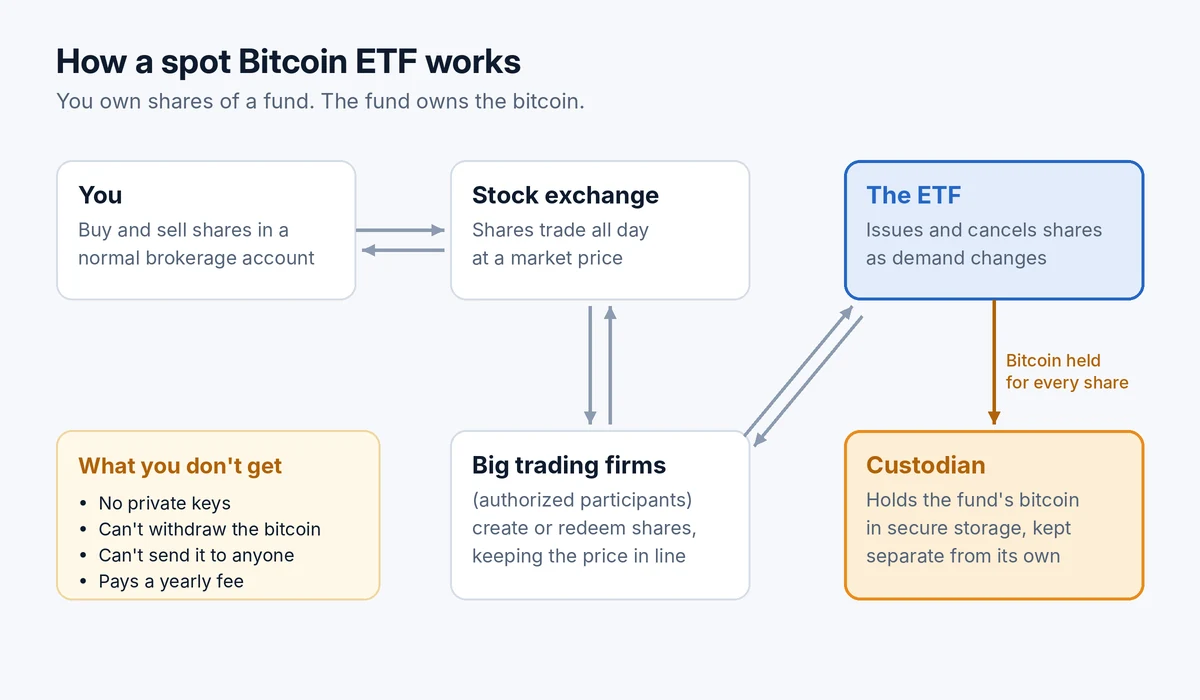
Here’s what’s going on behind the scenes:
- The fund buys bitcoin and keeps it with a custodian, a specialist company that stores it securely and separately from its own assets.
- You buy and sell shares on the stock market during trading hours, just like any other ETF.
- Large trading firms, called authorized participants, create new shares when demand rises and redeem shares when it falls. In return, the fund adds or releases bitcoin (or cash used to buy or sell it). This process keeps the share price close to the value of the bitcoin the fund holds.
- The fund charges a yearly fee, called the expense ratio. It isn’t billed to you separately: it’s taken from the fund’s assets, so each share slowly represents a little less bitcoin over time.
In the US, the Securities and Exchange Commission approved the first spot bitcoin ETPs on 10 January 2024, and they began trading the next day. In July 2025, the SEC also allowed these funds to create and redeem shares directly in bitcoin rather than only in cash, which brought them in line with how gold ETFs work.
Spot ETFs vs futures ETFs
“Spot” means the fund holds actual bitcoin. Before 2024, US investors could only buy futures Bitcoin ETFs, which hold contracts betting on bitcoin’s future price instead of the coin itself. Futures funds have to keep replacing contracts as they expire, which can cost money and make them track bitcoin’s price less closely over long periods. For a long-term holding, a spot fund is usually the more direct option. Check the fund’s name and description: spot funds generally say they hold bitcoin directly.
Bitcoin ETF vs buying bitcoin directly
| Spot Bitcoin ETF | Buying bitcoin directly | |
|---|---|---|
| Where you buy | Your usual brokerage or retirement account | A crypto exchange or app |
| What you own | Shares of a fund that holds bitcoin | Bitcoin itself |
| Ongoing cost | Yearly expense ratio, taken every year you hold | No yearly fee, but trading spreads and fees when you buy or sell |
| Security | Handled by the fund and its custodian | Your responsibility (or the exchange’s, if you leave it there) |
| Can you send or spend it? | No | Yes |
| When it trades | Stock market hours only | 24 hours a day, every day |
| Retirement accounts | Usually yes, through a normal brokerage | Only through specialist providers |
| If the company you bought from fails | The bitcoin belongs to the fund, held separately by a custodian | Coins left on a failed exchange may be at risk; coins in your own wallet aren’t affected |
The trade-off comes down to convenience versus control. An ETF removes almost everything that goes wrong for beginners: lost recovery phrases, hacked accounts, sending coins to the wrong address. In exchange, you pay a fee every year and give up the things that make bitcoin different from a stock: owning it outright, moving it whenever you want and not relying on any company.
What a Bitcoin ETF really costs
The expense ratio looks tiny, but it’s charged every year for as long as you hold the fund. Bitcoin itself costs nothing to hold once you’ve bought it, so the comparison matters most for long-term holders.
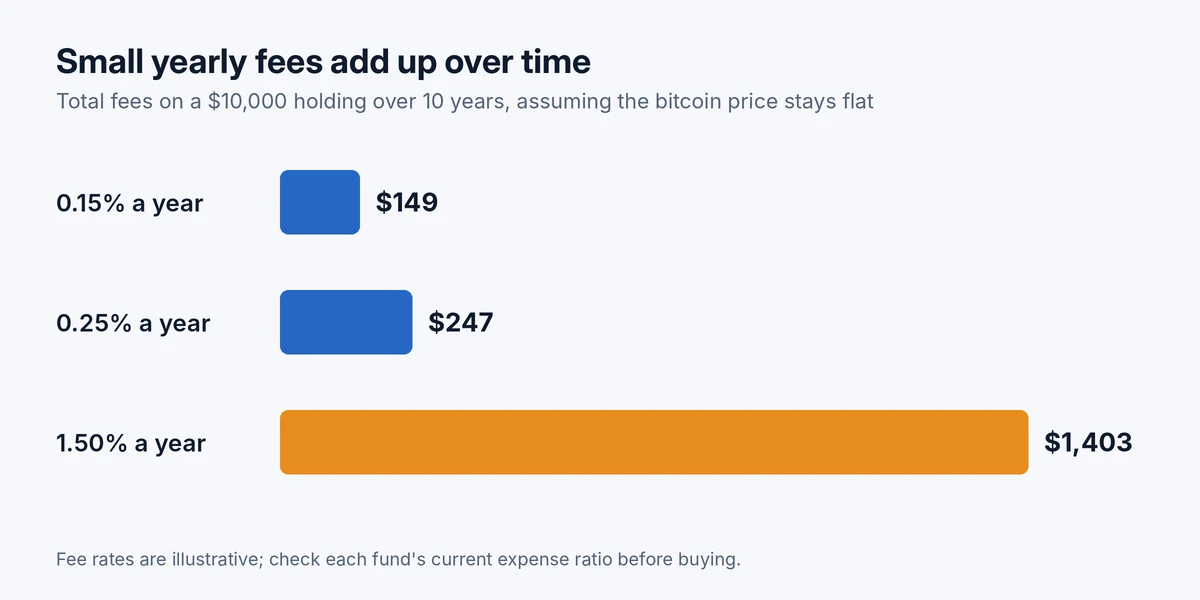
Fees differ a lot between funds that hold the same asset. These are the published expense ratios of some of the largest US spot Bitcoin ETFs at the time of writing:
| Fund | Ticker | Expense ratio |
|---|---|---|
| Grayscale Bitcoin Mini Trust | BTC | 0.15% |
| Bitwise Bitcoin ETF | BITB | 0.20% |
| iShares Bitcoin Trust (BlackRock) | IBIT | 0.25% |
| Fidelity Wise Origin Bitcoin Fund | FBTC | 0.25% |
| Grayscale Bitcoin Trust | GBTC | 1.50% |
Fees can change, so always check the fund’s own page before buying. Two other costs are worth knowing: your broker may charge a trading commission, and every ETF has a small gap between its buying and selling price (the bid-ask spread), which is usually narrow for the largest funds.
Buying bitcoin directly isn’t free either. Exchanges charge trading fees and spreads, and “simple buy” buttons are often the most expensive way to buy. Crypto exchange fees explained shows how to work out the real cost. As a rough rule, the more often you trade and the shorter you hold, the less the ETF’s yearly fee matters; the longer you hold, the more it adds up.
Can you buy Bitcoin ETFs where you live?
- United States: spot Bitcoin ETFs have been available through ordinary brokerages since January 2024, and many brokers allow them in IRAs.
- Canada: one of the first places to offer them. North America’s first bitcoin ETF launched in Toronto in February 2021, and several are available today.
- Australia: the ASX listed its first spot Bitcoin ETF in June 2024, and similar products trade on other Australian exchanges.
- United Kingdom: the products available to everyday investors are crypto exchange-traded notes (cETNs) rather than ETFs. The FCA has allowed retail investors to buy them since 8 October 2025, as long as they trade on an FCA-recognised exchange. An ETN is a debt note issued by a company, usually backed by bitcoin it holds, so check how the issuer stores that bitcoin. On ISAs, HMRC’s rules say cETNs moved from stocks and shares ISAs to Innovative Finance ISAs from 6 April 2026, so check which ISA your provider offers them in.
Whatever the wrapper, the FCA’s warning applies everywhere: these are high-risk products, and you could lose all the money you invest. Owning bitcoin through a fund removes the technical risks, not the price risk.
How taxes differ
This is often the deciding factor, and it depends on where you live and which account you use. In general:
- Inside a tax-advantaged account (an IRA or 401(k) in the US, a TFSA or RRSP in Canada, an ISA in the UK, a self-managed super fund in Australia), gains from an ETF can grow without being taxed each time you sell, subject to that account’s rules. That’s hard to replicate with bitcoin bought on an exchange.
- In a regular taxable account, selling ETF shares is taxed much like selling bitcoin: as a capital gain or loss. The ETF’s advantage is simpler paperwork, because your broker reports the sales for you.
- With bitcoin itself, every sale, swap or purchase made with bitcoin can be a taxable event, and you’re responsible for tracking your cost for each one.
Tax rules for crypto change often and differ by country, so treat this as a starting point and check the details for your situation. Start with what triggers a taxable event, then read the rules for the US, the UK, Canada or Australia.
Which should you choose?
A Bitcoin ETF is likely the better fit if:
- You want bitcoin as one part of a long-term investment portfolio, alongside stocks and bonds.
- You’d like to hold it in a retirement or other tax-advantaged account.
- You’re worried about losing a recovery phrase, getting hacked or making a sending mistake.
- You don’t plan to use bitcoin for anything other than holding it.
Buying bitcoin directly is likely the better fit if:
- You want to own the asset itself, without depending on any fund or company.
- You plan to send, spend or move your bitcoin.
- You’d rather not pay a yearly fee for as long as you hold it.
- You want to be able to sell at any hour, including weekends.
- You’re willing to learn how to store it safely. Crypto wallets explained and how to store a seed phrase safely are the place to start.
Some people do both: an ETF in their retirement account for the long term, and a small amount of real bitcoin to learn how it works. Whichever route you take, decide in advance how much you’re willing to risk, and consider buying in regular amounts over time with dollar-cost averaging rather than all at once.
How to buy a Bitcoin ETF
- Open or use an existing brokerage account that offers the funds available in your country. If you want tax advantages, choose the right account type first.
- Compare a few funds on expense ratio, size and trading volume. Larger funds usually have tighter spreads.
- Search for the ticker and check you’ve got the right fund. Similar names exist, including futures and leveraged products that behave very differently.
- Use a limit order rather than a market order, so you don’t pay more than you intended if the price moves quickly.
- Keep your contract notes for tax purposes, even though your broker will usually send an annual statement.
If you decide to buy bitcoin directly instead, follow how to buy crypto safely and compare costs with the cheapest ways to buy bitcoin in the US or in the UK.
Common questions
Does a Bitcoin ETF hold real bitcoin?
A spot ETF does. The fund buys bitcoin and keeps it with a custodian, and most funds publish their holdings regularly. Futures ETFs don’t hold bitcoin; they hold contracts linked to its price.
Can I swap my ETF shares for the actual bitcoin?
Not as an individual investor. Only the large trading firms that create and redeem shares deal directly with the fund. To own bitcoin itself, you’d sell your shares and buy bitcoin separately, which may trigger tax.
What happens if the fund company goes bust?
The bitcoin belongs to the fund, not the company managing it, and it’s held by a separate custodian, so it shouldn’t be available to the manager’s creditors. The bigger concern is that several large funds use the same custodian, which concentrates risk in one place. Read the fund’s prospectus to see who holds its bitcoin.
Is a Bitcoin ETF safer than bitcoin?
It’s safer from technical mistakes, hacks and lost keys. It isn’t safer from price drops: if bitcoin falls 50%, so does your ETF. To understand what drives that price, read what is Bitcoin and why does it have value.
This article is for educational purposes only and isn’t financial, investment or tax advice.

Pingback: Bitcoin vs Ethereum: The Real Difference for Beginners