Crypto tax in Australia works mainly through capital gains tax (CGT). The Australian Taxation Office (ATO) treats crypto as a CGT asset, so selling it, swapping it, spending it or giving it away is a CGT event. Your net capital gain is added to your taxable income and taxed at your marginal rate. The big relief: if you’ve held the crypto for more than 12 months, individuals can halve the gain with the 50% CGT discount.
Crypto you receive from staking, as payment or from some airdrops is ordinary income. This guide covers each rule, with an example of how much the 12-month discount can save.
General information, not tax advice. Check the ATO’s guidance or a registered tax agent for your situation.
What the ATO treats as a CGT event
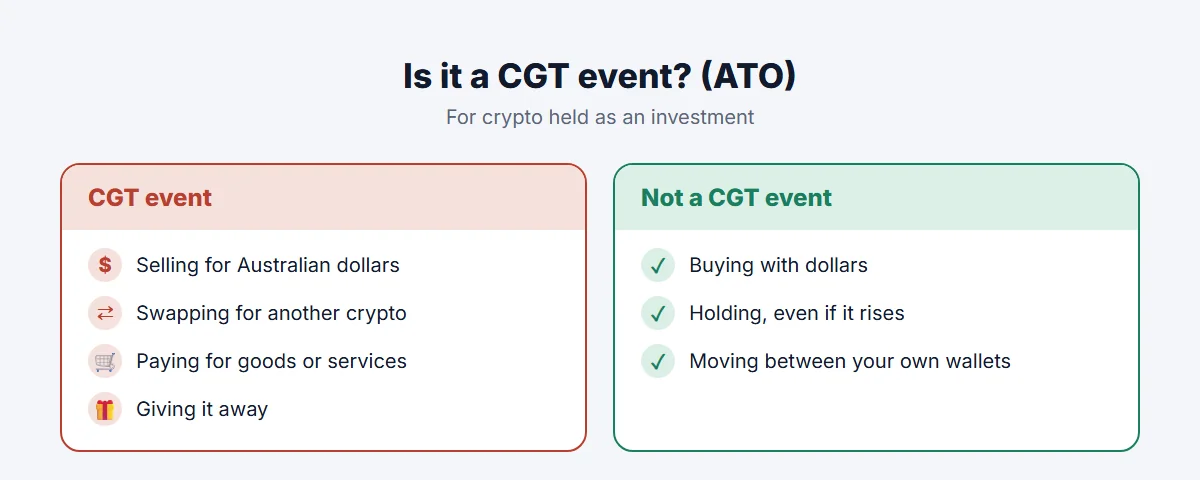
A CGT event happens when you dispose of crypto, including when you:
- sell it for Australian dollars,
- swap it for another crypto, including stablecoins, where each swap is a disposal of the coin you gave up,
- use it to pay for goods or services,
- give it away.
Buying crypto with dollars and holding it isn’t a CGT event, and neither is moving it between wallets you own, as long as you keep ownership. Keep records of those transfers anyway, so they aren’t mistaken for sales. The general principles are the same as in other countries, as explained in crypto taxes explained.
How the gain is calculated and taxed
Your capital gain is what you received (the Australian dollar value) minus your cost base, which includes what you paid and incidental costs such as fees. Australia’s financial year runs from 1 July to 30 June.
All your capital gains for the year, minus capital losses, minus any discount, form your net capital gain, which is added to your other income. It’s taxed at your marginal rate. For residents in 2026-27, those rates are 0% up to $18,200, 15% up to $45,000, 30% up to $135,000, 37% up to $190,000 and 45% above that, plus the 2% Medicare levy for most people.
The 50% CGT discount for crypto held over 12 months
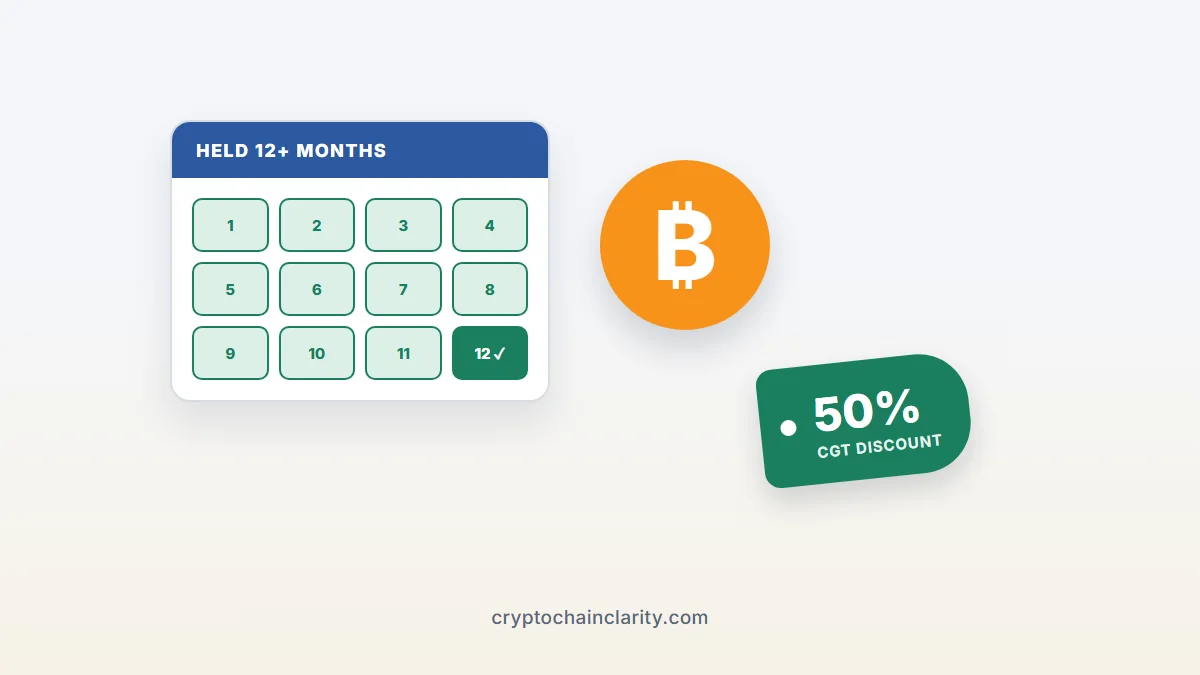
If you’re an individual (or a trust) and you held the crypto for at least 12 months before the CGT event, you can reduce the gain by 50% after applying any losses. Companies don’t get this discount.
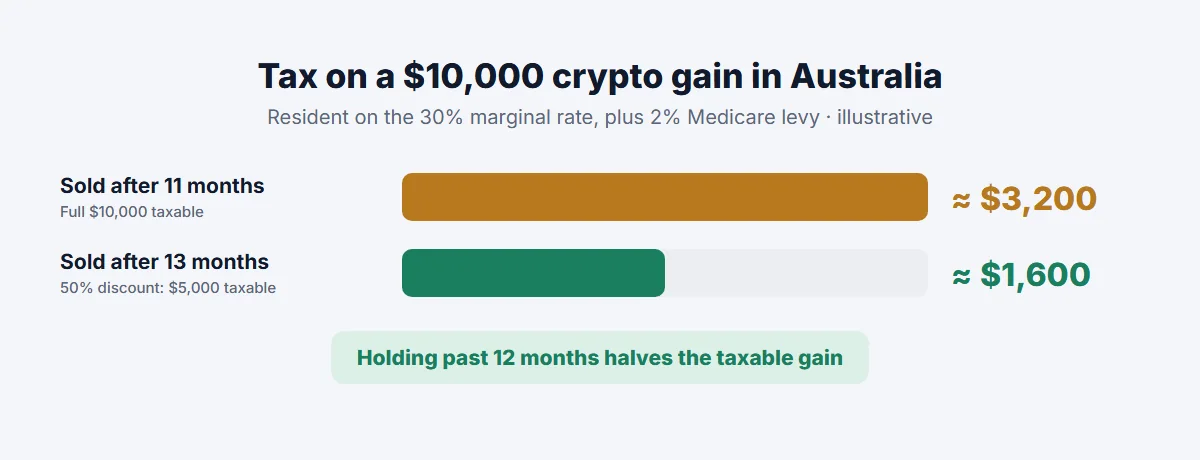
Example
You earn $90,000 a year, which puts your next dollar in the 30% bracket. You sell bitcoin for a $10,000 capital gain.
- Sold after 11 months: the full $10,000 is added to your income. At 30% plus the 2% Medicare levy, that’s about $3,200 in tax.
- Sold after 13 months: the 50% discount halves the gain to $5,000, so the tax is about $1,600.
Waiting two more months would save around $1,600 on the same gain. The holding period counts from the day after you acquire the crypto, and each swap restarts it for the new coin you receive.
Crypto income: staking, airdrops and business
Some crypto is taxed as ordinary income when you receive it, at its Australian dollar value:
- staking rewards,
- crypto received as payment for work or goods,
- some airdrops,
- profits if you’re carrying on a business of trading or mining.
That value becomes the cost base of those coins, so when you later dispose of them, the change in value is a capital gain or loss. If you’re trading as a business, crypto is treated as trading stock and the CGT discount doesn’t apply. Tax on crypto staking rewards explains the income side in more detail.
Capital losses
A capital loss on crypto can only offset capital gains, not your salary or other income. Unused losses carry forward indefinitely to future years. Apply losses before the 50% discount, and against non-discountable gains first if you have both.
Be careful with selling at a loss and buying straight back. The ATO has warned that these “wash sales” are a form of tax avoidance, including for crypto, and it can deny the loss. Crypto tax loss harvesting compares the rules across countries.
The personal use asset exemption is narrow
A capital gain on a “personal use asset” acquired for less than $10,000 can be exempt. Some people assume this covers small crypto purchases. In practice, the ATO’s view is that crypto held as an investment, or for a period before being spent, isn’t a personal use asset. The exemption may apply only where you acquire crypto mainly to buy goods or services for personal use, and use it for that purpose within a short time. Don’t rely on it for crypto you’ve held or traded.
Records and reporting
The ATO runs a data-matching program with crypto platforms, collecting details on hundreds of thousands of Australians who buy and sell crypto each year. Your return should match what the platforms report.
For each transaction, keep:
- the date and type of transaction,
- the value in Australian dollars at that time,
- what it was for and who the other party was (even just a wallet address),
- fees, exchange records and wallet addresses.
Capital gains go in the capital gains section of your tax return, and crypto income in the relevant income section. If you lodge yourself, the usual deadline is 31 October; using a registered tax agent can extend it. How to report crypto on your tax return explains the general process, and best crypto tax software compares tools that produce ATO-ready reports.
Ways to reduce crypto tax in Australia legally
- Hold for more than 12 months before selling to get the 50% discount.
- Time disposals for a year when your income, and so your marginal rate, is lower.
- Use capital losses against gains, and carry forward what you can’t use.
- Avoid unnecessary swaps, since each one is a CGT event that can restart your 12-month clock.
- Keep complete records, so you don’t overpay on gains you can’t prove the cost of.
For comparison with other countries, see the guides to crypto tax in the US, UK and Canada.