How is crypto taxed in Canada? The Canada Revenue Agency (CRA) treats crypto as a commodity, not money. When you sell, trade, spend or give it away, you have a gain or loss. For most individual investors that’s a capital gain, and only half of it is added to your taxable income. If your crypto activity looks like a business, the full profit is taxed as business income instead. Crypto you receive from staking, mining or as pay is income when you receive it.
This guide explains each of those rules, how to work out your cost using Canada’s average cost method, how losses work, and where it all goes on your return.
General information, not tax advice. Your situation may differ; check the CRA’s guidance or a tax professional.
How is crypto taxed in Canada: what’s taxable
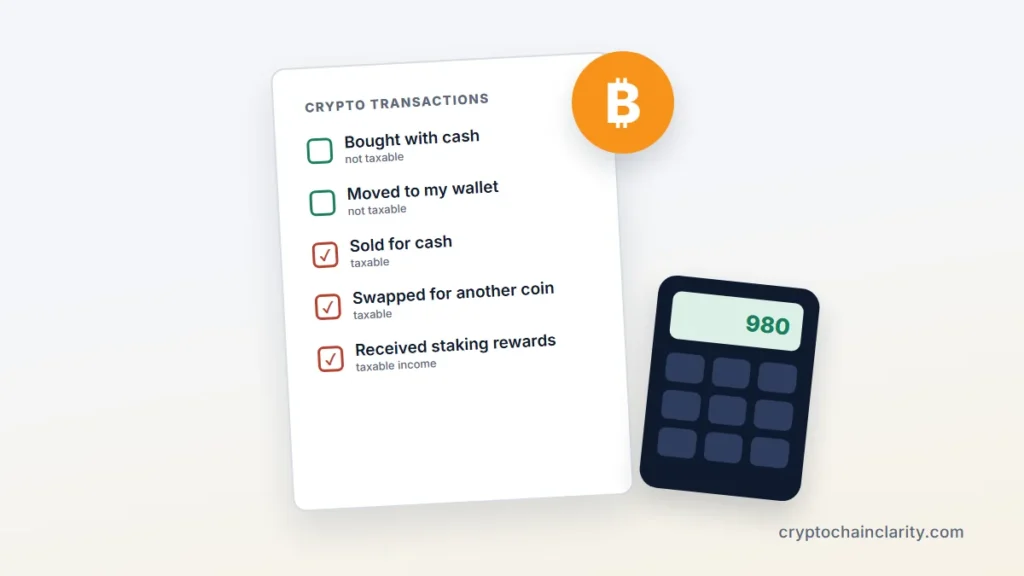
You have a disposition, and possibly a gain or loss, when you:
- sell crypto for Canadian dollars or another currency,
- trade one crypto for another, which the CRA treats as a barter transaction,
- spend crypto on goods or services,
- give crypto away, which is treated as a disposal at fair market value.
Buying crypto with Canadian dollars, holding it and moving it between your own wallets aren’t taxable on their own. The general logic is the same as in other countries, explained in crypto taxes explained.
Half of a capital gain is taxable
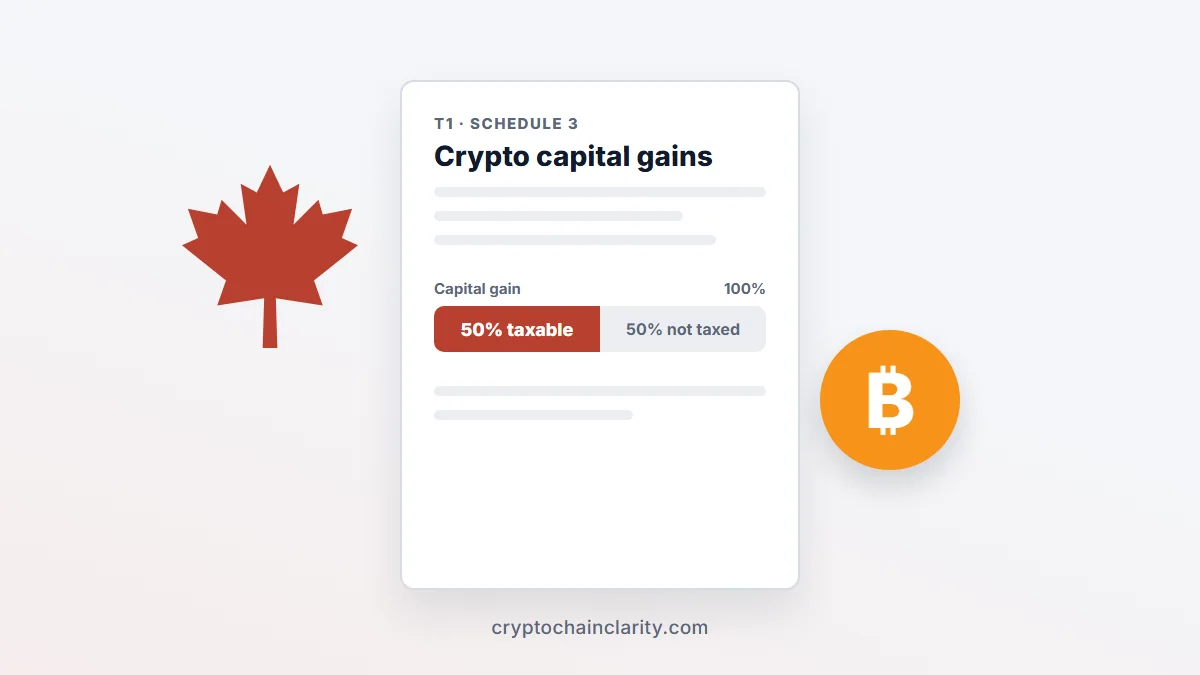
For individuals, the capital gains inclusion rate is 50%: half of your net capital gain for the year is added to your income and taxed at your normal federal and provincial rates. A proposal to raise the rate to two-thirds for gains above $250,000 was cancelled in March 2025, so the 50% rate continues to apply.
For example, if you have a $4,000 capital gain from crypto, $2,000 is added to your taxable income. At a combined marginal rate of 30%, that’s about $600 of tax. Your actual rate depends on your province and other income.
Working out your cost: the average cost method
Canada uses the adjusted cost base (ACB), an average cost across all the units of the same coin you hold. You can’t choose which units you sold, as you can in the US.
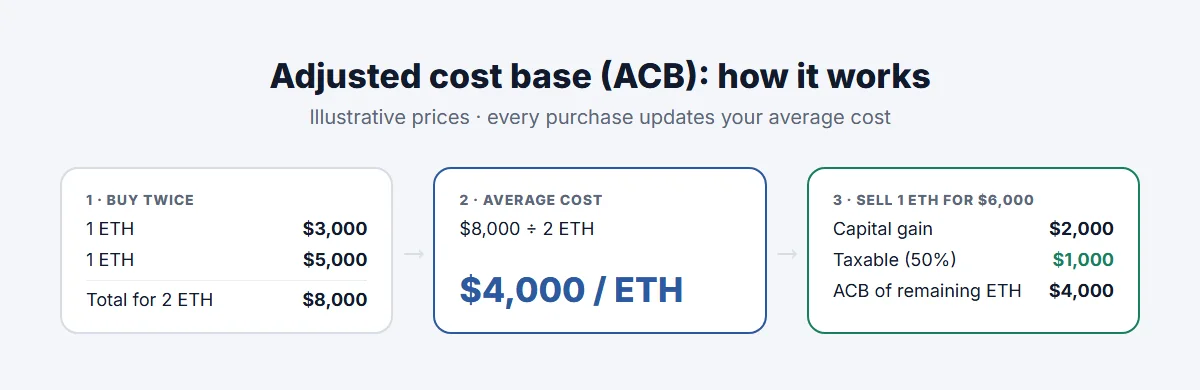
Here’s how it works with illustrative prices:
- You buy 1 ETH for $3,000, then another 1 ETH for $5,000. Your total cost is $8,000 for 2 ETH, so your ACB is $4,000 per ETH.
- You sell 1 ETH for $6,000. Your capital gain is $6,000 − $4,000 = $2,000.
- Half, $1,000, is added to your taxable income.
- Your remaining 1 ETH keeps its ACB of $4,000.
Include fees: purchase fees add to your ACB, and selling fees reduce your proceeds. Keep a running ACB for each coin, updated with every purchase. With many trades, crypto tax software does this automatically; see best crypto tax software.
Capital gain or business income?
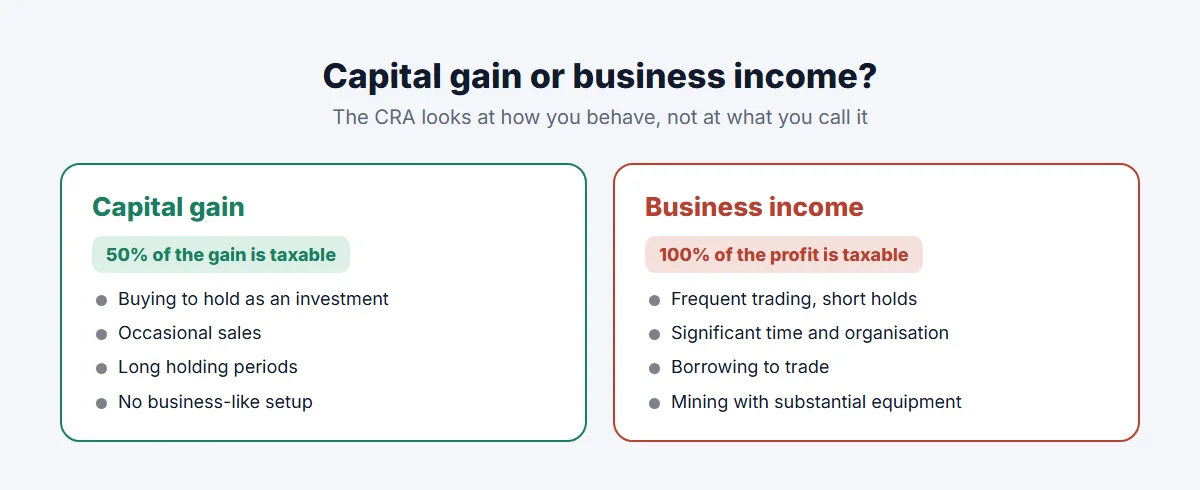
Most people who buy and hold are making capital investments. But the CRA can treat your activity as a business if it looks like one. Factors it considers include:
- how often you trade and how long you hold,
- the time you spend on it and how organised it is,
- whether you borrow to trade or promote yourself as a trader,
- mining with significant equipment.
Business income is fully taxable (100%, not 50%), but it also lets you deduct related expenses and, if you have losses, use them against other income. Day traders and miners should get professional advice on which category they fall into.
Staking, mining and other crypto income
Crypto you receive is generally income at its fair market value in Canadian dollars when you receive it. That includes staking rewards, crypto paid for work, and mining rewards. That value becomes the cost of those coins and is added to your ACB. When you later sell them, any change in value is a capital gain or loss. Tax on crypto staking rewards compares the rules in Canada, the US and the UK.
Capital losses and the superficial loss rule
Capital losses offset capital gains. If your losses exceed your gains for the year, you can carry the net loss back three years or forward indefinitely to use against capital gains.
Be careful with selling at a loss and buying back. Under the superficial loss rule, if you or an affiliated person, such as your spouse, buy the same coin within 30 days before or after the sale and still hold it 30 days after, the loss is denied and added to the cost of the new coins. Crypto tax loss harvesting explains how this compares with other countries.
How to report crypto on your Canadian return
- Capital gains and losses go on Schedule 3 of your T1 return, in the section for crypto-assets, with the taxable amount carried to line 12700.
- Business income from trading or mining goes on Form T2125.
- Other crypto income, such as occasional staking rewards, is reported as income.
- If you hold crypto considered foreign property with a total cost of more than $100,000, you may also need to file Form T1135. Whether crypto on a foreign exchange counts isn’t always clear-cut, so ask a professional if you’re near that level.
The usual filing deadline for individuals is 30 April. The CRA’s guide for crypto-asset users covers income, records and reporting, and its tip on reporting capital gains as a crypto-asset user shows where gains go. How to report crypto on your tax return walks through the process in general.
Records the CRA expects you to keep
For every transaction: the date, the type of transaction, the coin and amount, its value in Canadian dollars, the fees, wallet addresses or exchange used, and your running ACB. Keep exchange exports and receipts, and download them before closing an account. The CRA can obtain customer information from crypto platforms, and international reporting rules for exchanges are expanding, so your records should match what the platforms hold.
Ways to pay less, legally
- Hold for the long term and avoid frequent trading that could look like a business.
- Use capital losses, including carrying them back to recover tax from the previous three years.
- Consider a crypto ETF in a TFSA: gains inside a TFSA are tax-free, although you don’t own the coins directly. How to buy crypto in Canada compares the two routes.
- Give crypto to a registered charity after professional advice, since donating rather than selling can have tax advantages.
For comparison with other countries, see the guides on crypto tax in the US and crypto tax in the UK.