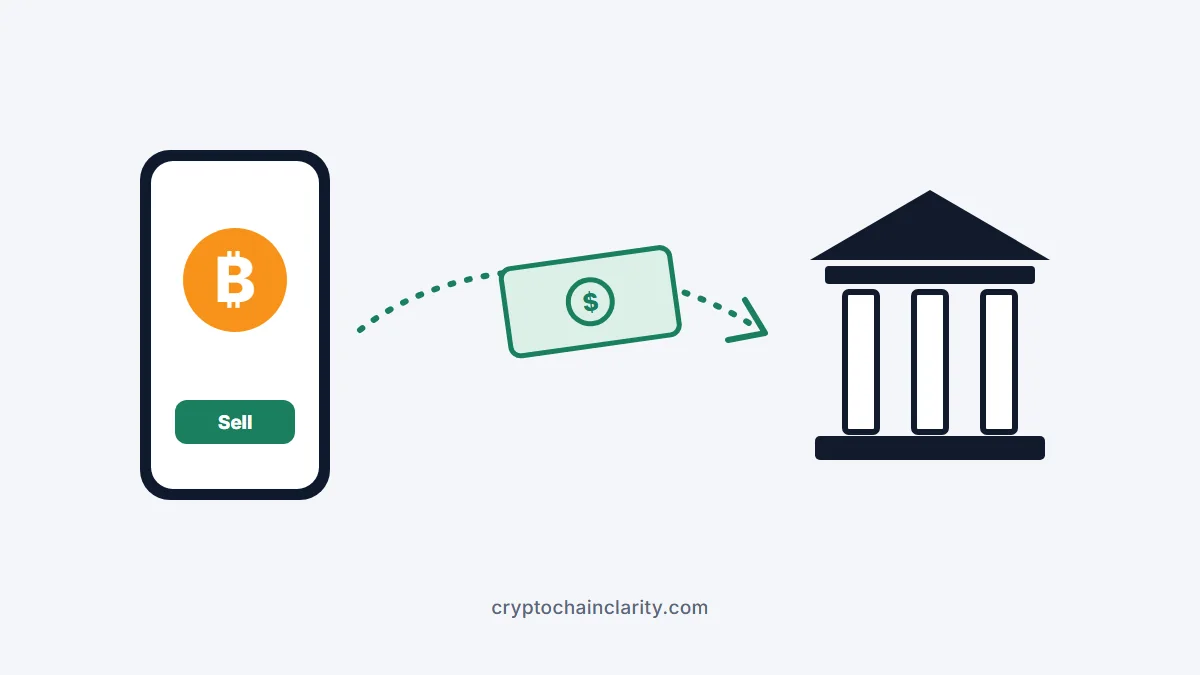
To withdraw crypto to your bank account, you sell it for regular money on an exchange, then transfer that cash to a bank account in your own name. It usually takes from a few minutes to a few business days. Done through a regulated exchange you already use, it’s routine. The surprises come from details: the coins sitting in the wrong place, a fee on the fast option, a holding period, a cautious bank, or a tax bill you didn’t plan for.
This guide covers the steps and then the problems that most often catch people out, so you can cash out without delays.
How to withdraw crypto to your bank account in three steps
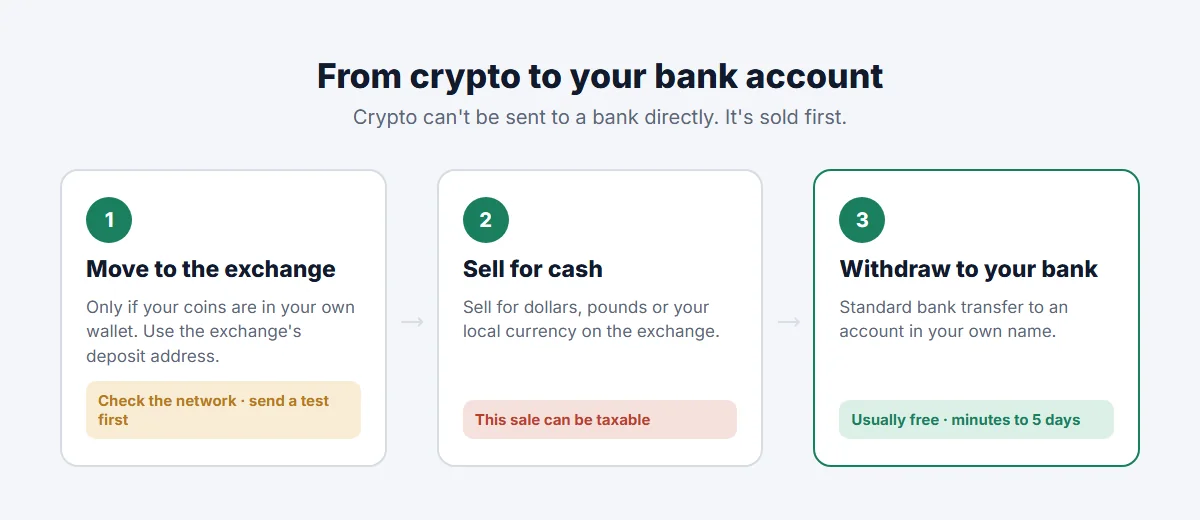
1. Get the crypto onto your exchange account
If your coins are already on the exchange where you bought them, skip this step. If they’re in your own wallet, such as a hardware wallet, you first send them to your exchange account:
- In the exchange, open Receive or Deposit for that coin and copy the deposit address.
- Check that the network matches the one you’re sending from. Sending a token on a network the exchange doesn’t support for that coin can mean losing it.
- Send a small test amount first, wait for it to arrive, then send the rest.
How to move crypto from Coinbase to a hardware wallet shows the same checks in the opposite direction.
2. Sell for your local currency
On the exchange, sell the crypto for dollars, pounds, euros or Canadian dollars. As when buying, the simple Sell button usually includes a spread, while a limit order on the advanced screen costs less. On larger amounts the difference can be significant. Crypto exchange fees explained shows how to compare.
If you only want to lock in a value without leaving crypto yet, some people sell to a stablecoin instead. That doesn’t put money in your bank, and in many countries it’s still a taxable sale.
3. Withdraw the cash to your bank
Choose Withdraw or Cash out, pick your linked bank account and confirm. The usual methods:
| Country | Usual method | Typical speed | Typical cost |
|---|---|---|---|
| US | ACH bank transfer | 1 to 5 business days | Often free |
| US | Wire transfer | Same or next day | Flat fee from the exchange and often your bank |
| US | Instant cash-out to a debit card | Minutes | A percentage fee |
| UK | Faster Payments | Minutes to hours | Free or low |
| Canada | Interac e-Transfer or EFT | Minutes to 2 days | Free or low on most platforms |
| Australia | Bank transfer (PayID or standard) | Minutes to 1 day | Free or low |
| Eurozone | SEPA transfer | Same day to 2 days | Free or low |
The exact fees and limits are shown on the withdrawal screen before you confirm. If speed doesn’t matter, the standard bank transfer is almost always the cheapest.
The surprises, and how to avoid them
Withdrawal holds
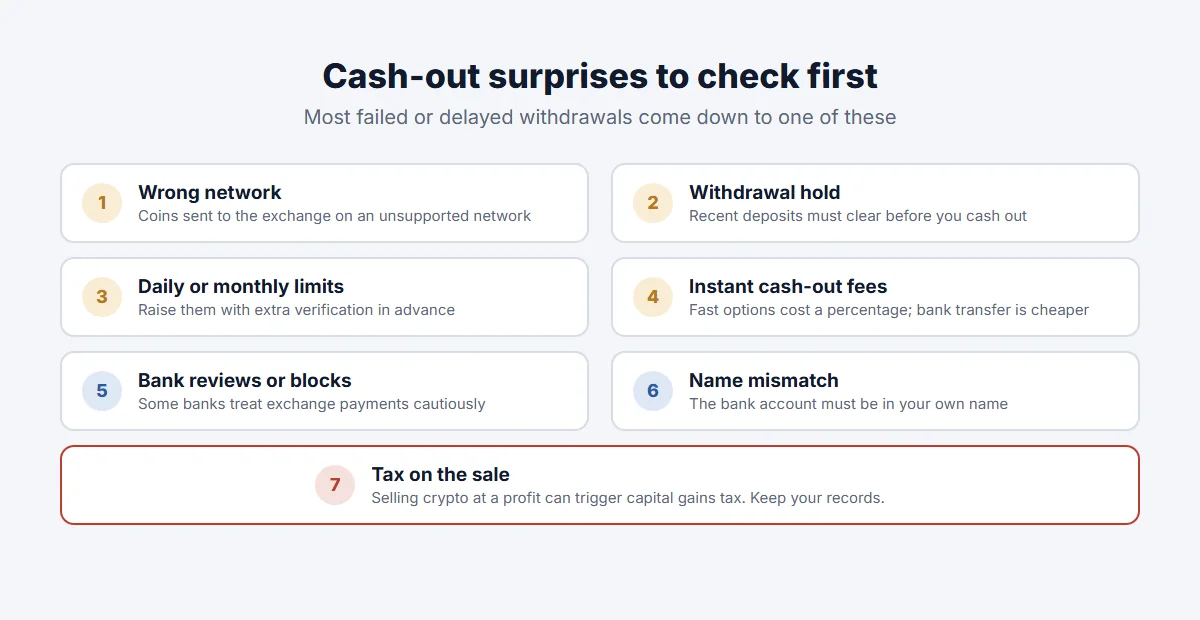
If you recently deposited money by bank transfer or card, the exchange may not let you withdraw cash until that deposit has fully cleared, which can take several days. It’s an anti-fraud rule, not a sign of trouble. The hold date is usually shown in your balance or transaction details.
Withdrawal limits
Exchanges set daily or monthly limits that depend on your verification level. For a large withdrawal, check your limits first and, if needed, complete extra verification before you need the money. Splitting a sale over a few days is common.
The bank account must be in your name
Exchanges only send money to accounts in the name on your exchange account. A joint account usually works; a friend’s or business account usually doesn’t. Mismatched names are a common reason for returned transfers.
Your bank may review the payment
Some banks treat money from crypto exchanges cautiously. In the UK in particular, several banks limit or block payments to and from exchanges, and others route them through extra checks. Before moving a large amount:
- Check your bank’s policy on crypto exchanges.
- Make sure the exchange is a well-known, regulated one.
- Keep records showing where the money came from: your original purchases and the sale.
If the bank asks, a simple history of buy and sell transactions usually answers the question.
Tax on the sale
Selling crypto is a taxable event in the US, UK, Canada, Australia and most other countries. If you sell for more than you paid, you may owe capital gains tax. The withdrawal itself isn’t taxed; the sale is. Keep the exchange’s transaction history and see our crypto taxes guide for what counts and how gains are calculated.
Selling at a bad moment
Prices can move while your coins travel from a wallet to the exchange. If you need a specific amount by a specific date, move the coins a little earlier, or sell part and withdraw in stages.
Avoid these cash-out traps
- Platforms that ask you to pay a “withdrawal fee” or “tax” before releasing your funds. This is the classic final step of investment scams. A real exchange deducts fees from your balance; it doesn’t ask you to send more money. The US Federal Trade Commission lists this among the signs of crypto scams. Common crypto scams explains how these schemes work.
- Strangers offering to buy your crypto for cash or bank transfer outside a regulated platform. Peer-to-peer trades carry real risks of fraud and reversed payments.
- Bitcoin ATMs for selling. Where they allow sales, the rates are usually poor.
- “Support” contacting you about a stuck withdrawal. Contact the exchange only through its official app or website.
Quick checklist before a large withdrawal
- The coins are on your exchange account, sent on the right network.
- Any recent deposit has cleared and you’re within your withdrawal limits.
- Your bank account is in the same name as your exchange account.
- You’ve checked how your bank treats exchange payments.
- You’ve chosen limit orders or the advanced screen to sell, if the amount is large.
- You’ve saved your transaction history for tax.
If you haven’t picked an exchange yet, Coinbase vs Kraken compares two common choices, and is it safe to keep crypto on an exchange? explains why it’s best not to leave coins there longer than you need.