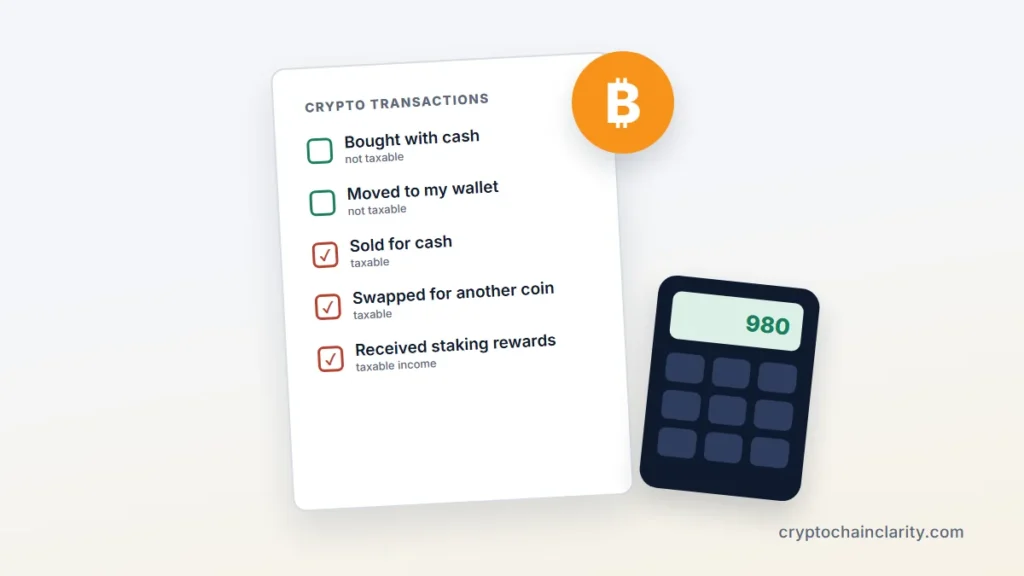
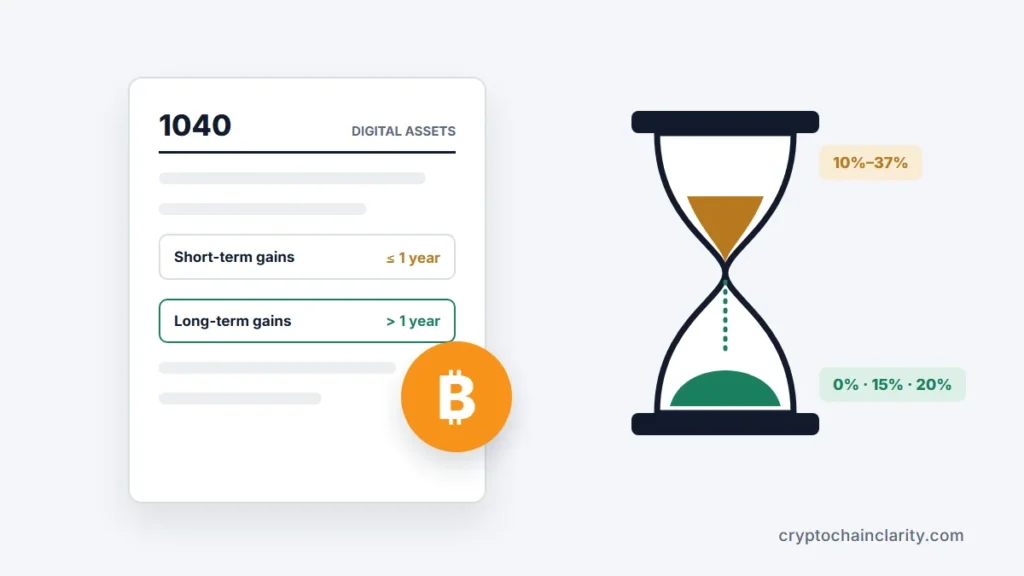
Yes. In the US, UK and Canada, tax on crypto staking rewards is generally due as income when you receive the rewards, based on their value in your local currency at that moment. Later, when you sell, swap or spend those rewarded coins, any rise or fall in value since you received them is a capital gain or loss. So staking can create two tax events from the same coins: income first, capital gains later.
This guide explains how that works in each country, with an example, plus the records you need and the situations where the answer is less clear.
General information, not tax advice. Staking rules are still developing; check your tax authority’s guidance or a professional.
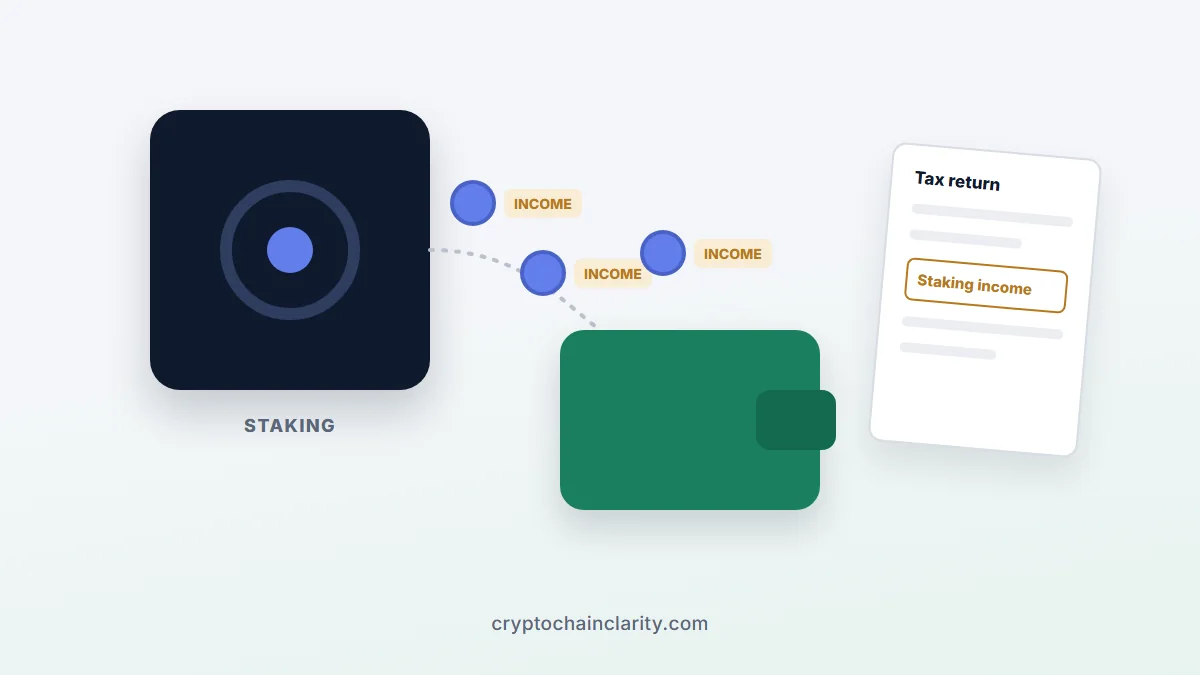
How staking rewards are taxed: two steps
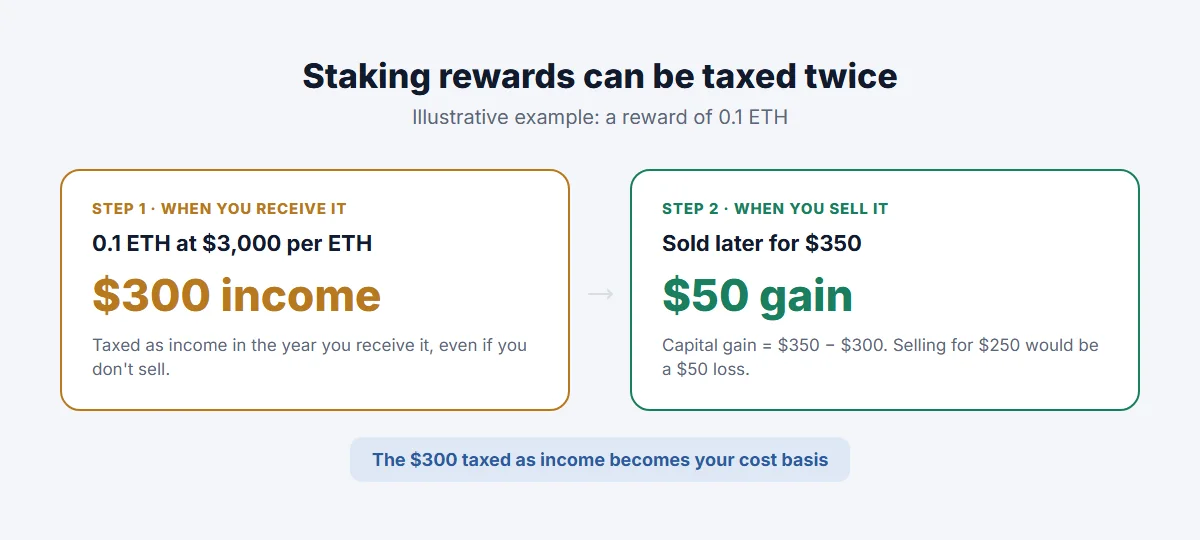
Take a simple example with illustrative prices. You stake ether and receive a reward of 0.1 ETH when ETH is worth $3,000.
- When you receive it: the reward is worth $300, so $300 is income for that tax year, even if you never sell.
- The $300 becomes your cost basis for that 0.1 ETH.
- When you sell it: if you later sell the 0.1 ETH for $350, you have a $50 capital gain. If you sell for $250, you have a $50 capital loss.
The awkward part is that if prices fall after you receive rewards, you can owe income tax on a value you never actually had in your pocket. The later capital loss helps, but it may not offset income in the same way. Many people who stake sell a portion of their rewards over the year to cover the tax.
Staking rewards tax in the US, UK and Canada
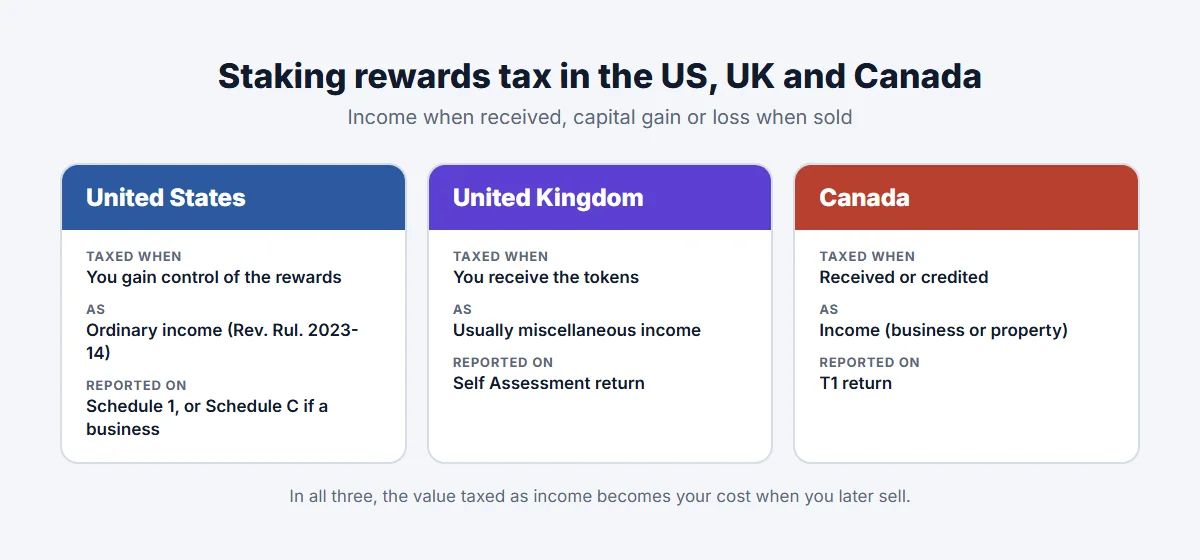
| United States | United Kingdom | Canada | |
|---|---|---|---|
| When it’s taxed | When you gain control of the rewards | When you receive them | When they’re received or credited |
| Type of income | Ordinary income | Usually miscellaneous income; trading income if run as a business | Generally income (business or property, depending on the facts) |
| Value used | Fair market value in dollars at that time | Sterling value at that time | Fair market value in Canadian dollars at that time |
| Where it’s reported | Schedule 1 (or Schedule C if it’s a business) | Self Assessment, income section | T1 return, usually other income or business income |
| When you sell later | Short- or long-term capital gain from that value | Capital gain, with the reward added to your pool for that token | Capital gain, half of which is taxable |
United States
The IRS set out its position in Revenue Ruling 2023-14: staking rewards are included in gross income in the year you gain “dominion and control” over them, meaning when you can sell, transfer or otherwise use them. The amount is their fair market value at that time. The IRS’s digital assets page lists staking rewards among the transactions you must report.
If you stake through an exchange, it may send you a Form 1099-MISC once your rewards reach $600 for the year. Below that, you still owe tax on them; the form just isn’t issued. How is crypto taxed in the US? explains the capital gains side when you later sell.
United Kingdom
HMRC’s cryptoassets manual treats staking returns as taxable income. For most individuals, that’s miscellaneous income, valued in pounds when you receive the tokens. If your staking amounts to a trade, it’s trading income instead. Any appropriate expenses can reduce the taxable amount.
When you later dispose of the tokens, the value you were taxed on is your cost, and the usual Capital Gains Tax rules apply, including HMRC’s pooling rules. Crypto tax in the UK covers those.
Canada
The Canada Revenue Agency’s guidance treats rewards from staking as income at their fair market value when received. Whether that’s business income or property income depends on your circumstances; a large validator operation looks more like a business than occasional staking through a platform. When you later sell, half of any capital gain is taxable. The CRA’s guide for crypto-asset users has the details.
Situations where it’s less clear
Liquid staking tokens. Swapping ETH for a liquid staking token such as stETH or cbETH may itself be treated as a disposal of your ETH in some countries, because you receive a different token. Whether the token grows in number or in value also affects how rewards are recognised. If you use liquid staking, get specific advice.
Locked rewards. Some networks lock rewards for a period. In the US, the “dominion and control” test means timing can depend on when you’re actually able to use them.
Slashing. If a validator is penalised and you lose part of your stake, how you treat that loss depends on your country and whether you’re running a business. Keep records of any slashing events.
Rewards through a platform vs your own node. Staking through an exchange and running your own validator are usually treated the same way for the rewards themselves, but running a validator is more likely to be seen as a business, with different forms and possible self-employment tax in the US.
Our guide to what crypto staking is explains these staking methods if you’re not sure which one you use.
Records to keep
Rewards often arrive daily or even more often, which means hundreds of small income events a year. For each one you need:
- the date and time received,
- the amount of tokens,
- their value in your local currency at that moment,
- which wallet or platform received them.
Exchanges usually provide a rewards report you can download. If you stake from your own wallet, tracking it by hand is impractical; best crypto tax software compares tools that import staking rewards and value them automatically.
Tax on crypto staking rewards: the short answer
Staking rewards are taxable income when you receive them, at their value then, in the US, UK and Canada. That value becomes your cost basis, and selling later creates a separate capital gain or loss. Set aside part of your rewards for tax, keep a record of every reward, and check the specific rules if you use liquid staking or run a validator. For the full picture of what’s taxable in crypto, see crypto taxes explained.