

Crypto scams work because crypto payments are fast, global and almost impossible to reverse. Once you send coins to a scammer, there’s usually no bank, card company or customer service desk that can get them back. That makes spotting a scam before you pay the only real protection.
The scale is huge. According to the FBI’s latest Internet Crime Report, Americans reported about $11.4 billion in crypto-related losses in 2025, more than half of all reported internet crime losses. Fake investment schemes alone accounted for about $7.2 billion, and people aged 60 and over lost around $4.4 billion.
The good news: almost every crypto scam follows a handful of patterns. Learn the warning signs below and the ten scams that follow, and you’ll recognize most attempts long before they cost you anything.
The six warning signs behind almost every crypto scam
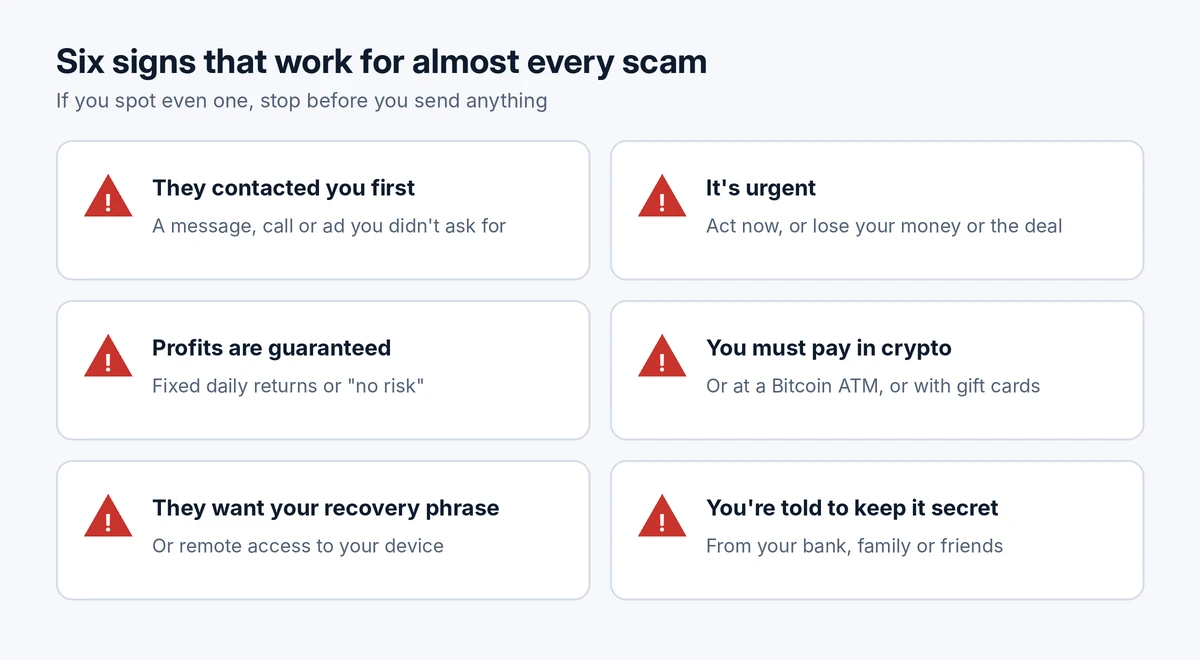
You don’t need to memorize every scam. If a situation includes even one of these signs, stop before you send anything, and talk to someone you trust.
1. Fake investment platforms (“pig butchering”)
This is the most costly scam by far. It usually starts with a “wrong number” text, a dating app match or a friendly social media contact. Over weeks, the scammer builds a relationship, then mentions how well they’re doing trading crypto and offers to show you how.
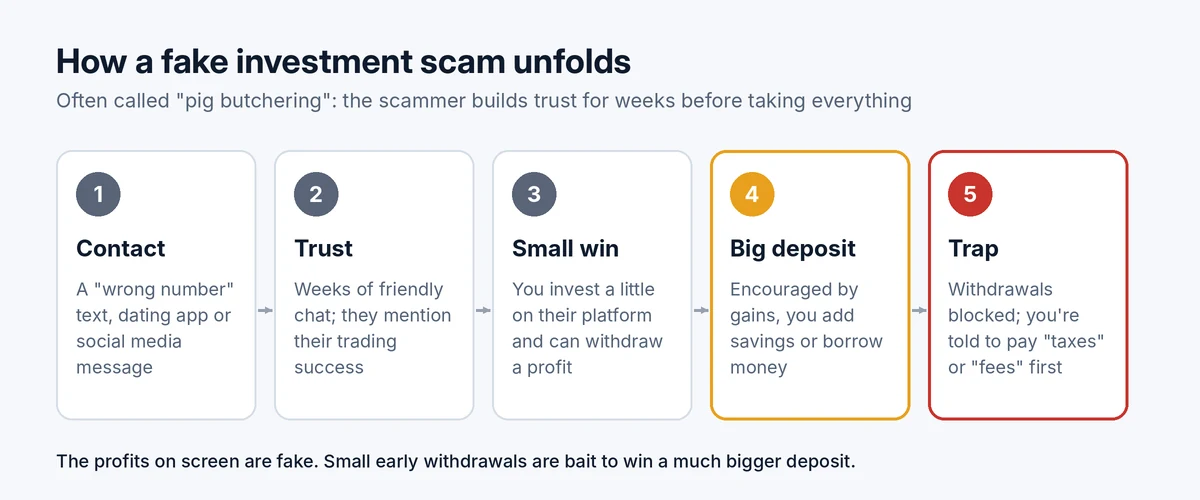
You’re directed to a professional-looking website or app where your “investment” appears to grow quickly. You may even be allowed to withdraw a small amount, which builds confidence. Then, when you deposit a large sum, withdrawals stop and you’re told to pay “taxes” or “fees” to release your money. Those payments disappear too. The platform was never real.
How to spot it: investment advice from someone you’ve only met online, a trading platform you can’t find through independent sources, and pressure to invest more. US regulators describe this exact pattern in their investor alert on crypto scams.
2. Fake customer support and impersonation
Scammers pose as your exchange, wallet company, bank or even a government agency. They might reply to your public complaint on social media, call you claiming your account was hacked, or message you in a crypto community. Their goal is to get your recovery phrase, your login codes or remote access to your computer, or to persuade you to move your funds to a “secure” wallet that they control.
How to spot it: real companies never ask for your recovery phrase, never ask you to move funds to protect them and rarely contact you first. If someone does, end the conversation and contact the company yourself through its official app or website. Your phrase should never leave your hands: see how to store a seed phrase safely.
3. Phishing sites and fake wallet apps
Copycat websites and apps imitate real exchanges and wallets, often appearing in paid search results or app stores. Phishing emails warn that your wallet is “locked” or needs “verification” and link to a fake page. Anything you type there, including your login details or recovery phrase, goes straight to the scammer.
How to spot it: check the web address carefully, bookmark the official sites you use and download apps only through links on the company’s verified website. Be suspicious of any message that pressures you to act immediately.
4. Wallet drainers and malicious approvals
On crypto apps, you often “approve” a smart contract to use your tokens. Malicious sites trick you into approving a contract that lets them take everything of a certain token, or sign a message that hands over control. These sites are often promoted through fake airdrops, free NFT mints or hijacked social media accounts.
How to spot it: be wary of “claim your free tokens” links, read what you’re approving in your wallet before signing, and use a separate wallet with a small balance for trying new apps. A hardware wallet helps, but only if you actually read what it asks you to confirm.
5. Giveaway and “doubling” scams
A video, post or livestream appears to show a famous person or company promising to send back double whatever crypto you send. These now often use AI-generated deepfakes of real celebrities and executives.
How to spot it: nobody gives away free money in exchange for you sending them crypto first. Any offer to “send 1, get 2 back” is a scam, no matter who seems to endorse it.
6. Rug pulls and pump-and-dumps
New tokens are hyped on social media with promises of huge gains. In a pump-and-dump, promoters buy early, drive up the price with hype, then sell to the latecomers. In a rug pull, the creators drain the money from the project or trading pool and disappear, leaving holders with worthless tokens.
How to spot it: anonymous teams, a few wallets holding most of the supply, no real product and marketing that’s all about price. Our seven-question checklist in how to tell a real project from a hype coin covers how to check, and crypto market cap explained shows why a “cheap” coin can still be a bad deal.
7. Bitcoin ATM scams
A caller claims to be from your bank, a government agency or tech support and says your money is in danger. You’re told to withdraw cash and deposit it into a Bitcoin ATM, scanning a QR code they send you, to “protect” it. The QR code belongs to the scammer. These scams hit older adults hardest: the US Federal Trade Commission reported that people over 60 were more than three times as likely to report losing money to Bitcoin ATM scams.
How to spot it: no real business or government agency will ever ask you to pay with a Bitcoin ATM. If a call tells you to withdraw cash to keep it safe, hang up.
8. Address poisoning
After you make a transfer, scammers send a tiny or zero-value transaction to your wallet from an address that looks almost identical to one you use, with the same first and last few characters. The next time you copy an address from your transaction history, you might grab theirs by mistake and send your funds to the scammer.
How to spot it: never copy addresses from your transaction history. Use saved, verified addresses or your wallet’s address book, and check the whole address, not just the start and end. If funds already went to the wrong place, see crypto sent to the wrong address.
9. Job and “task” scams
You’re offered easy remote work, such as rating products, liking videos or “optimizing” apps, paid in crypto. At first, small payments arrive. Then you’re told you need to deposit your own crypto to unlock bigger tasks or withdraw your earnings. The deposits are never returned.
How to spot it: a real job never requires you to pay to get paid. Any job that asks you to deposit crypto is a scam.
10. Recovery scams
After losing money, victims are often targeted a second time. Someone offers to recover the stolen crypto, sometimes posing as a lawyer, a blockchain investigator or even a government agency, in exchange for an upfront fee. They take the fee and disappear.
How to spot it: be very skeptical of anyone who contacts you offering to recover lost crypto, especially if they ask for payment upfront or claim special access to the blockchain. Report losses to the authorities and work with your own lawyer if needed.
If you’ve been scammed
- Stop sending money, including any “fees” to release your funds.
- Secure your accounts. If you shared a recovery phrase, move any remaining funds to a new wallet with a new phrase immediately. Change passwords and turn on app-based two-factor authentication.
- Contact the exchange you sent from. They can’t reverse blockchain transactions, but they may be able to flag the receiving address, especially if it belongs to another exchange.
- Report it. In the US, report to the FBI at ic3.gov and the FTC at ReportFraud.ftc.gov. In the UK, report to Action Fraud. Keep records: addresses, transaction IDs, screenshots and messages.
- Watch out for recovery scams that follow.
Being scammed isn’t a sign of being foolish. These operations are run by organized groups who are very good at what they do. Talking about it, with family, friends or a professional, also helps protect others.
Habits that keep you safe
- Keep your recovery phrase offline and never share it with anyone, for any reason.
- Buy and sell only through reputable, regulated exchanges you reached by typing the address yourself. See how to buy crypto safely.
- Keep long-term savings in a hardware wallet, as explained in crypto wallets explained.
- Use app-based two-factor authentication and a withdrawal allowlist on exchange accounts. More in is it safe to keep crypto on an exchange?
- Pause before acting on any unexpected message. Scammers rely on urgency; time is your best defense.
This article is for educational purposes only and isn’t legal or financial advice.
Pingback: Ledger vs Trezor: Which Hardware Wallet Is Better for Beginners?
Pingback: Bitcoin vs Ethereum: The Real Difference for Beginners
Pingback: Best Crypto Wallets for Beginners (2026): 7 Options Compared
Pingback: Is It Safe to Keep Crypto on an Exchange? Risks Explained
Pingback: How to Store a Seed Phrase Safely (and Mistakes That Get People Robbed)