

When the last bitcoin is mined, around the year 2140, the network keeps running exactly as before. Transactions still get processed, coins can still be sent and bought, and miners still secure the network. The only thing that changes is how miners are paid: instead of earning newly created bitcoin plus transaction fees, they’ll earn transaction fees alone.
Whether those fees will be enough to keep the network secure is a genuine open question, and the most interesting part of the topic. This article covers when the supply actually runs out, why it takes so long, what happens to miners, the debate over Bitcoin’s long-term security and what any of it means for you as a holder today.
When will the last bitcoin actually be mined?
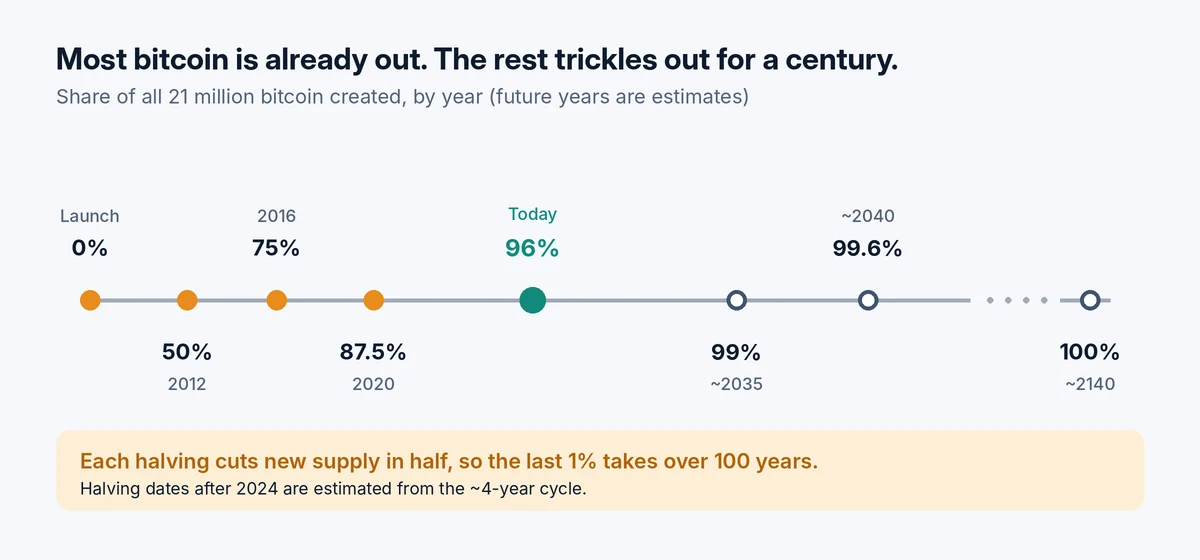
Not for a long time, though most of the supply is already out. New bitcoin is created as a reward for each block, and that reward halves every 210,000 blocks, roughly every four years. Because each halving cuts the flow of new coins in half, the supply approaches 21 million faster and faster at first, then more and more slowly.
| Period (approx.) | New bitcoin per block | Share of all bitcoin created by the end |
|---|---|---|
| 2009–2012 | 50 | 50% |
| 2012–2016 | 25 | 75% |
| 2016–2020 | 12.5 | 87.5% |
| 2020–2024 | 6.25 | 93.75% |
| 2024–2028 (current) | 3.125 | 96.9% |
| 2028–2032 | 1.5625 | 98.4% |
| 2032–2036 | 0.78125 | 99.2% |
| Around 2140 | 0 | 100% |
Just over 20 million bitcoin exist today. By the mid-2030s, more than 99% will have been created, and the last 1% will then take over a century to trickle out. In practical terms, the supply will be almost fixed long before 2140.
One detail people find surprising: the total will never quite reach 21 million. Because rewards are rounded down to the smallest unit, a satoshi (one hundred-millionth of a bitcoin), the final supply works out at just under 21 million, about 20,999,999.98 bitcoin. The difference is too small to matter, but it’s a nice example of how exactly the rules are written into the code. The halving schedule itself is covered in what a Bitcoin halving is.
What happens to miners once all bitcoin is mined
Miners spend money on hardware and electricity to add blocks and secure the network. Today, they’re paid in two ways:
- The block subsidy: newly created bitcoin, currently 3.125 per block.
- Transaction fees: paid by users to get their transactions included.
Right now, the subsidy is almost everything. In 2026, transaction fees have made up less than 1% of miners’ revenue for long stretches. Once the subsidy disappears, fees will be miners’ only income.
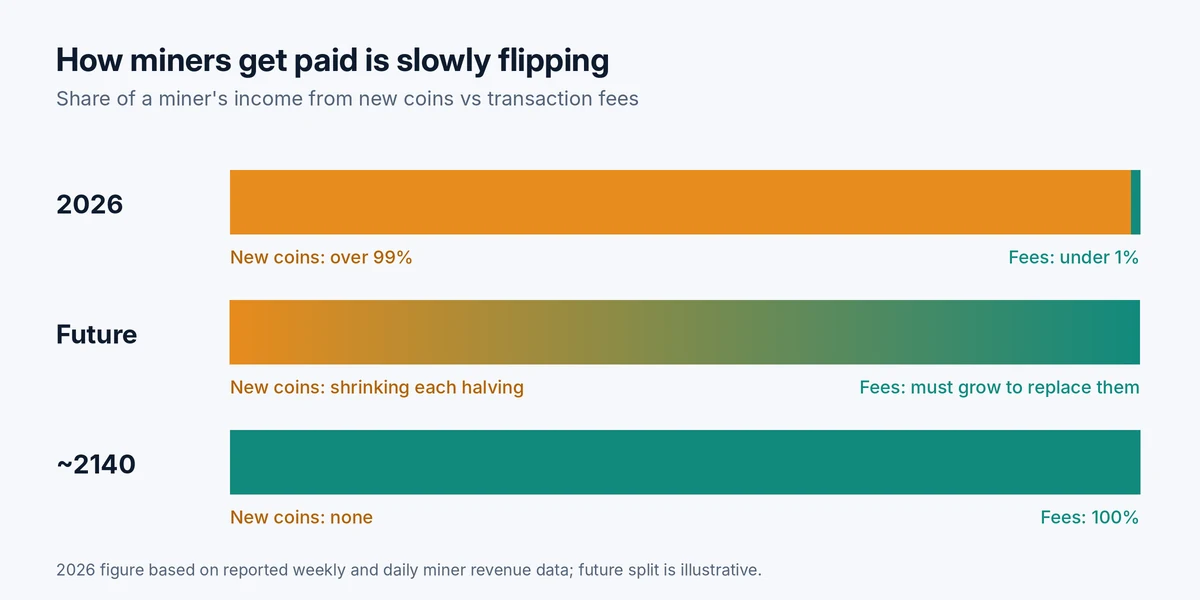
This shift was part of Bitcoin’s design from the start. The original Bitcoin whitepaper describes it directly: once a set number of coins is in circulation, the incentive for miners can move entirely to transaction fees. It also won’t happen overnight. Each halving shrinks the subsidy gradually, so miners, users and the fee market have more than a century to adjust.
The real debate: will fees be enough?
Here’s the question serious Bitcoin researchers actually argue about. The more miners earn, the more computing power they can afford to point at the network, and the more expensive it becomes to attack. People call this the security budget. If fees stay tiny after the subsidy is gone, miners would earn far less, some would switch off, and in theory the network could become cheaper to attack.
There are three broad views on how this plays out:
1. Fees rise to fill the gap
The optimistic view is that demand for space in Bitcoin’s blocks will grow as more people and institutions use it, especially for large, high-value transfers that justify meaningful fees. Since each block has limited space, competition for it would push fees up. Supporters also point out that if bitcoin’s price is much higher in the future, even small fees in bitcoin terms could be worth a lot in dollars.
2. Security adjusts downwards, and that’s fine
A second view accepts that mining revenue may fall, but argues the network would still be very hard to attack. Mining difficulty adjusts automatically to the amount of computing power, so blocks keep coming, and an attack would still require enormous resources.
3. The rules change
A minority have suggested adding a small, permanent reward (a “tail emission”) so miners always earn something. That would mean breaking the 21 million cap, which is the property most holders value most. Any such change would need overwhelming agreement from the people running the network, and there’s currently very little support for it. Most people treat the cap as effectively permanent.
Nobody knows which view will prove right, and anyone who tells you with certainty is overstating their case. What helps is the timeline: the subsidy halves gradually over the next century, so there will be plenty of evidence along the way about whether fees are keeping up.
Things that won’t happen
Some common worries about what happens once all bitcoin is mined are based on misunderstandings:
- “The network will shut down.” No. Blocks don’t depend on new coins. As long as miners find it worth processing transactions for fees, the network runs normally.
- “You won’t be able to buy bitcoin anymore.” You’ll be able to buy it from existing holders, the same way most people buy it today. Exchanges don’t get their bitcoin from miners directly.
- “The price will automatically skyrocket.” A fixed supply doesn’t guarantee a rising price. Price depends on demand. By 2140, new supply will have been tiny for over a century, so the final coin itself will barely register.
- “We’ll run out of bitcoin to use.” Each bitcoin divides into 100 million satoshis, so even a fixed supply can handle transactions of any size.
What it means for you as a holder
For anyone holding bitcoin today, 2140 is far beyond any realistic time horizon. What’s more relevant is the trend that’s already happening: new supply keeps shrinking with each halving, and around 96% of all bitcoin already exists. That predictable, shrinking issuance is a big part of why people call bitcoin “digital gold”, as explained in what is Bitcoin and why does it have value.
Two practical points are worth knowing:
- Lost coins make the real supply smaller. Bitcoin whose keys are lost can never move again. That means the usable supply is already below the official figure, and every lost coin is gone for good. Protecting your own coins starts with storing your seed phrase safely.
- Fees may matter more in the future. If fees rise over time, small, frequent on-chain transfers could become more expensive, and more everyday payments may move to faster layers built on top of Bitcoin, such as the Lightning Network. What is a Layer 2? explains how those work. If a transaction ever gets stuck because the fee was too low, see what to do when a Bitcoin transaction is unconfirmed.
Quick answers
Can more than 21 million bitcoin ever be created?
Only if the people running Bitcoin’s software agreed to change the rules, and the cap is the feature most holders care about most. It’s technically possible but very unlikely.
Why is the end date 2140 and not sooner?
Because each halving cuts the reward in half, the amounts become tiny but never jump straight to zero. It takes 33 halving periods, about 132 years from launch, for the reward to fall below one satoshi.
Will mining stop being profitable?
Not necessarily. Mining difficulty adjusts to the number of miners, so if some switch off, it becomes easier and cheaper for the rest. Whether it stays profitable depends on fees and the price of bitcoin.
Does Ethereum have the same limit?
No. Ether has no maximum supply, and its supply can rise or fall depending on network activity. Bitcoin vs Ethereum compares the two approaches.
New to Bitcoin? Our plain-English guide to how crypto works covers how mining and transactions fit together, and proof of work vs proof of stake explains why Bitcoin needs miners at all.
This article is for educational purposes only and isn’t financial or investment advice.
Pingback: What Is Bitcoin and Why Does It Have Value? Explained Simply