A crypto withdrawal on hold is usually a routine safety measure, not a sign that something has gone wrong. The most common reasons are a recent deposit or purchase that hasn’t fully cleared, a recent security change such as a new password or two-factor device, a new withdrawal address, incomplete identity verification, or a compliance check on a large or unusual transfer. Most holds lift on their own, and the exchange usually shows when.
The exceptions are worth knowing too: an exchange that freezes everyone’s withdrawals, or a “platform” asking you to pay a fee to release your money. This guide explains how to tell the difference.
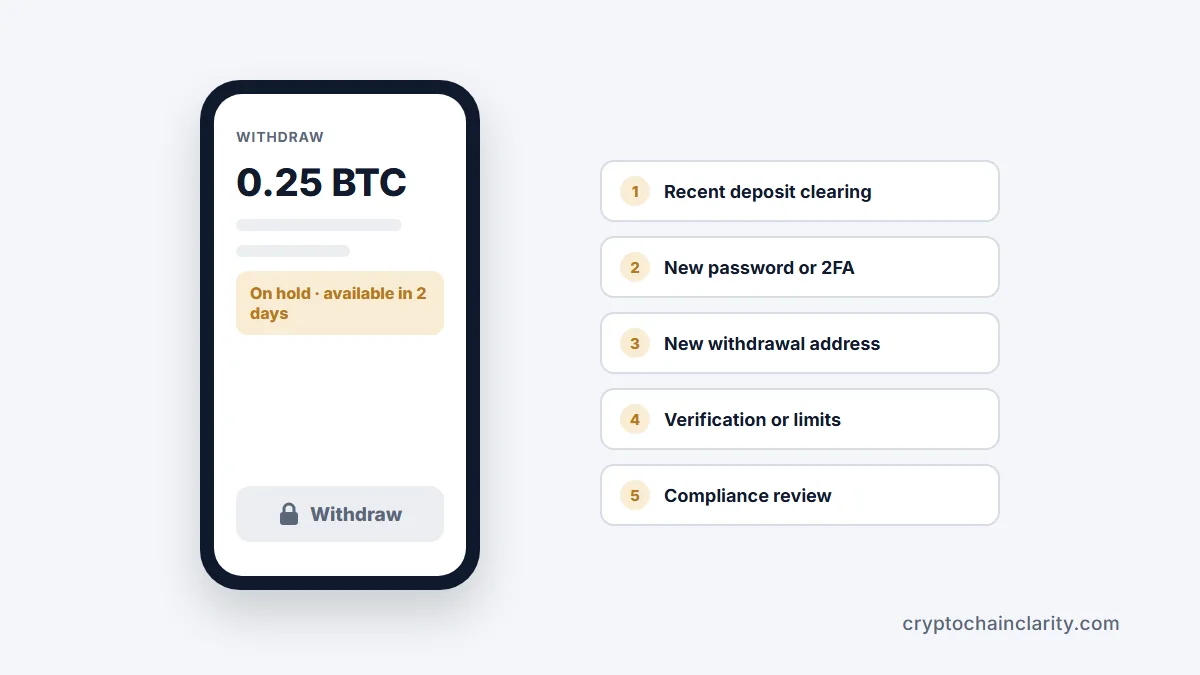
Common reasons a withdrawal is on hold
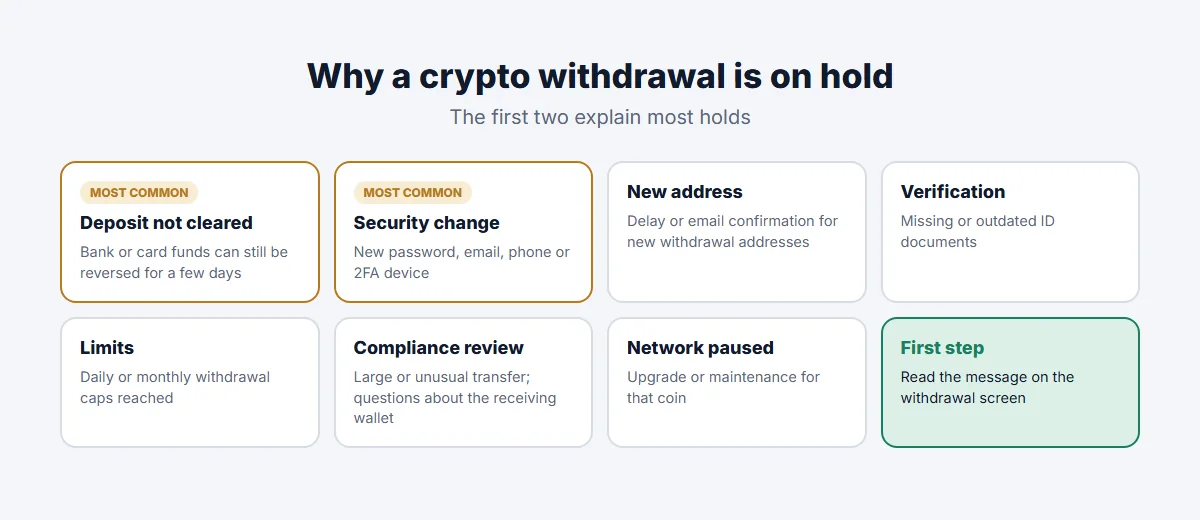
1. A recent deposit or purchase hasn’t cleared
Bank transfers can be reversed for several days after they appear in your account, and card payments can be disputed. To protect against fraud, exchanges stop you withdrawing crypto or cash bought with those funds until they’re final. You can usually still trade, just not withdraw.
For example, Kraken’s withdrawal holds page explains that card and digital wallet purchases may carry a 72-hour withdrawal hold, and that holds also apply to funds from ACH bank deposits. Coinbase similarly places holds on purchases made by bank transfer, showing the date funds become available before you confirm. The exact length depends on the exchange, the payment method and your account history.
2. You recently changed your security settings
Changing your password, email, phone number or two-factor authentication device often triggers a temporary withdrawal lock, typically from 24 hours to a few days. It’s there so that if someone hijacked your account and changed the login, they can’t immediately empty it.
3. You added a new withdrawal address
Many exchanges delay withdrawals to newly added addresses, or require you to confirm the address by email first. If you use an address allowlist, a new entry may only become active after a waiting period.
4. Your verification isn’t complete
Withdrawal limits often depend on your verification level. If you haven’t completed every step, or the exchange asks for an updated document, withdrawals can be blocked or capped until you do.
5. You’ve reached a limit
Daily or monthly withdrawal limits are common. A large withdrawal may need to be split or wait until the next period, or you may be able to raise the limit by completing extra verification.
6. A compliance review
Large or unusual transfers can be held for a manual review. Under “travel rule” requirements in the UK, EU and elsewhere, exchanges may also ask who owns the receiving wallet, and whether it’s your own self-custody wallet or another platform, before releasing a transfer. Answer through the exchange’s official app; it’s a normal request.
7. The network or coin is paused
Exchanges sometimes suspend withdrawals of a specific coin during network upgrades, congestion or wallet maintenance. A notice is usually shown on the withdrawal screen or the exchange’s status page.
What to do, step by step
- Read the message on the withdrawal screen. It often states the reason and the time the hold ends.
- Check your email and notifications from the exchange for verification requests or security alerts.
- Check the exchange’s status page for paused networks or maintenance.
- Wait out a timed hold. A withdrawal on hold because of a deposit or a security change can’t usually be lifted early.
- Contact support only through the official app or website, with your account email and any transaction IDs. Avoid phone numbers found in search results or social media; fake “support” numbers are a common scam.
If you were trying to move crypto to your own wallet, you can still prepare: set up the wallet, write down the recovery phrase and test the address with a small amount once the hold lifts. How to move crypto from Coinbase to a hardware wallet walks through it. If you were cashing out to a bank, how to withdraw crypto to your bank account covers the other common delays.
Withdrawal on hold: normal or a red flag?
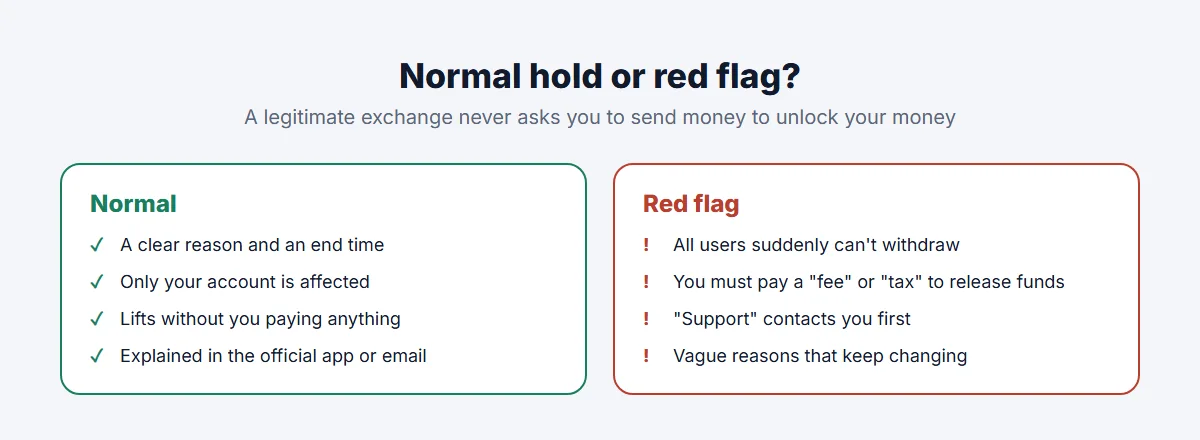
Normal: the hold has a clear reason, an end date, applies to your account only, and lifts without you paying anything.
Red flags:
- Everyone is affected. If an exchange suddenly halts all withdrawals with vague explanations, take it seriously. That’s how several platform failures started, including FTX in 2022. Follow official news, and consider whether you’re comfortable keeping funds there. Is it safe to keep crypto on an exchange? explains the risks.
- You’re asked to pay to unlock your funds. A “withdrawal fee”, “tax” or “verification deposit” that must be paid separately before you can withdraw is the classic final stage of an investment scam. Real exchanges deduct fees from your balance. Common crypto scams explains how these schemes work.
- “Support” contacts you first, by phone, text or social media, offering to fix the hold.
How to avoid holds next time
- Fund purchases by bank transfer well before you plan to withdraw.
- Make security changes when you don’t need to move funds soon.
- Add and verify withdrawal addresses in advance.
- Complete full verification once, early.
- For large amounts, check your withdrawal limits before you need the money.
If you’re choosing a platform, Coinbase vs Kraken compares two large exchanges, including how they handle fees and security.