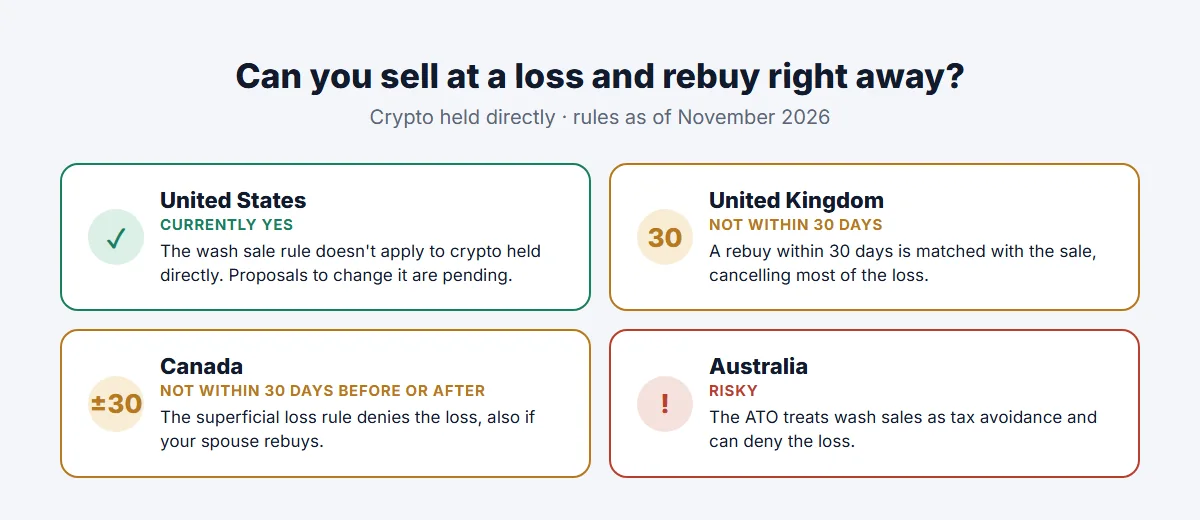
Crypto tax loss harvesting means selling crypto that’s worth less than you paid, so the loss reduces the tax on your other gains. If you still believe in the coin, you can buy it back afterwards. In the US, crypto held directly isn’t currently covered by the wash sale rule, so you can rebuy straight away. In the UK, Canada and Australia, rules or anti-avoidance enforcement make an immediate buyback ineffective or risky.
Done well, it can cut a real tax bill. Done carelessly, it creates paperwork and trading costs, and only delays tax rather than avoiding it. Here’s how it works and when it’s worth doing.
General information, not tax advice. Anti-avoidance rules are applied case by case; check with a professional before acting on a large loss.
How crypto tax loss harvesting works
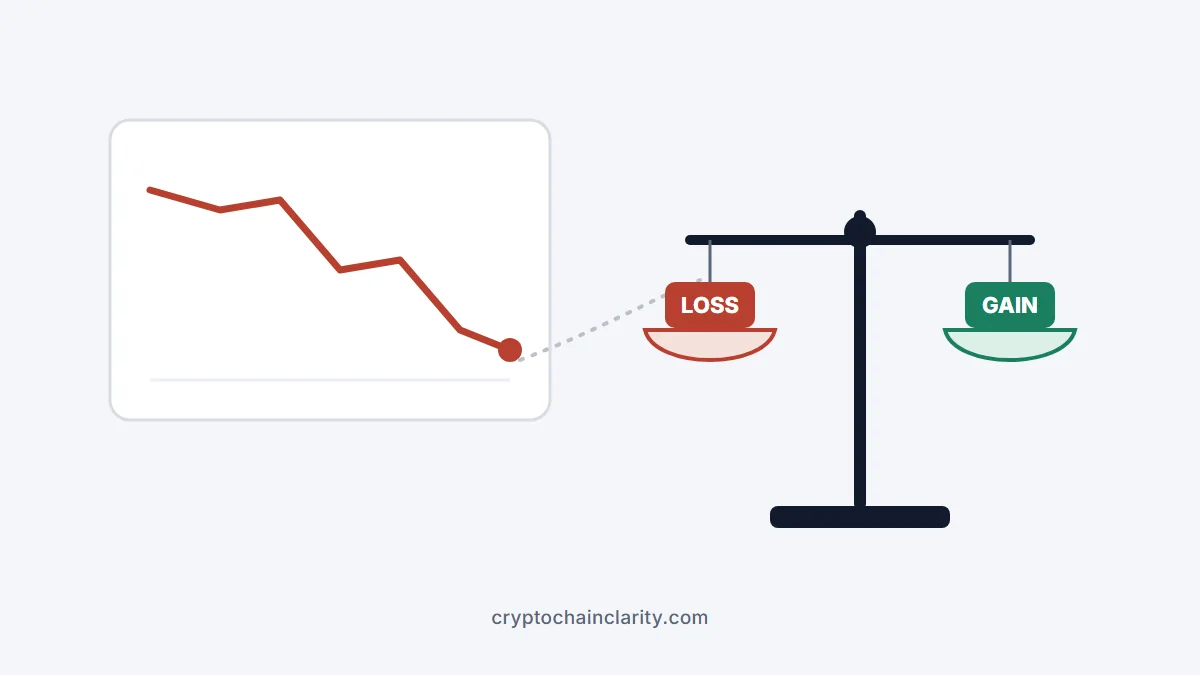
A loss only counts for tax when it’s realised, meaning you dispose of the crypto. A coin that has fallen in value but still sits in your wallet has an unrealised loss, which does nothing for your tax return.
Harvesting turns that paper loss into a realised one:
- Find holdings worth less than their cost basis.
- Sell them, or swap them for another coin, before the end of the tax year.
- Use the realised loss against your capital gains for the year.
- Optionally, buy back the same coin or a similar one, subject to your country’s rules.
A worked example
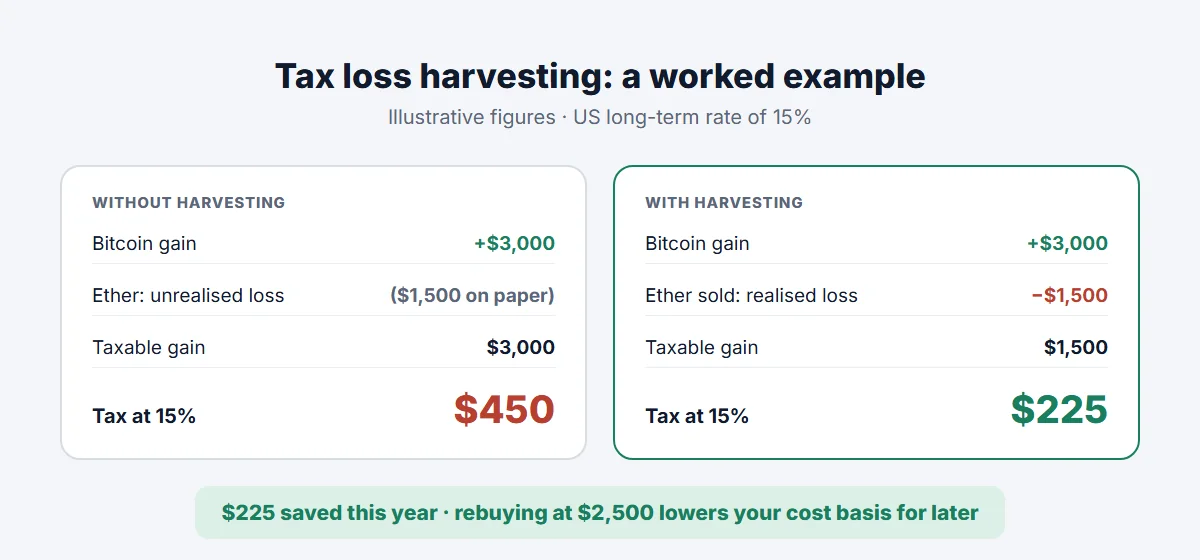
Say that this year, you sold bitcoin for a $3,000 long-term gain. You also hold ether you bought for $4,000 that’s now worth $2,500.
- Without harvesting: you pay tax on the $3,000 gain. At a 15% long-term rate, that’s $450.
- With harvesting: you sell the ether, realising a $1,500 loss. Your net gain falls to $1,500, and the tax to $225. You saved $225.
If your losses exceed your gains, US rules let you deduct up to $3,000 of net capital losses against other income each year and carry the rest forward. Other countries also allow losses to be carried forward, with their own conditions.
The catch: you’re often deferring, not avoiding
If you buy the ether back at $2,500, your new cost basis is $2,500 instead of $4,000. When you eventually sell at a profit, your gain will be $1,500 larger than it would have been. In effect, you’ve moved tax from this year to a future year.
That can still be worthwhile:
- money you don’t pay now stays invested,
- you might sell in a future year when your income, and so your tax rate, is lower,
- in the US, short-term gains this year can be offset now, while the future gain may qualify for the lower long-term rate.
But it also has costs:
- Trading fees and spreads on both the sale and the buyback. On small losses they can wipe out the benefit.
- The holding period restarts on the repurchased coins, so a future sale within a year is short-term again in the US.
- Price risk if you wait before buying back and the price jumps.
- More records to keep and report.
As a rough rule, harvesting makes sense when the loss is large enough that the tax saved clearly exceeds the costs, and when you have gains to offset or can carry the loss forward usefully.
The rules in each country
United States: no wash sale rule for crypto, for now
The wash sale rule stops investors in stocks and securities from claiming a loss if they buy back the same or a substantially identical security within 30 days. Because the IRS treats crypto held directly as property rather than a security, that rule doesn’t currently apply to it. You can sell at a loss and rebuy immediately, keeping your position.
Two cautions. First, Congress has repeatedly proposed extending the wash sale rule to digital assets, so check the current law before relying on it. Second, it doesn’t apply to crypto ETFs or other securities, which follow the normal wash sale rule. A transaction with no real economic effect can also be challenged under general doctrines, so keep it simple and genuine. How is crypto taxed in the US? explains how losses fit into your return.
United Kingdom: the 30-day rule
HMRC’s matching rules match a disposal with any purchase of the same token in the following 30 days before using your average cost pool. If you sell at a loss and buy back within 30 days, the sale is matched with the new purchase at almost the same price, and most of the loss disappears.
To harvest a loss in the UK, you’d need to stay out of that token for more than 30 days, or buy a different token instead. Remember that unused UK losses must be reported to HMRC within four years to be carried forward. See crypto tax in the UK.
Canada: the superficial loss rule
Canada’s superficial loss rule denies a capital loss if you, or an affiliated person such as your spouse, buy the identical property within 30 days before or after the sale and still hold it 30 days after. The denied loss is added to the cost of the repurchased coins, so it isn’t lost forever, but you can’t use it now. Bitcoin is identical to bitcoin wherever it’s held. See crypto tax in Canada.
Australia: wash sales treated as tax avoidance
Australia has no specific wash sale rule, but the Australian Taxation Office has warned that selling and quickly rebuying to create a loss is a form of tax avoidance, explicitly including crypto. It can deny the loss and apply penalties, and it receives data from exchanges. Selling a coin you’ve genuinely given up on is fine; selling and buying it straight back is risky. See crypto tax in Australia.
How to do it in practice
- Review your positions a month or two before the end of your tax year (31 December in the US and Canada, 5 April in the UK, 30 June in Australia).
- List realised gains so far, so you know how much a loss can offset.
- Identify the specific lots with the biggest losses. In the US, with good records you can choose which units you sell; the highest-cost lots produce the biggest losses.
- Check the costs of selling and, if relevant, buying back.
- Respect your country’s buyback rules, and leave enough time for trades to settle before the year ends.
- Record everything: date, price, fees and the matching repurchase.
Crypto tax software can show unrealised losses lot by lot and simulate the result, which makes this much easier. Best crypto tax software compares the options.
When not to bother
- The loss is small and fees would eat most of the saving.
- You have no gains this year and wouldn’t benefit much from carrying the loss forward.
- You’d be tempted to rebuy in a way your country’s rules block.
- The coin is illiquid and selling would move the price against you.
Tax should never be the only reason to keep or sell an investment. If a coin no longer makes sense for you, selling it can be the right decision on its own merits, and the tax loss is a bonus. For the bigger picture of what’s taxable, see crypto taxes explained.