How is crypto taxed in the US? The IRS treats crypto as property, so it’s taxed much like stocks. When you sell, swap or spend crypto, you have a capital gain or loss. If you held it for a year or less, the gain is short-term and taxed at your ordinary income tax rate, up to 37%. If you held it for more than a year, it’s long-term and taxed at 0%, 15% or 20%, depending on your taxable income. Crypto you receive as pay or rewards is taxed as ordinary income when you receive it.
This guide covers the 2026 rates and thresholds, a worked example of how much holding period matters, how losses work, and which forms you’ll need.
General information, not tax advice. Your situation may differ; check IRS guidance or a tax professional before filing.
What’s taxable and what isn’t
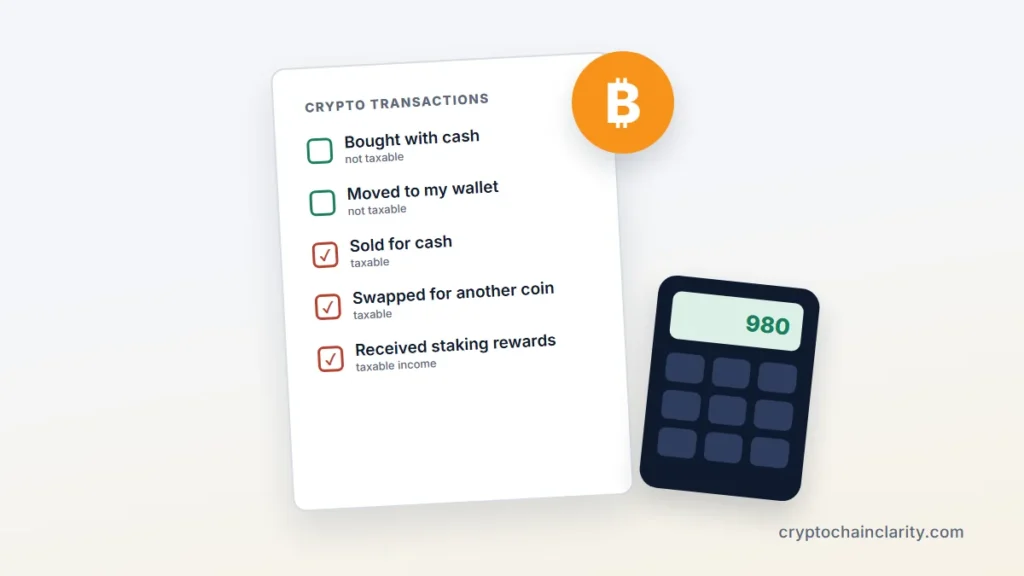
On its digital assets page, the IRS lists the transactions you must report: selling crypto for dollars, exchanging one crypto for another, using it to buy goods or services, and receiving it as payment, mining or staking rewards. Buying crypto with dollars, holding it, and moving it between your own wallets aren’t reportable events on their own.
Our crypto taxes guide explains each of these in more detail. The rest of this article focuses on how much tax you actually pay.
How is crypto taxed in the US: short-term vs long-term gains
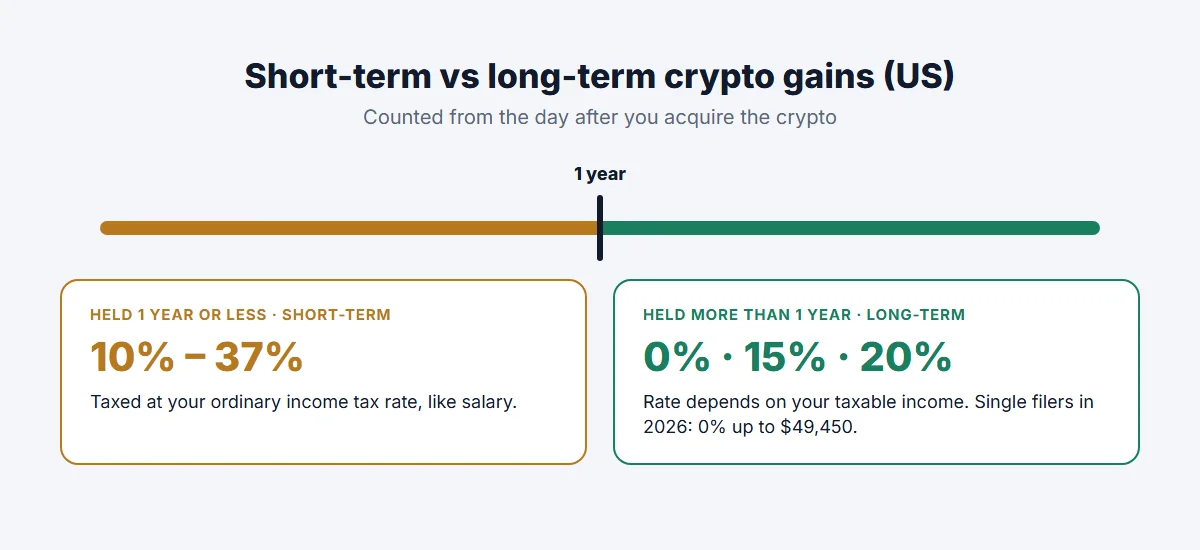
The holding period runs from the day after you acquire the crypto to the day you dispose of it.
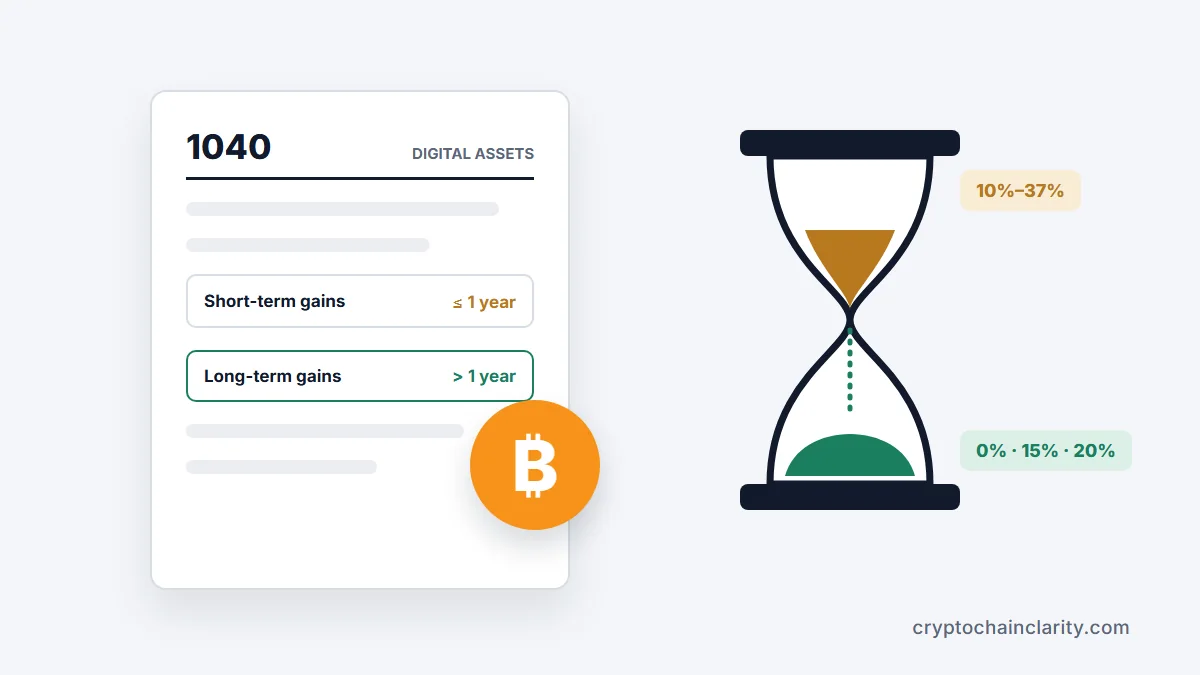
- Held one year or less: short-term. The gain is added to your other income and taxed at your ordinary federal rate: 10%, 12%, 22%, 24%, 32%, 35% or 37%.
- Held more than one year: long-term. The gain gets the lower long-term capital gains rates.
2026 long-term capital gains rates
For tax year 2026 (the return you file in 2027), the IRS thresholds are based on your taxable income, including the gain:
| Rate | Single | Married filing jointly | Head of household |
|---|---|---|---|
| 0% | Up to $49,450 | Up to $98,900 | Up to $66,200 |
| 15% | $49,451 to $545,500 | $98,901 to $613,700 | $66,201 to $579,600 |
| 20% | Over $545,500 | Over $613,700 | Over $579,600 |
These figures come from the IRS’s annual inflation adjustments for 2026 (Revenue Procedure 2025-32). For 2025 returns, the thresholds are slightly lower: for a single filer, the 0% rate applied up to $48,350 and the 15% rate up to $533,400.
Net investment income tax. Higher earners may also owe an extra 3.8% on investment income, including crypto gains, if their modified adjusted gross income is above $200,000 (single) or $250,000 (married filing jointly).
State taxes. Most states tax capital gains as regular income on top of federal tax. A few, such as Florida and Texas, have no state income tax.
Worked example: why holding period matters
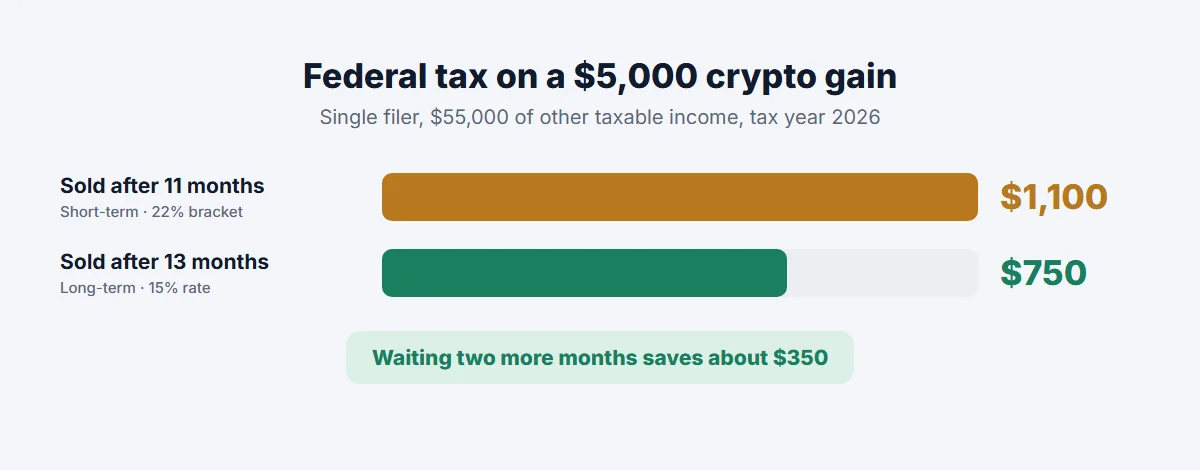
Say you’re a single filer with $55,000 of taxable income from your job in 2026, and you sell bitcoin for a $5,000 gain.
- Sold after 11 months (short-term): the $5,000 is taxed like salary. At that income level it falls in the 22% bracket, so federal tax is about $1,100.
- Sold after 13 months (long-term): your taxable income is already above $49,450, so the whole gain is taxed at 15%: $750.
Waiting two more months would save about $350 on the same gain. With lower income, the difference can be even bigger: a long-term gain that fits under the 0% threshold owes no federal tax at all.
How crypto income is taxed
Crypto you receive is taxed as ordinary income at its fair market value in dollars when you receive it:
- Staking rewards: the IRS’s Revenue Ruling 2023-14 says they’re income in the year you gain control over them.
- Mining rewards, crypto paid as wages or for freelance work, and many airdrops.
That dollar value becomes your cost basis. When you later sell, the difference from that value is a short- or long-term capital gain or loss, with the holding period starting when you received the coins. Do you pay tax on crypto staking rewards? covers the details. If crypto is your business, such as running a mining operation, self-employment tax can apply too.
Losses: how they reduce your tax
Capital losses first offset capital gains. If your losses exceed your gains for the year, you can deduct up to $3,000 of the excess against other income ($1,500 if married filing separately), and carry the rest forward to future years.
Because crypto is property rather than a security, the wash sale rule, which stops stock investors from claiming a loss if they buy back within 30 days, doesn’t currently apply to crypto held directly. Congress has repeatedly proposed changing that, so check the rule’s status before relying on it. Crypto tax-loss harvesting explains how investors use losses and the risks involved.
Forms you’ll use
- Form 1040 digital asset question. Every taxpayer must answer whether they received, sold, exchanged or otherwise disposed of digital assets during the year.
- Form 8949 and Schedule D for each sale, swap or spend, with dates, proceeds, cost basis and gain or loss.
- Schedule 1 (or Schedule C if it’s a business) for staking, mining and other crypto income.
- Form 1099-DA from your exchange. Brokers now report digital asset sales to the IRS: gross proceeds starting with 2025 transactions, plus cost basis for assets acquired from 2026 onward in the same account. If you moved coins in from another wallet or exchange, the form may not show your cost basis, so your own records are what count.
How to report crypto on your tax return walks through the filing step by step, and best crypto tax software compares tools that fill in Form 8949 for you.
Ways to legally pay less
- Hold for more than a year before selling, when it fits your plans.
- Use losses to offset gains, and don’t forget to carry forward unused losses.
- Sell in a lower-income year if you can choose the timing, for example after retiring or during a career break.
- Give crypto to charity directly: for long-held crypto, donating it can avoid capital gains tax and may be deductible. Rules apply, especially for larger gifts.
- Keep good records so you don’t overpay because a 1099-DA is missing your cost basis.
If you’re in the UK or Canada instead, see crypto tax in the UK or crypto tax in Canada.