

A stablecoin is a cryptocurrency built to keep a steady price, almost always $1. USDT (Tether) and USDC (Circle) hold their price the same way: for every coin in circulation, the company behind it keeps about $1 in cash and short-term US government debt, and certain customers can swap coins for dollars, and dollars for coins, at exactly $1. Traders use that swap to profit whenever the market price drifts, and their trades push it back to $1.
That system works well most of the time. It also breaks down under specific conditions, and knowing which ones is the difference between using stablecoins sensibly and assuming they’re as safe as a bank account. This article covers both.
A stablecoin in one example
Imagine a business deposits $1,000,000 with Circle. Circle creates (or “mints”) 1,000,000 USDC and sends it to the business’s crypto wallet. The dollars go into Circle’s reserve. From then on, those USDC can move on a blockchain like any other crypto: sent across the world in minutes, used on exchanges, held in a wallet.
Later, someone holding USDC sends 500,000 back to Circle and asks for dollars. Circle “burns” (destroys) those coins and wires $500,000 from the reserve. The number of coins always tracks the money in the reserve.
Two details are worth knowing from the start:
- Most people never deal with the issuer directly. Minting and redeeming are mainly for businesses and verified customers. Ordinary users buy and sell stablecoins on exchanges, where the price is set by trading, not by the issuer.
- The issuer makes money from your dollars. The reserve earns interest, mostly from US Treasury bills, and the issuer keeps it. Holders usually get no interest from the issuer. That’s the business model, and it’s why issuing stablecoins has become very profitable.
How the $1 price actually holds
No one sets the price of USDT or USDC on an exchange. It holds near $1 because any gap creates an easy profit for traders who can mint and redeem with the issuer.
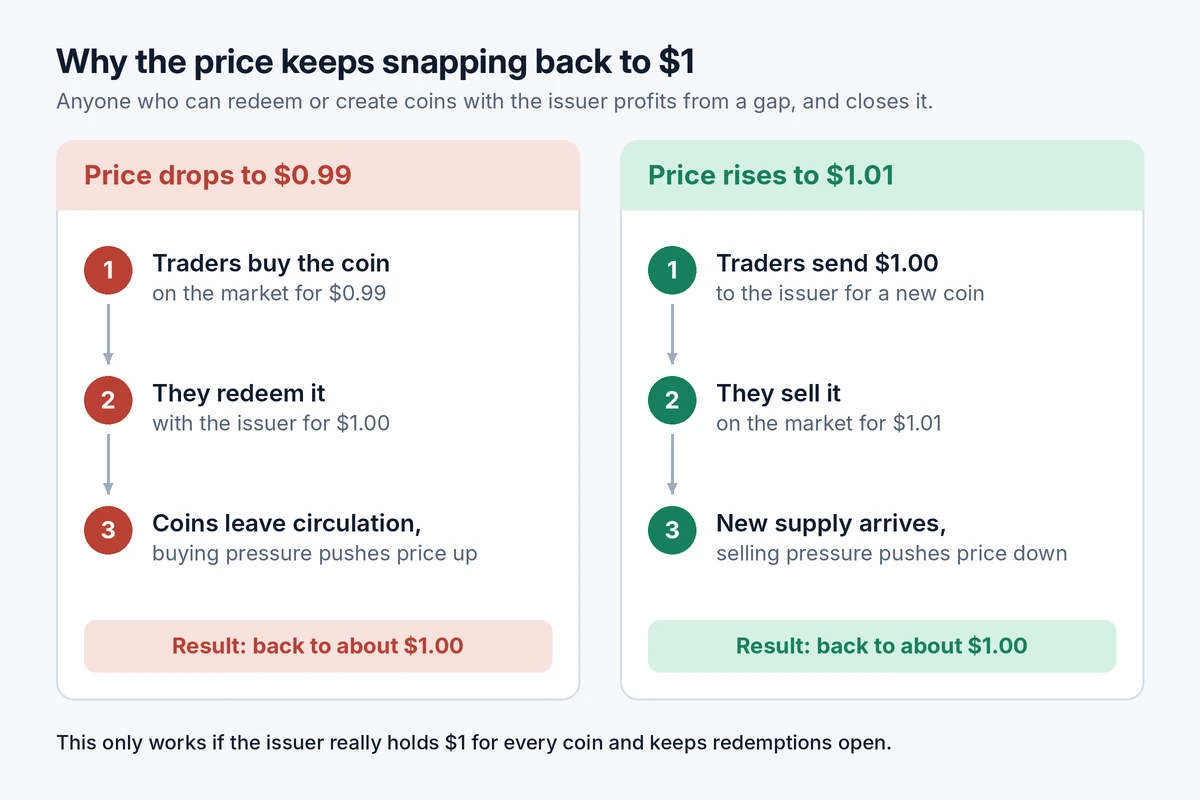
If the price drops to $0.99, traders buy coins cheaply on the market and redeem them with the issuer for $1.00 each. Their buying pushes the market price up, and the redeemed coins disappear from circulation.
If the price rises to $1.01, traders send $1.00 to the issuer, receive new coins and sell them on the market for $1.01. The extra supply pushes the price back down.
This tug-of-war (called arbitrage) usually keeps both coins within a fraction of a cent of $1. But it depends on two conditions: the reserve must really be there, and redemptions must stay open. When either one is in doubt, the price can slip, which is exactly what has happened in every major stablecoin scare.
USDT vs USDC: same goal, different trust model
USDT and USDC are the two largest stablecoins, and they work the same way in principle. The differences are in who stands behind them, what’s in their reserves and how much you can verify.
| USDT (Tether) | USDC (Circle) | |
|---|---|---|
| Issuer | Tether, based outside the US | Circle, a US company listed on the stock market |
| Main reserve assets | Mostly US Treasury bills, plus gold, bitcoin, secured loans and other investments | Short-term US Treasuries held in a money market fund, plus cash at banks |
| How reserves are checked | Quarterly attestations by an accounting firm; no full audit published | Monthly third-party attestations, with weekly reserve reporting |
| Regulatory status | Not authorized under the EU’s MiCA rules; Tether launched a separate US-regulated coin, USAT, in January 2026 | Authorized under MiCA through a French e-money license |
| Where it’s most used | Trading outside the US and payments in emerging markets | US and European platforms, apps and institutions |
The biggest practical difference is the reserve. Circle describes the USDC reserve as roughly 80% short-dated Treasuries, held through a government money market fund, and 20% cash at banks. Tether’s most recent quarterly attestation, as of 31 March 2026, showed about $141 billion in direct and indirect Treasury exposure, around $20 billion in gold and about $7 billion in bitcoin, against roughly $183 billion of USDT in circulation. Tether reported a cushion of about $8 billion in assets beyond what it owes holders. You can read both reports yourself: how Circle structures the USDC reserve and Tether’s Q1 2026 attestation.
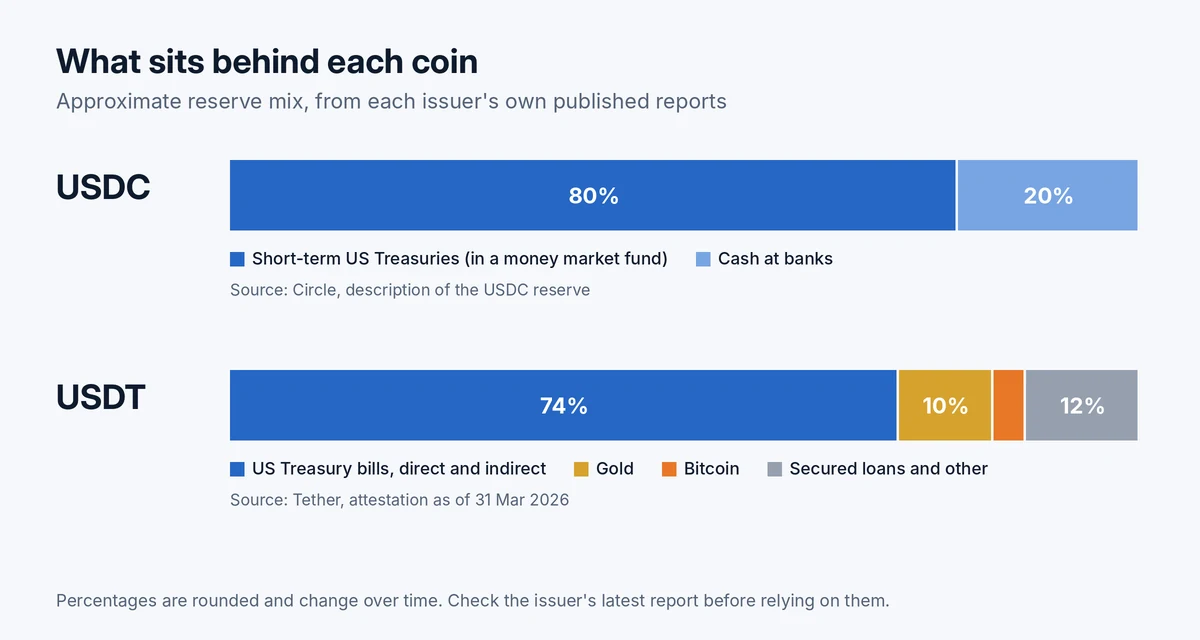
Gold and bitcoin can lose value quickly, which is one reason Tether keeps an extra cushion. Supporters point to that buffer and Tether’s long record of meeting redemptions. Critics point to the lack of a full audit and to Tether’s history: in 2021, the US Commodity Futures Trading Commission fined Tether $41 million, finding it had made misleading statements about its reserves between 2016 and 2019. Tether settled without admitting wrongdoing.
Neither coin is risk-free. USDC trades some yield and flexibility for simpler, more transparent reserves. USDT offers deeper trading markets in much of the world, with a reserve that’s harder to assess.
Not all stablecoins work this way
“Stablecoin” is a broad label. How a coin keeps its peg matters more than its name:
- Fiat-backed (USDT, USDC, PYUSD and others): backed by cash and short-term government debt held by a company. Most stablecoin money sits in this group.
- Crypto-backed (such as DAI and its successor USDS): backed by other cryptocurrencies locked in smart contracts, usually worth well over $1 per coin to absorb price swings. They avoid a single company but depend on code and on the value of the collateral.
- Algorithmic: try to hold the peg with incentives and a sister token rather than real reserves. TerraUSD (UST) was the best-known example until it collapsed in May 2022, falling far below $1 and wiping out tens of billions of dollars in value within days.
The Terra collapse is the clearest lesson in this area: a coin that promises $1 without holding $1 can fail completely. If you can’t find out what backs a stablecoin, treat it as a risky asset, whatever its name says.
When the peg has broken
Even well-backed stablecoins have wobbled. The most important case involved USDC. On 10 March 2023, Silicon Valley Bank failed while holding $3.3 billion of Circle’s reserves, about 8% of the total. Over that weekend, USDC fell as low as about $0.88 on the market as holders rushed to sell. Once US authorities said all of the bank’s depositors would be protected, USDC returned to about $1 within days.
Nobody who held on lost money, but anyone who panic-sold at $0.88 locked in a 12% loss on something they thought was as good as cash. The episode showed the real risks of a fiat-backed stablecoin:
- Banking risk: the reserve’s cash sits in ordinary banks, which can fail.
- Redemption risk: if redemptions pause, even for a weekend, the arbitrage that holds the peg stops working.
- Issuer risk: stablecoins aren’t bank deposits. They aren’t covered by FDIC insurance in the US or the FSCS in the UK. If an issuer fails, holders depend on the reserve and on bankruptcy proceedings.
- Freeze risk: USDT and USDC issuers can freeze coins at specific addresses, usually at the request of law enforcement. That helps fight crime, but it also means these coins aren’t censorship-resistant like bitcoin.
How regulation is changing stablecoins
Rules have tightened considerably since 2023. In the US, the GENIUS Act, signed into law on 18 July 2025, created the first federal framework for payment stablecoins. Issuers must hold at least $1 of approved reserves (cash, insured deposits, short-dated Treasury bills and similar assets) for every $1 issued, publish regular reports on those reserves, and are barred from paying interest directly to holders. Regulators are still writing the detailed rules, so parts of the framework are being phased in.
In the European Union, the MiCA regulation requires stablecoin issuers to be authorized. Circle obtained authorization for USDC, while Tether did not apply for USDT. As a result, regulated exchanges in the EU have removed USDT trading for European users.
For you, the practical takeaway is that a regulated stablecoin isn’t the same as a government-guaranteed one. Regulation sets minimum standards for reserves and disclosure, but it doesn’t turn a stablecoin into an insured bank deposit.
What people actually use stablecoins for
- Parking money between trades. Moving from bitcoin into USDC on an exchange avoids withdrawing to a bank and waiting days to move back in.
- Sending dollars across borders. A transfer can arrive in minutes, at any hour, often for less than an international wire. Network fees still apply, and on some blockchains they’re tiny while on others they can spike. See what gas fees are.
- Holding dollars where local currency is unstable. In countries with high inflation, stablecoins offer a way to hold dollar value without a US bank account.
- Using crypto apps. Many lending, payment and trading apps run on stablecoins. Some offer yield on stablecoin deposits, but that yield always comes from lending or other activities that carry their own risk.
Before you use a stablecoin
A few checks prevent most of the problems people run into:
- Know what backs it. Stick to coins whose issuer publishes regular reserve reports from an accounting firm, and read the latest one.
- Check the network before sending. USDT and USDC exist on several blockchains (Ethereum, Tron, Solana and others). Sending on a network the receiving wallet or exchange doesn’t support is one of the most common ways people lose stablecoins. If it has happened to you, read sent crypto to the wrong network.
- Don’t treat it as a savings account. Stablecoins have no deposit insurance. For large amounts held for a long time, an insured bank account or Treasury fund carries less risk.
- Decide where to keep it. Coins left on an exchange depend on the exchange as well as the issuer. Is it safe to keep crypto on an exchange? covers that risk, and crypto wallets explained covers holding them yourself.
- Remember the tax side. Swapping bitcoin or another coin into a stablecoin is usually a taxable disposal, even though no dollars hit your bank. Start with what triggers a taxable event.
- Watch for fake tokens. Scammers create look-alike tokens named “USDT” or “USDC”. Only accept or buy stablecoins through reputable exchanges and check the official contract address. More warning signs are in 10 common crypto scams.
Quick answers
Is USDT or USDC safer?
USDC’s reserve is simpler and more transparent, holding only cash and short-term Treasuries, and it’s regulated in the US and EU. USDT has a longer track record and deeper markets, but its reserve includes riskier assets and it hasn’t published a full audit. Many people use USDC for holding and USDT where it’s the only practical option for trading.
Can a stablecoin go to zero?
An algorithmic stablecoin can, as TerraUSD showed. A properly backed fiat stablecoin is very unlikely to, because the reserve holds real assets. But it can trade below $1 for a while, and if an issuer failed, getting your money back could take time.
Do I earn interest on stablecoins?
Not from the issuer. Some exchanges and apps pay rewards for holding stablecoins with them, funded by lending or other activities. That extra return comes with the risk of that platform, so check how it’s generated before you chase it.
Are stablecoins the same as a digital dollar from the government?
No. Stablecoins are issued by private companies. A digital currency issued by a central bank (a CBDC) would be a direct claim on the government. The US doesn’t have one.
If you’re still finding your feet with crypto, our plain-English guide to how crypto works covers the basics, and what is Bitcoin explains the opposite approach: a coin designed to have a fixed supply rather than a fixed price.
This article is for educational purposes only and isn’t financial, investment or tax advice.

Pingback: Bitcoin vs Ethereum: The Real Difference for Beginners
Pingback: What Are Altcoins? How to Spot a Real Project vs a Hype Coin