Crypto inheritance fails for a simple reason: the feature that keeps your coins safe from thieves also keeps them safe from your family. If nobody knows your crypto exists, where the recovery phrase is, or how to use it, the coins stay on the blockchain forever. No court order can unlock a self-custody wallet.
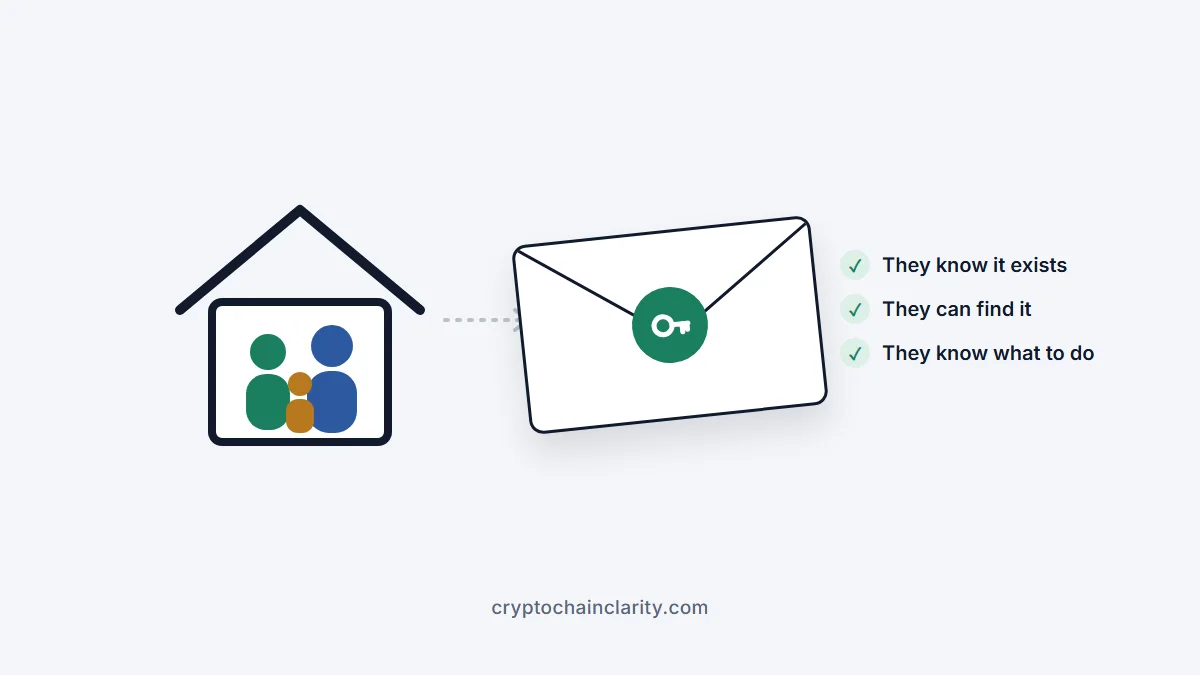
The fix doesn’t require a lawyer specialized in crypto or an expensive service. It requires three things your family can rely on: they know the crypto exists, they can find the access details, and they understand what to do with them. Below is how to set that up, written for an ordinary person with a hardware wallet or an exchange account, plus the mistakes that most often lock heirs out.
This guide explains the practical side. Wills, trusts and taxes depend on where you live, so check the legal part with an estate planning professional.
What happens to crypto when you die without a plan
It depends on where the crypto is held.
- On an exchange (Coinbase, Kraken and similar): the account is a normal financial account in your name. Your executor can claim it with the usual estate paperwork. Coinbase, for example, lists a death certificate, probate documents such as Letters Testamentary or a small estate affidavit, and ID for the person named in them on its deceased account holder page. It’s slow, but it works, as long as your family knows the account exists.
- In a self-custody wallet (a hardware wallet or an app like Exodus or MetaMask): there’s no company to call. Whoever has the recovery phrase controls the coins. Without it, the coins are lost for everyone.
Most beginners end up with both: some crypto left on an exchange, the rest on a hardware wallet. A crypto inheritance plan has to cover each one differently.
The three things your family will need
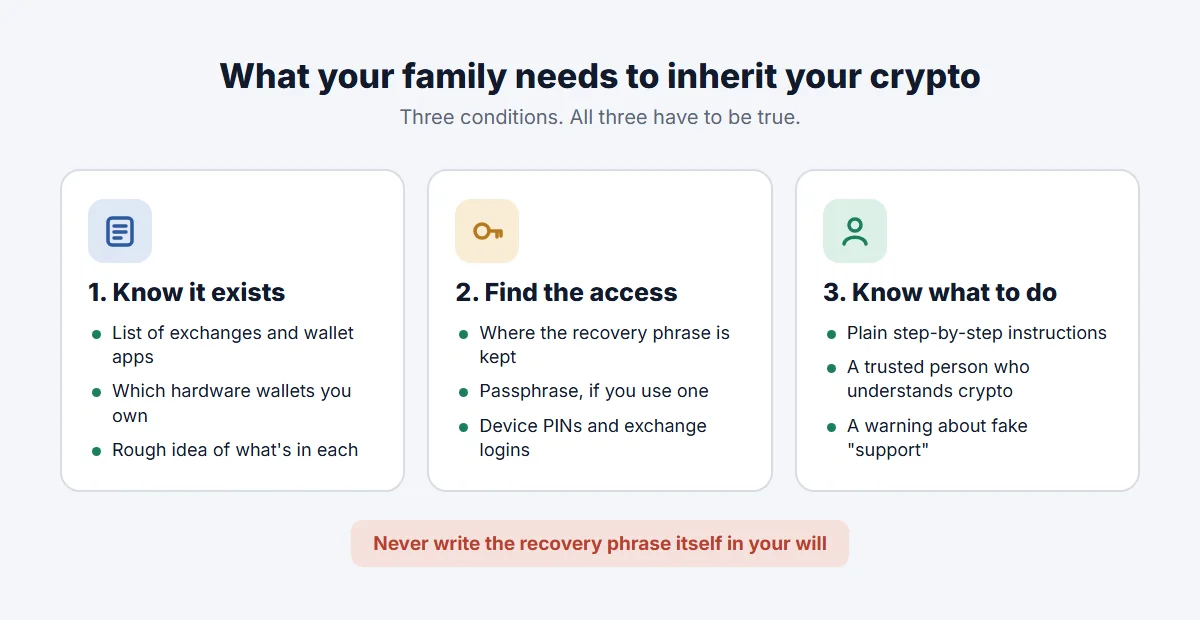
1. To know it exists. This is the step people skip. Crypto doesn’t send paper statements. If you never mentioned it, your family may never look for it. A simple list of where you hold crypto solves this.
2. To find the access details. For exchanges, that means the account email and where the login details are kept. For a self-custody wallet, it means the location of the recovery phrase (and the passphrase, if you use one) and the device PIN.
3. To know what to do. A recovery phrase is useless to someone who has never heard of one, and dangerous if they type it into the first website Google shows them. Short, plain instructions and the name of someone trustworthy who understands crypto make the difference.
Build your crypto inheritance plan in five steps
Step 1: List what you hold and where
Write down every place you hold crypto: each exchange, each wallet app, each hardware wallet. Note roughly what’s in each and which coins and networks are involved. You don’t need exact balances, which change daily. The goal is that nothing is forgotten.
Keep this list separate from the recovery phrase. On its own, it’s harmless: it says where to look, not how to get in.
Step 2: Decide how your heirs will get access
This is the real decision, and there’s a trade-off: the easier you make access for your family, the easier you might make it for someone else. The common approaches:
| Approach | How it works | Good for | Watch out for |
|---|---|---|---|
| Sealed letter with the phrase location | The phrase stays in a safe place; a sealed letter, held by your executor or lawyer, says where it is | Most beginners | The safe place must be reachable by your family |
| Phrase stored with a lawyer or in a bank safe deposit box | A copy of the phrase is held by a professional or in a box your executor can open | People who don’t want it at home | Access after death can take weeks; check the bank’s rules |
| Split knowledge | The phrase is in one place, the PIN or passphrase known by a different person | Larger amounts, trusted family | Too clever a split can lock everyone out |
| Paid recovery or inheritance service | A company keeps an encrypted backup or coordinates access for your heirs; check exactly what happens after your death before signing up | People who want a managed option | Ongoing fees, identity checks and trust in the provider |
| Multisignature wallet | Several keys are needed to move funds, held by you, a relative and possibly a service | Large holdings, more technical users | Complex to set up and to explain to heirs |
For most people starting out, the first or second option is enough. What matters more than the method is that it’s written down and that someone knows the plan exists.
Step 3: Write a letter of instruction
A letter of instruction is a plain-language document for your executor or family. It isn’t a legal document, and it shouldn’t contain the recovery phrase itself. It explains what you own and how to reach it.
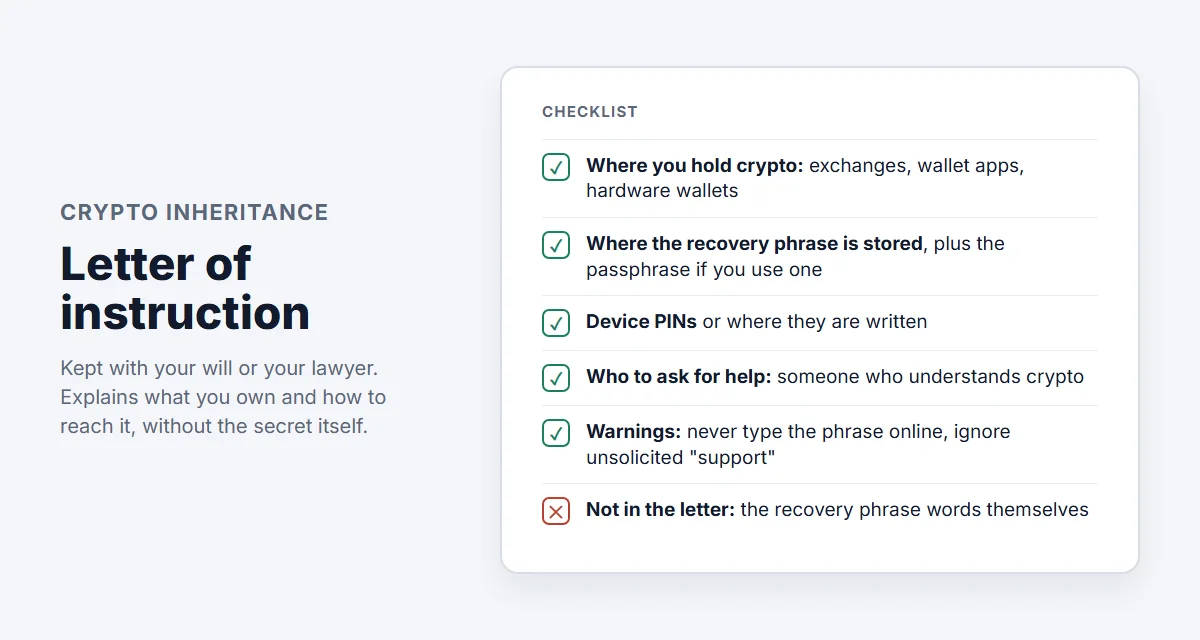
A good letter covers:
- The list from step 1: exchanges, wallets and devices.
- Where the recovery phrase and any passphrase are kept, without writing the words in the letter.
- The device PINs or where they’re written down.
- Who to ask for help: a trusted friend or relative who understands crypto. Not someone who will have unsupervised access to the phrase, unless you’d trust them with the money.
- A short warning: never type the recovery phrase into a website, never share it with “support”, and take time before moving anything. Grieving families are a target for crypto scams.
- What you’d like to happen: who gets what, or a pointer to your will.
Store the letter where your executor will find it: with your will, with your lawyer, or in a sealed envelope with someone you trust.
Step 4: Make your will mention your crypto
Your will should say that you own crypto and who inherits it, so your executor has the authority to claim exchange accounts and distribute coins. In the US and UK, a will that goes through probate can become a public document, so the recovery phrase should never appear in it. Refer instead to the letter of instruction or the place where access details are kept.
Ask your estate planner whether a trust or another structure makes sense for you. That part depends heavily on where you live and how much you hold.
Step 5: Test and review the plan
Read your letter as if you knew nothing about crypto. Could you follow it? If a family member is willing, walk them through the general idea without showing them the phrase.
Then review it once a year, and whenever something changes: you move coins to a new wallet, open a new exchange account, replace a hardware wallet or create a new recovery phrase. An outdated plan that points to an empty wallet can send your family on a long search.
Mistakes that lock heirs out (or let thieves in)
Most crypto inheritance failures come down to a handful of avoidable mistakes:
- Writing the recovery phrase in your will. It can become public during probate.
- Storing the phrase digitally in email, cloud storage, a notes app or a photo. Your family might find it, and so might a hacker. How to store a seed phrase safely covers better options.
- Telling no one. The most secure setup in the world fails if nobody knows it exists.
- Forgetting the passphrase. If you use one, your heirs need it as well as the phrase, or they’ll open an empty wallet.
- Hiding the phrase too well. A clever hiding place known only to you is the same as no backup.
- Relying on one person who could act alone. Giving a single relative the phrase today means trusting them with the money today.
A note on taxes
Inherited crypto is generally treated like other inherited property, but the details vary by country. In the US, inherited assets usually take a cost basis equal to their value on the date of death, which can reduce capital gains tax when the heir sells. In the UK, HMRC treats cryptoassets as property for Inheritance Tax, so they count toward the value of the estate.
Your executor will need values in dollars or pounds as of the date of death, so a list with the coins and wallets involved makes their job much easier. Our crypto taxes guide explains the basics, and a tax professional can confirm how it applies to your estate.
Where to start this week
If this feels like a lot, start with the step that removes the biggest risk: write the list of where you hold crypto and tell one trusted person that it exists and where to find it. That alone turns “lost forever” into “found and recoverable”.
Then add the letter of instruction and update your will at your next review. If your recovery phrase backup still isn’t solid, fix that first, because no plan works without it. And if you ever lose the device itself, what happens if you lose your hardware wallet shows why the phrase, not the device, is what your family really needs.