

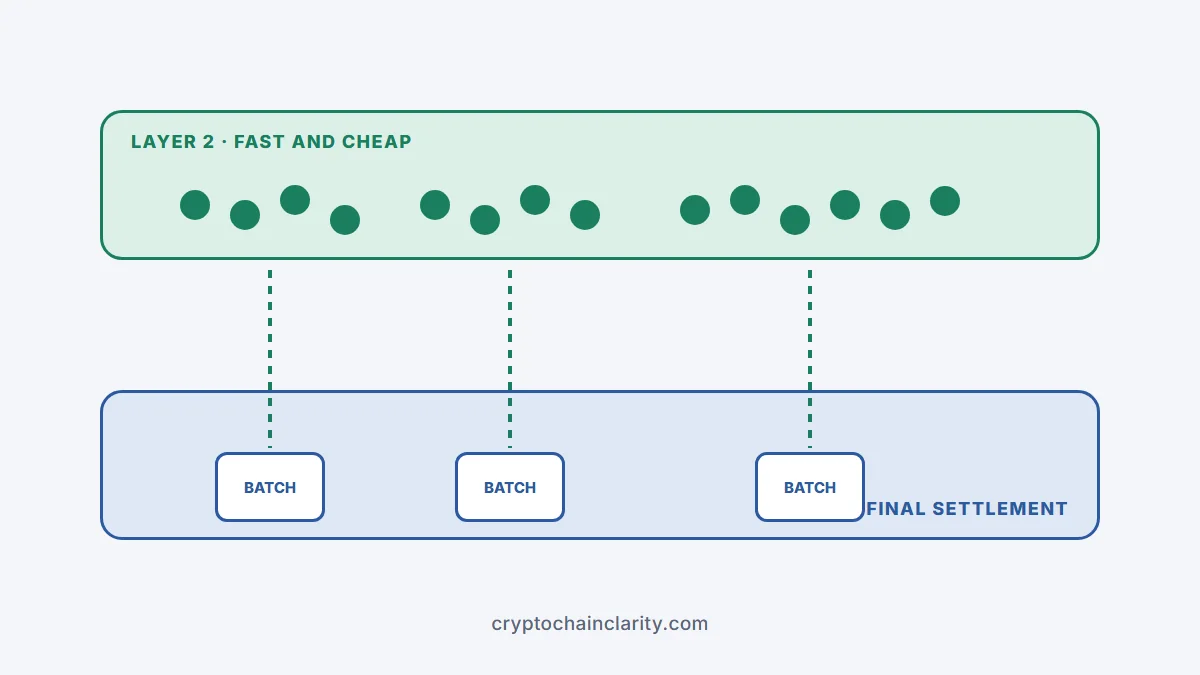
A layer 2 is a network built on top of an existing blockchain, called the layer 1, such as Bitcoin or Ethereum. It handles most of the activity itself, quickly and cheaply, and relies on the main chain for final security. Think of it as an express lane above a busy road: many transactions travel on the upper lane, and only summaries or settlements come down to the main road.
The best-known layer 2s are the Lightning Network for Bitcoin, and Arbitrum and Base for Ethereum. They work in different ways and carry different risks. This guide explains each in plain English, and what to check before moving money onto one.
Why layer 2s exist
Blockchains like Bitcoin and Ethereum are slow and expensive by design: every node checks every transaction, and block space is limited. When demand rises, fees rise too. What are gas fees? explains why that happens on Ethereum.
Making the main chain much bigger would make it harder for ordinary people to run a node, which would weaken decentralisation. Layer 2s take a different route: keep the main chain small and secure, and move everyday activity to a layer above it.
How a layer 2 works: two main designs
Payment channels (Bitcoin’s Lightning Network)
Lightning lets two parties open a channel by locking bitcoin in a shared on-chain transaction. They can then send each other payments instantly, as many times as they like, without touching the blockchain. When they’re done, they close the channel and the final balance is settled on Bitcoin.
Channels link together into a network, so you can pay someone you don’t have a direct channel with, as long as a path exists. Payments are fast and usually cost very little, which suits small, everyday amounts. Several wallets and some exchanges support sending and receiving over Lightning.
Rollups (Ethereum’s Arbitrum, Optimism, Base and others)
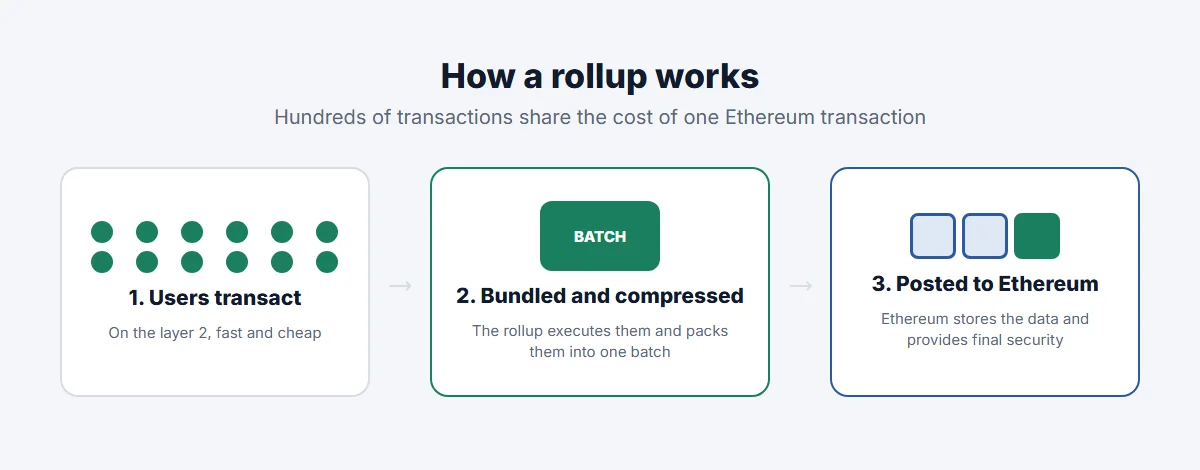
A rollup runs transactions on its own chain, then bundles many of them into a compressed batch and posts that batch to Ethereum. Because hundreds of transactions share the cost of one main-chain transaction, each one is much cheaper. According to ethereum.org, once a rollup’s data is on Ethereum, reversing those transactions would require reversing Ethereum itself.
There are two kinds:
- Optimistic rollups, such as Arbitrum, Optimism and Base, assume batches are valid unless someone proves otherwise. That’s why withdrawing from them to Ethereum through their official bridge typically involves a waiting period of about a week, which gives time to challenge a fraudulent batch.
- Zero-knowledge (ZK) rollups, such as zkSync and Starknet, post a cryptographic proof that the batch is correct, which allows faster withdrawals.
Lightning, Arbitrum and Base compared
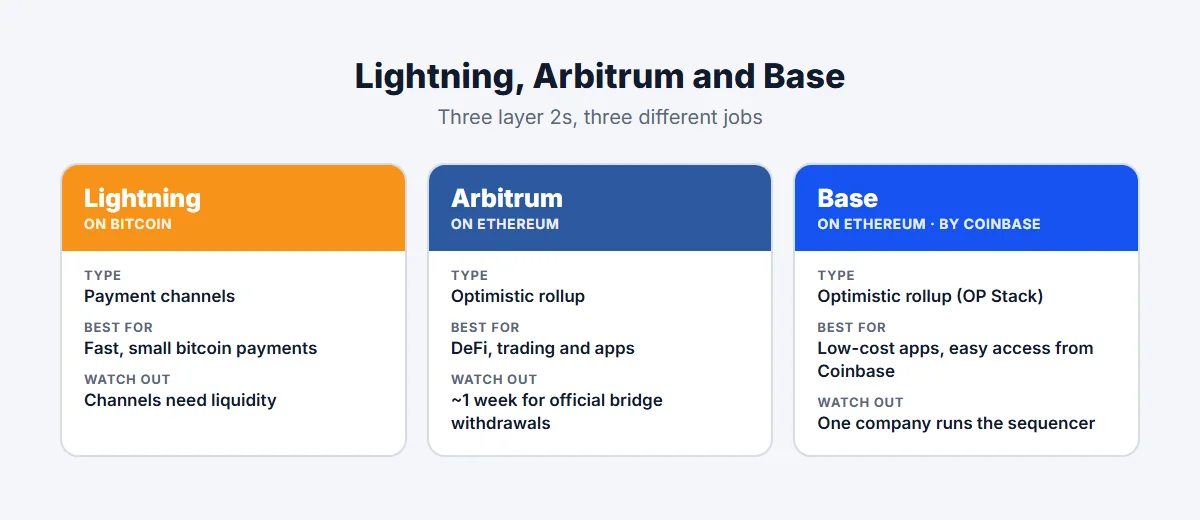
| Lightning Network | Arbitrum | Base | |
|---|---|---|---|
| Built on | Bitcoin | Ethereum | Ethereum |
| Type | Payment channels | Optimistic rollup | Optimistic rollup (OP Stack) |
| What it’s for | Fast, cheap bitcoin payments | DeFi, trading and apps | Low-cost apps and payments |
| Fees paid in | Bitcoin | ETH | ETH |
| Who runs it | Independent nodes | Offchain Labs and the Arbitrum DAO | Coinbase |
| Notable trade-off | Channels need liquidity; best for smaller payments | ~1-week wait for official bridge withdrawals | Single company operates the sequencer |
Base was launched by Coinbase in 2023 and is built on the same open-source software as Optimism. Its close link with Coinbase makes it easy to move funds between a Coinbase account and Base, which explains much of its popularity.
The risks of using a layer 2
Layer 2s are useful, but they’re not as battle-tested as Bitcoin or Ethereum themselves. Before moving meaningful amounts:
- Network mix-ups. An address on Base looks exactly like an address on Ethereum or Arbitrum. Sending funds on the wrong network is one of the most common ways to lose them. Always check the network on both the sending and receiving side. Our guide on sending crypto to the wrong network explains what can and can’t be recovered.
- Bridges. Moving funds between layers uses bridges, and third-party bridges have been the target of some of the largest hacks in crypto. Official bridges and well-known exchanges are generally safer than little-known ones.
- Centralised parts. Many rollups rely on a single sequencer, the operator that orders transactions, and some can still be upgraded by a small group. If the sequencer goes down, the network can pause. L2BEAT tracks how mature each rollup is and what risks remain.
- Withdrawal delays. With optimistic rollups, leaving through the official bridge can take about a week. Exchanges and third-party services offer faster exits, sometimes for a fee.
Should you use a layer 2?
Probably, if you use Ethereum apps regularly or want to send small amounts cheaply. Layer 2 fees are often a small fraction of main-chain fees, and most popular wallets support them. For bitcoin, Lightning is the practical choice for small payments.
For long-term storage of significant amounts, many people still prefer the main chain, ideally in a hardware wallet. Best crypto wallets for beginners covers wallets that support both. For the basics underneath it all, see how blockchain works, and for what apps on these networks actually do, what is a smart contract?.
Pingback: What Are Gas Fees and Why Are They So High Sometimes?