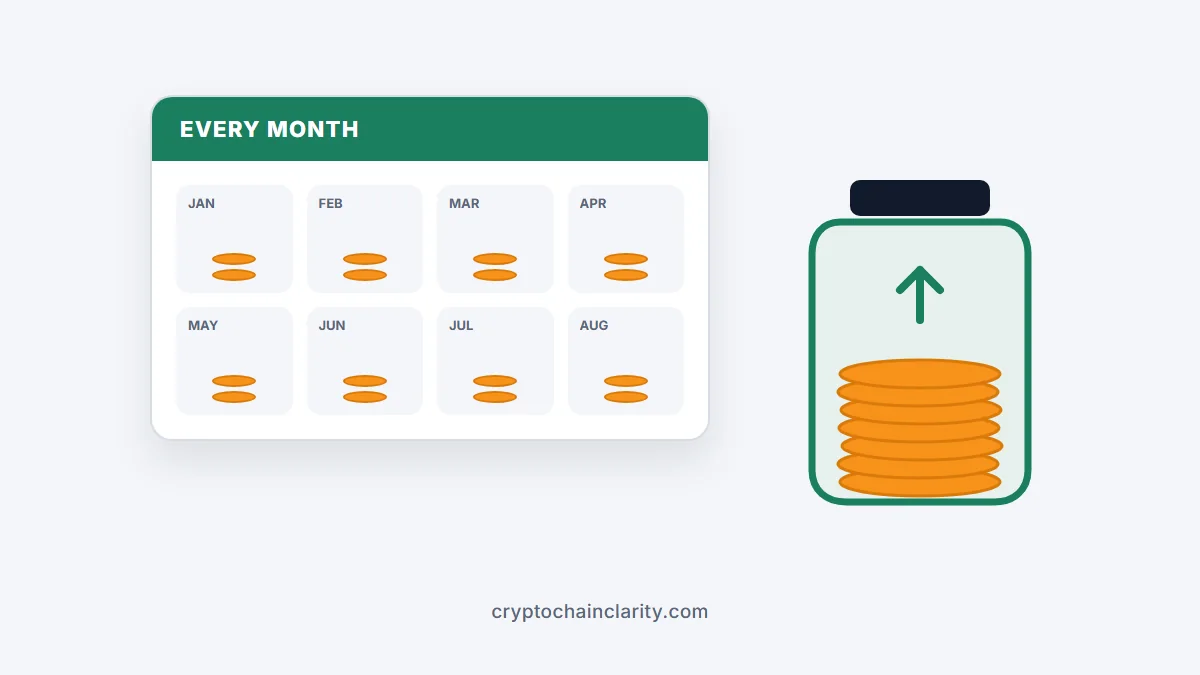
Dollar-cost averaging in crypto (often shortened to DCA) means buying a fixed amount, say $50 every week or $200 every month, on a regular schedule, whatever the price. When the price is high your money buys a little; when it’s low it buys more. Over time you end up with an average purchase price, and you never have to decide whether today is a good day to buy.
It doesn’t make crypto less risky, and it isn’t guaranteed to beat investing everything at once. What it does well is take timing and emotion out of buying a very volatile asset. Below is how it works with real numbers, when it makes sense, and how to set up recurring buys without losing too much to fees.
How DCA works: a six-month example
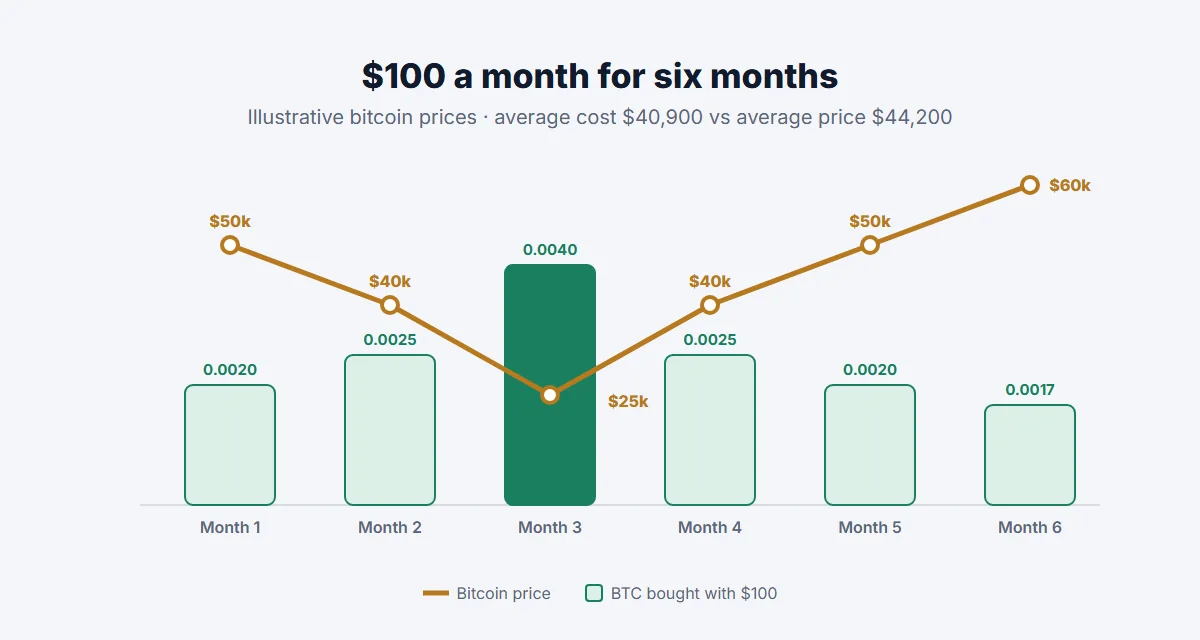
Imagine you put $100 into bitcoin on the first of each month for six months, and the price moves like this. The prices are illustrative, chosen to show a typical up-and-down stretch.
| Month | Bitcoin price | Amount invested | Bitcoin bought |
|---|---|---|---|
| 1 | $50,000 | $100 | 0.00200 BTC |
| 2 | $40,000 | $100 | 0.00250 BTC |
| 3 | $25,000 | $100 | 0.00400 BTC |
| 4 | $40,000 | $100 | 0.00250 BTC |
| 5 | $50,000 | $100 | 0.00200 BTC |
| 6 | $60,000 | $100 | 0.00167 BTC |
| Total | $600 | 0.01467 BTC |
Two things stand out:
- Your average cost is about $40,900 per bitcoin ($600 divided by 0.01467 BTC), below the simple average of the six prices (about $44,200). That’s because the fixed amount automatically buys more in the cheap months.
- The bad month helped. The drop to $25,000 felt terrible at the time, but it’s where you bought the most.
If you had put all $600 in during month 1 at $50,000, you’d have 0.012 BTC. At the month-6 price of $60,000, that’s worth $720. The DCA position would be worth about $880. In this example DCA won, but only because the price dipped in the middle. If the price had risen steadily from month 1, the lump sum would have done better.
DCA vs investing a lump sum
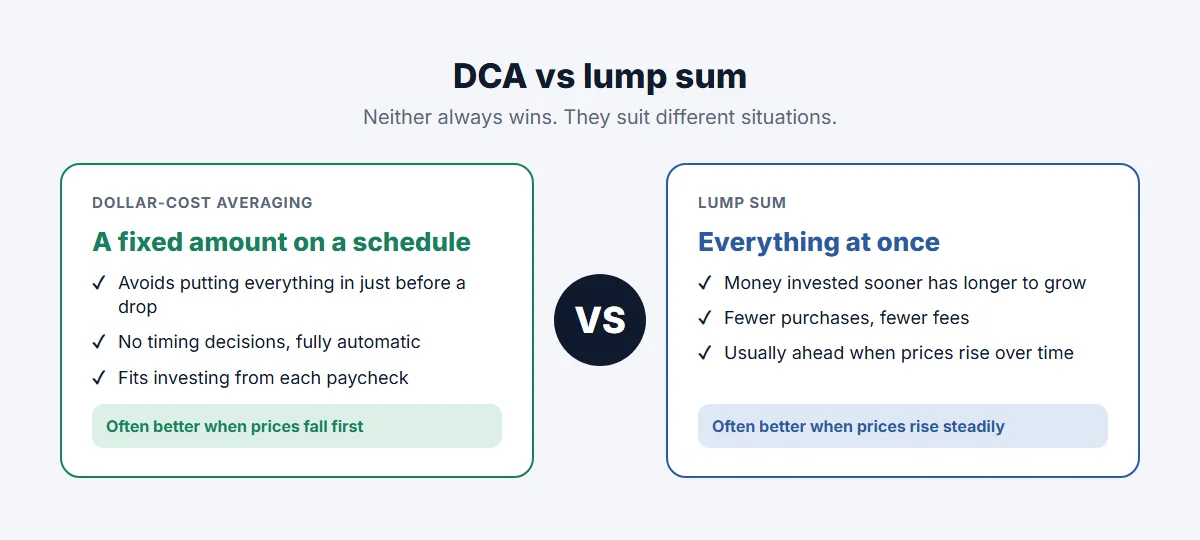
If you already have a sum to invest, research on traditional markets suggests that investing it all at once has usually come out ahead. Vanguard’s studies of stock and bond portfolios found lump-sum investing beat dollar-cost averaging roughly two-thirds of the time, simply because markets have tended to rise over long periods and money invested earlier has more time to grow.
Crypto is far more volatile, so the range of outcomes is wider in both directions. The case for DCA isn’t really about squeezing out extra return. It’s about:
- Avoiding the worst-case timing, such as putting everything in just before a 50% drop.
- Making it automatic, so you don’t stop buying when headlines are scary or chase prices when they’re euphoric.
- Matching how most people earn money: a bit every month, not a windfall.
For most beginners investing from their income, DCA isn’t a choice against a lump sum anyway. It’s simply how they invest.
How to set up recurring crypto buys
Most exchanges and crypto apps have a recurring buy feature. The setup takes a few minutes:
- Choose the coin. DCA works best with assets you expect to hold for years, which for most people means bitcoin and possibly ether. Averaging into a weak coin doesn’t make it a good investment. What are altcoins? explains the extra risks of smaller coins.
- Pick an amount you can keep up through a downturn. The strategy only works if you don’t stop when prices fall.
- Pick a frequency. Weekly or monthly is plenty. Daily purchases rarely improve the average and multiply fees if each one has a minimum charge.
- Fund it from your bank account, not a card, to avoid card fees on every purchase.
- Set it and leave it. Check in occasionally, not every day.
Watch the fees on each purchase
Recurring buys are often charged like any simple purchase, with a fee and a spread every time. On small, frequent buys, those costs add up. Kraken, for example, charges 1% on instant and recurring buys, according to its fee schedule.
Some services specialize in cheaper recurring buys. In the US, River charges no fee on recurring bitcoin purchases after the first week, and Cash App says Auto Invest purchases carry no fee or spread. The cheapest way to buy bitcoin in the US compares these options. Elsewhere, compare the cost of a recurring buy with placing your own monthly limit order on an exchange’s advanced screen, which can be cheaper if you don’t mind doing it by hand. Crypto exchange fees explained shows how to compare.
Common DCA mistakes
- Stopping in a downturn. The months when prices are low are exactly when DCA does its work.
- Buying daily in tiny amounts on a platform with a minimum fee per purchase.
- DCA into too many coins. Spreading $50 a week across ten tokens multiplies fees and usually means holding things you haven’t researched.
- Leaving years of purchases on an exchange without a plan. Once the total becomes meaningful, consider moving it to your own wallet in occasional batches. Best crypto wallets for beginners can help you choose one.
- Losing track of purchases for tax. Each recurring buy is a separate purchase with its own cost. Download your history regularly; when you eventually sell, you’ll need it. Our crypto taxes guide explains why.
Is dollar-cost averaging in crypto right for you?
It suits you if you want exposure to crypto, plan to hold for years, invest out of your monthly income and would rather not watch prices. It’s less useful if you’re trading short term, or if you have a lump sum and are comfortable with the possibility of investing it just before a fall.
Whatever you choose, invest only what you can afford to see fall sharply, and keep it to a part of your savings you won’t need soon. If you haven’t bought crypto before, how to buy crypto safely for the first time covers the setup before your first recurring purchase.