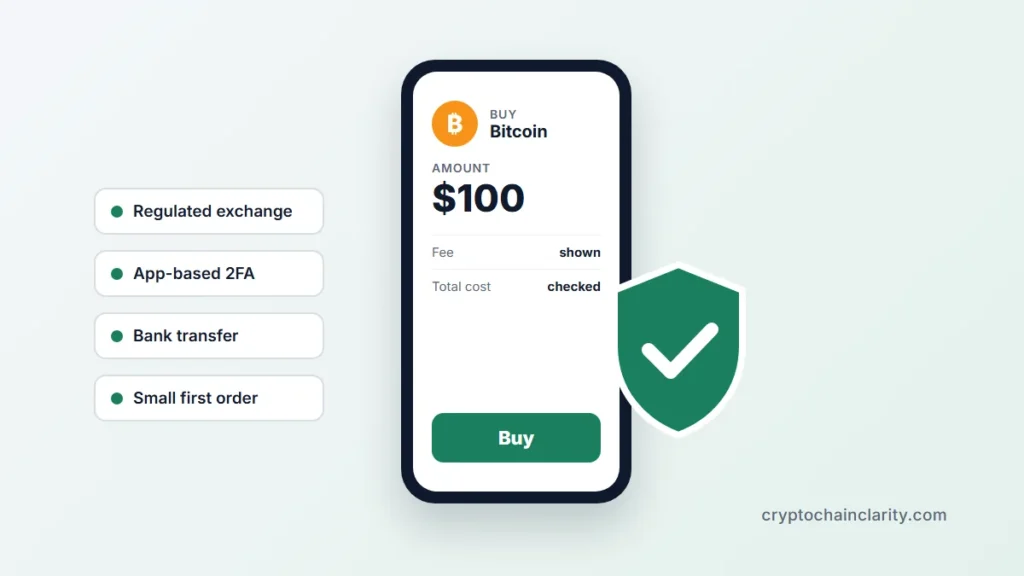
The difference between centralized vs decentralized exchanges comes down to one question: who holds your crypto while you trade? On a centralized exchange (a CEX, such as Coinbase or Kraken), a company holds it and runs the trading for you. On a decentralized exchange (a DEX, such as Uniswap), you trade directly from your own wallet through software on the blockchain, and nobody holds your funds but you.
For a beginner, the answer is usually simple: start on a reputable centralized exchange. It’s the only easy way to turn dollars, pounds or euros into crypto, and it protects you from several expensive mistakes. A DEX becomes useful later, once you have your own wallet, understand network fees and want a coin a CEX doesn’t list.
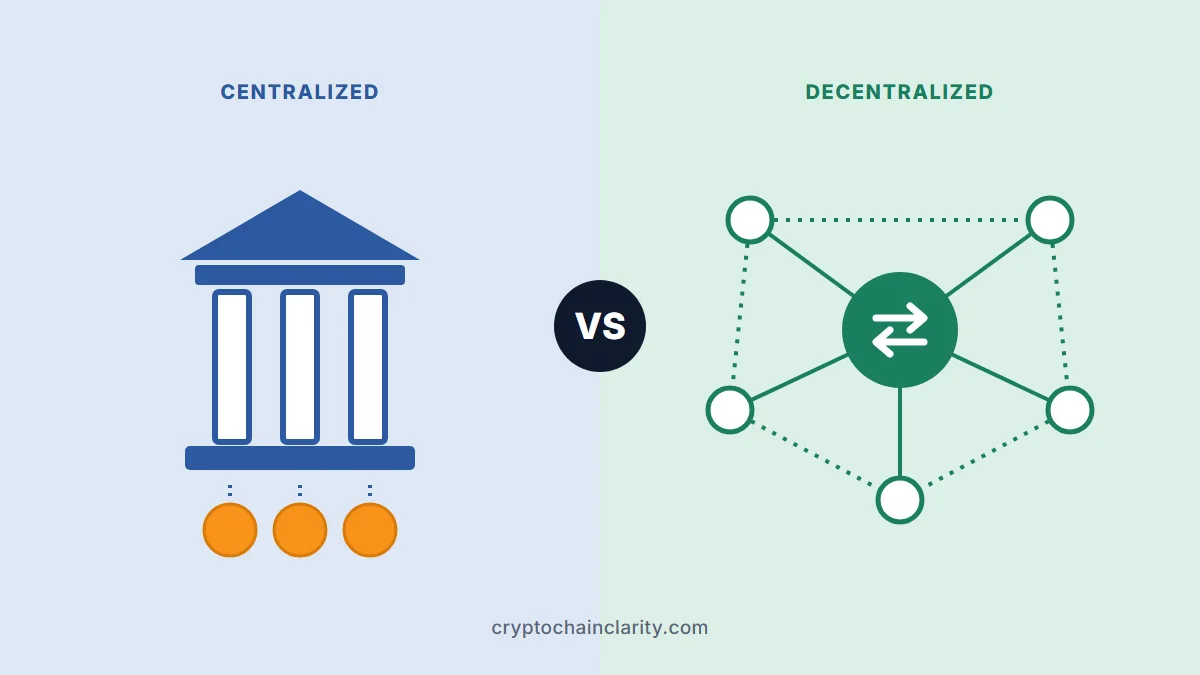
Centralized vs decentralized exchanges side by side
| Centralized exchange (CEX) | Decentralized exchange (DEX) | |
|---|---|---|
| Who holds your crypto | The exchange | You, in your own wallet |
| Account and ID checks | Yes, required by law | No account; you connect a wallet |
| Buy with bank money | Yes | Generally no; you need crypto first |
| How prices are set | Order book matching buyers and sellers | Usually a liquidity pool with a pricing formula |
| Fees | Trading fee and spread; withdrawal fees | Pool fee plus a blockchain network fee on every swap |
| Coin selection | Curated list | Almost any token, including scams |
| If something goes wrong | Customer support, regulators, sometimes reimbursement | Usually no one can reverse it |
| Main risks | Exchange failure, hacks, frozen accounts | Your own mistakes, fake tokens, smart contract bugs |
How a centralized exchange works
A CEX works like a brokerage. You open an account, verify your identity, deposit money and buy crypto on the exchange’s order book or through a simple buy screen. Your balance is an entry in the company’s records, and the exchange holds the actual coins in its own wallets.
That brings real advantages: bank deposits, customer support, password recovery, and in most countries a regulated company with obligations to its customers. The trade-off is that you rely on the company. When FTX collapsed in November 2022, customers couldn’t withdraw for years. Is it safe to keep crypto on an exchange? explains that risk and how to limit it.
How a decentralized exchange works
A DEX is a set of smart contracts, programs running on a blockchain such as Ethereum or Solana. Instead of matching buyers and sellers, most DEXs use liquidity pools: large pots of two tokens supplied by other users, with a formula that sets the price based on the ratio between them.
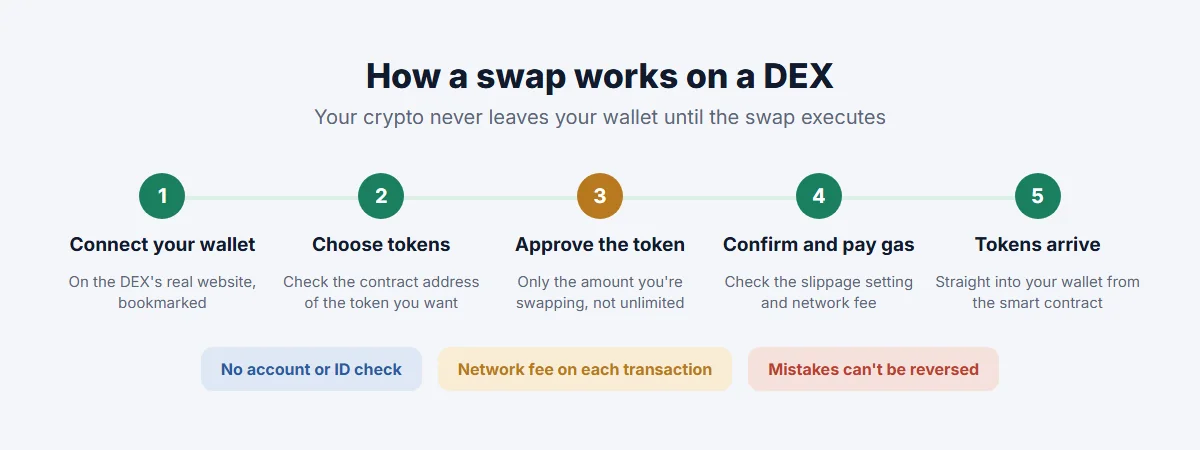
To swap on a DEX you:
- Open the DEX’s website and connect your own wallet (MetaMask, Phantom or a hardware wallet).
- Choose the token you’re giving and the one you want.
- On networks like Ethereum, approve the DEX to spend the token you’re giving. This is a separate transaction.
- Confirm the swap in your wallet and pay the network fee.
- The contract sends the new token straight to your wallet.
There’s no deposit, no withdrawal and no company in between. That’s the appeal: you never give up control of your coins, and you can trade tokens no exchange has listed yet.
The costs of a DEX
DEX trades have two costs:
- The pool fee, a small percentage that goes to the people supplying liquidity. Uniswap pools, for example, use fee tiers from 0.01% to 1%.
- The network fee (often called gas), paid to the blockchain for every transaction, including approvals. It doesn’t depend on the size of your trade, so it can be a large share of a small swap on Ethereum’s main network, and much lower on networks like Solana or Ethereum layer 2s.
Then there’s slippage: the price can move between quoting and confirming your swap, especially in small pools or big trades. Your wallet’s slippage setting caps how much worse a price you’ll accept. Set it too tight and the swap fails, and you may still pay the network fee; set it too loose and you can get a bad price.
On a CEX, the costs are the trading fee and spread, plus a withdrawal fee when you move coins out. Crypto exchange fees explained covers them in detail.
The risks of a DEX that catch beginners
The DEX itself rarely steals from you. The danger is that nobody checks what you’re doing.
- Fake tokens. Anyone can create a token called “USDC” or copy a popular project’s name. Always check the token’s contract address against the project’s official site or a reputable source before swapping.
- Fake DEX websites. Search ads and social posts point to look-alike sites that ask you to connect your wallet and sign a transaction that empties it. Bookmark the real address.
- Token approvals. An approval lets a contract move your tokens. Unlimited approvals stay active after the trade, so if that contract is ever exploited, your tokens can be taken. Approve only what you need and revoke old approvals, as Trezor’s guide to DEXs recommends.
- Smart contract bugs. Well-established DEXs have been audited and battle-tested, but newer ones carry more risk.
- No undo. A swap sent to the wrong token or a malicious contract can’t be reversed, and there’s no support line.
Many of these are variations on scams covered in common crypto scams, particularly wallet drainers.
Centralized vs decentralized exchanges: which should you use?
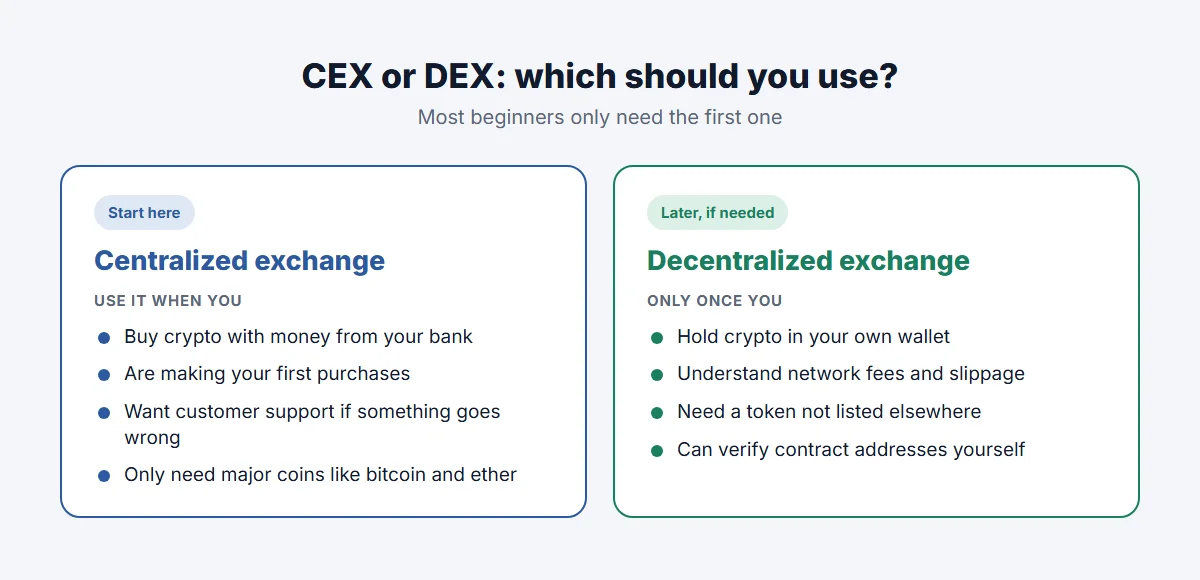
Use a centralized exchange if you’re buying crypto with money from your bank, it’s your first time, you want support if something goes wrong, or you only need major coins such as bitcoin and ether. How to buy crypto safely for the first time walks through that process, and Coinbase vs Kraken compares two well-known options.
Consider a decentralized exchange once you already hold crypto in your own wallet, understand network fees and slippage, and want to swap for a token that centralized exchanges don’t list or to keep your coins in self-custody throughout.
Many experienced users do both: they buy on a CEX, withdraw to their own wallet, and use a DEX occasionally. If you go that route, start with a small amount, use a well-known DEX, and check every address twice. If you’re still choosing a wallet, crypto wallets explained is the place to start.