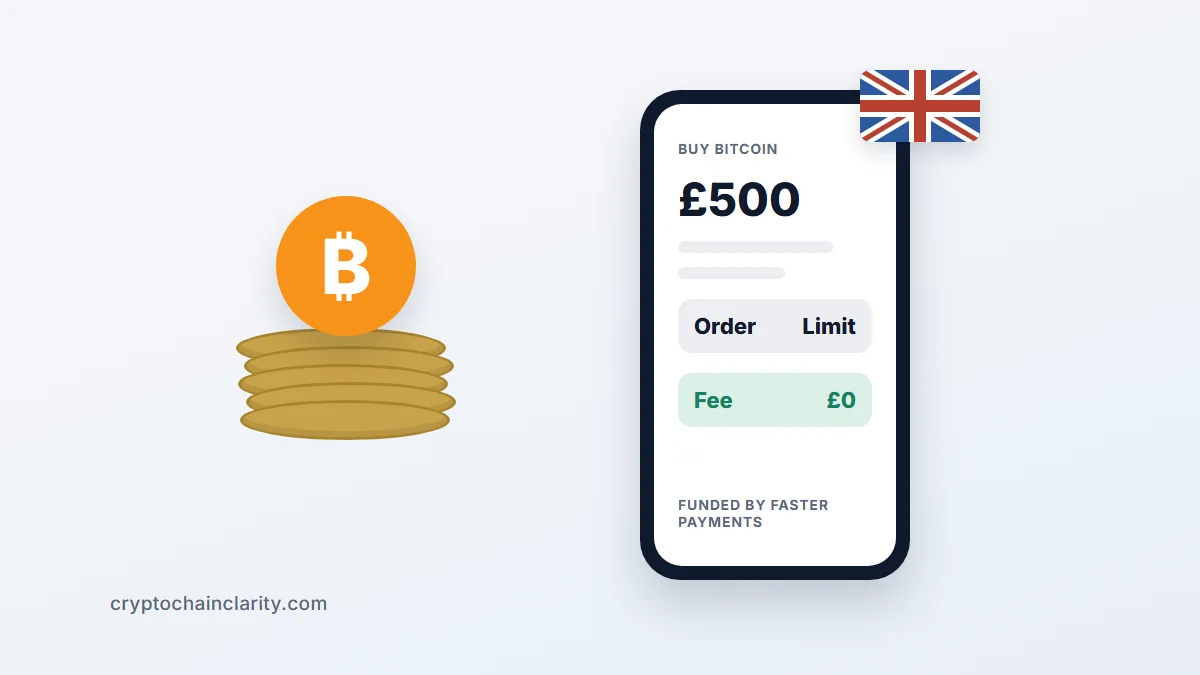
The cheapest way to buy bitcoin in the UK is to deposit pounds by Faster Payments, which is usually free, and buy on an exchange’s order book rather than through its instant “Buy” button. On published fees, Revolut X is currently the cheapest of the large FCA-registered options, at 0% for limit orders and 0.09% for market orders. Kraken Pro and Coinbase Advanced cost more but are still far cheaper than instant buys or card payments.
Below: what a £500 purchase costs on each route, the UK-specific rules that affect your first purchase, and when a crypto ETN in a brokerage account makes more sense than owning bitcoin directly.
What £500 of bitcoin costs on each route
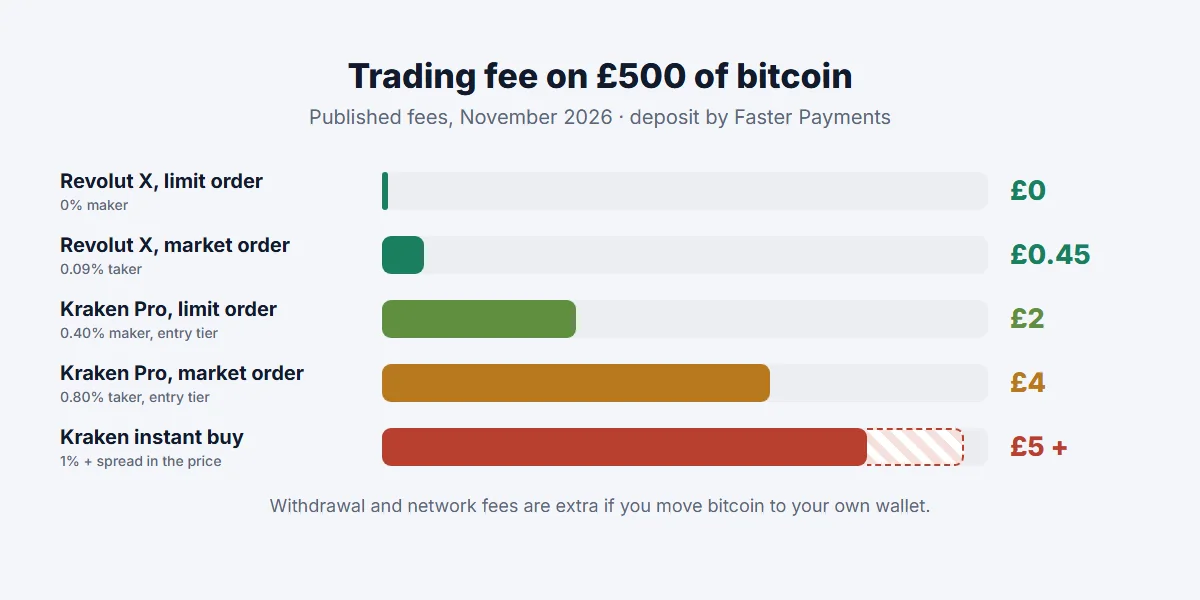
| Route | Published trading fee | Fee on £500 | Notes |
|---|---|---|---|
| Revolut X, limit order (maker) | 0% | £0 | Needs a Revolut account; order-book interface |
| Revolut X, market order (taker) | 0.09% | £0.45 | Fills immediately |
| Kraken Pro, limit order | 0.40% at entry tier | £2 | Falls with higher monthly volume |
| Kraken Pro, market order | 0.80% at entry tier | £4 | Falls with higher monthly volume |
| Kraken instant buy | 1% plus spread | £5 + spread | The default screen in the Kraken app |
| Coinbase Advanced | Tiered maker/taker | Check current rates | Coinbase changed its tiers in 2026 |
| Coinbase simple buy, card payment | Spread, fee and card charges | Usually the most expensive | Avoid for anything but a tiny test |
Sources: Revolut X and Kraken’s fee schedule, as published in November 2026. Fees change, so always check the order preview before confirming.
Two things decide the real cost beyond this table:
- The spread. Order-book trades have no built-in markup; instant buys and many app “Buy” buttons do. That’s why the instant route costs more than its headline fee.
- Withdrawal fees. If you move bitcoin to your own wallet, you’ll pay a network fee and possibly a platform fee. Check it on the withdrawal screen before you choose a platform, especially if you plan to withdraw small amounts often.
Why Faster Payments matters
Depositing pounds by Faster Payments is free or close to it on the main UK platforms, and money usually arrives within minutes. Card deposits are instant too, but they typically add a fee of a few percent, which wipes out the savings of a cheap order book.
One UK quirk: some banks limit or block payments to crypto exchanges, or flag them for extra checks. If your transfer is declined, check your bank’s policy before trying again. Moving money through a third party to get around a block isn’t a good idea.
UK rules that affect your first purchase
Every crypto firm serving UK customers must be registered with the FCA for anti-money-laundering purposes. You can check any platform’s name on the FCA register before signing up. Registration doesn’t mean your crypto is protected: crypto held on an exchange isn’t covered by the Financial Services Compensation Scheme (FSCS).
Under the FCA’s promotion rules, the first time you invest with a firm you’ll also see:
- a personalised risk warning,
- a short appropriateness quiz about how crypto works and its risks,
- a 24-hour cooling-off period before you can make your first investment.
This applies per firm, not per purchase, so it’s only a delay the first time. Because of it, it pays to choose your platform carefully rather than signing up to several to compare. The full process, from security settings to your first order, is in how to buy crypto safely for the first time.
Owning bitcoin vs buying a crypto ETN
Since 8 October 2025, UK retail investors can buy crypto exchange-traded notes (ETNs) that track bitcoin or ether, listed on a UK exchange and bought through a normal investment platform. You get price exposure without managing coins, wallets or recovery phrases.
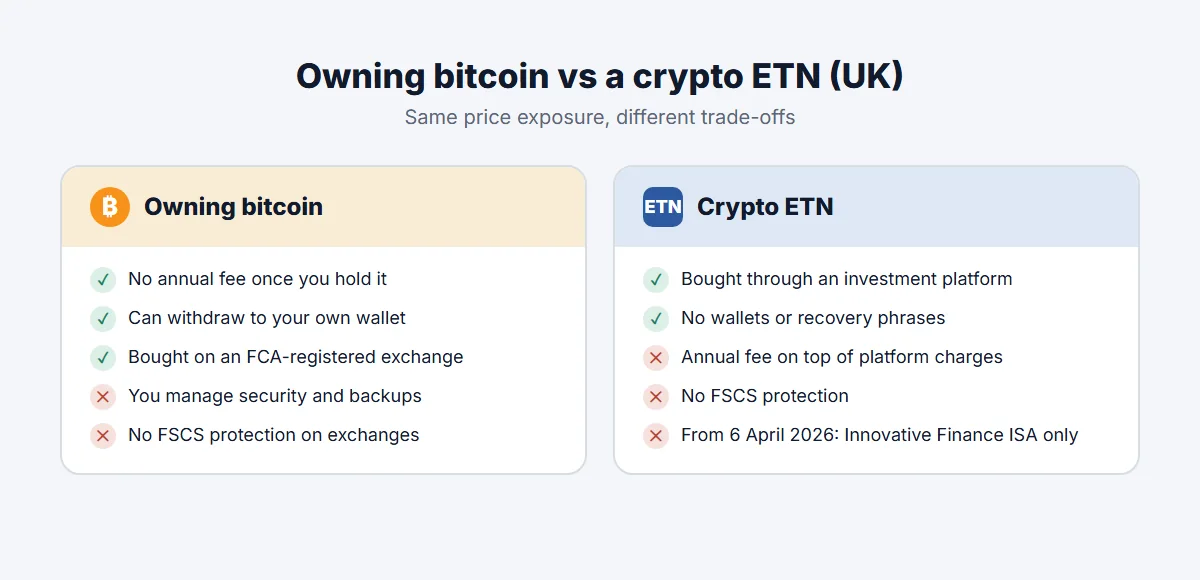
Before choosing an ETN, know the trade-offs:
- Ongoing fees. ETNs charge an annual fee taken from the product’s value, on top of any platform charge. Owning bitcoin directly has no annual fee.
- No FSCS protection for crypto ETNs, and they’re notes issued by a provider, so you rely on that issuer’s structure.
- ISA rules changed. HMRC announced that from 6 April 2026 crypto ETNs qualify only for the Innovative Finance ISA, not the stocks and shares ISA. ETNs already held in a stocks and shares ISA before that date are treated as Innovative Finance ISA investments. In practice, few platforms offer an Innovative Finance ISA that can hold them, so check before buying with an ISA in mind.
- You can’t withdraw the bitcoin. If self-custody is part of why you want bitcoin, an ETN doesn’t offer it.
For a regular investor who will hold for years, buying bitcoin directly on a cheap order book and moving it to a hardware wallet usually costs less over time. An ETN suits someone who wants bitcoin inside an existing investment account and doesn’t want to manage keys. The US equivalent, spot bitcoin ETFs, is explained in how bitcoin ETFs work.
Don’t forget tax
Selling, swapping or spending bitcoin can trigger Capital Gains Tax in the UK, and HMRC expects you to keep records of each purchase, including the fees you paid, which reduce your taxable gain. Download your transaction history from each platform regularly. Our crypto taxes guide explains what counts as a taxable event.
The cheapest way to buy bitcoin in the UK, step by step
- Pick an FCA-registered platform with an order book: Revolut X if you already use Revolut, or Kraken Pro.
- Pass the identity checks, risk warning, quiz and 24-hour cooling-off.
- Deposit pounds by Faster Payments, not card.
- Place a limit order at or just below the current price to pay the lowest fee.
- Leave small amounts on the platform with two-factor authentication, or withdraw larger amounts in one go to your own wallet.
If you plan to buy a fixed amount every month, dollar-cost averaging in crypto explains how to set up recurring purchases without paying high fees on each one. For a closer look at the two best-known exchanges, see Coinbase vs Kraken.