Blockchain is often described as revolutionary, secure, decentralized, and transparent. But behind those words is a technical structure that, while complex, follows clear principles.
Understanding how blockchain technology works doesn’t require advanced coding knowledge. It requires seeing how data, cryptography, distributed networks, and incentives come together to form a system that records information without relying on a central authority.
This technical foundation is what makes cryptocurrencies, smart contracts, and many Web3 applications possible.
Table of Contents
Step One: A Distributed Ledger
At the core of blockchain is a ledger — a record of transactions.
In traditional systems, a ledger might be controlled by a bank or company. In a blockchain, copies of this ledger are stored across many independent computers (often called nodes). Each participant has access to the same transaction history.
Because there is no single central copy, the system is more resilient. If one node fails, others continue operating.
Step Two: Transactions Enter the Network
When a user sends cryptocurrency or interacts with a smart contract, that action becomes a transaction.
This transaction is broadcast to the network. Nodes check whether it follows the rules — for example, whether the sender has enough balance and whether the digital signature is valid.
Only valid transactions move forward in the process.
Step Three: Transactions Are Grouped Into Blocks
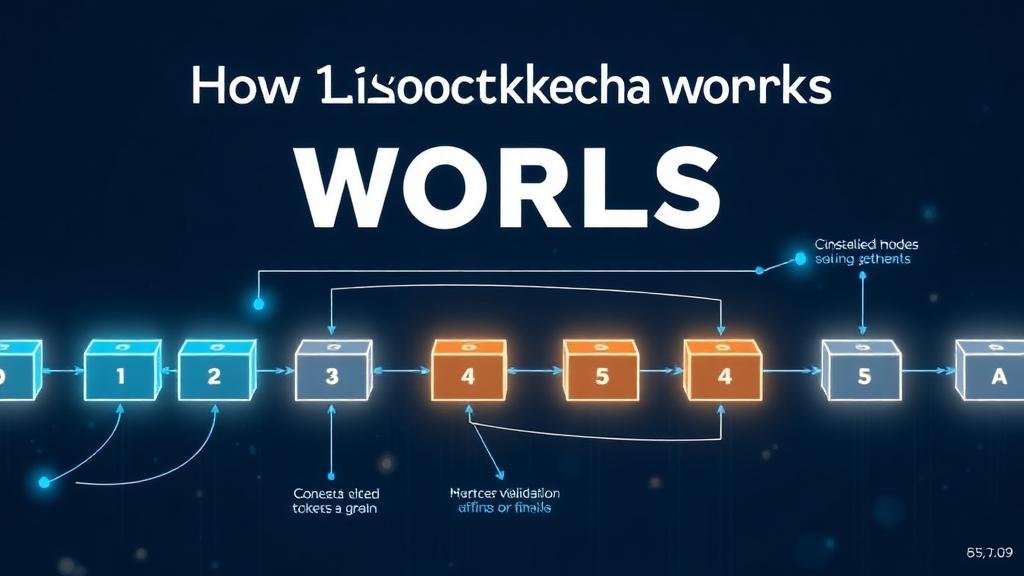
Instead of recording transactions one by one, blockchains bundle many transactions together into blocks.
Each block includes:
A list of transactions
A timestamp
A reference to the previous block
A cryptographic hash representing its data
This structure is where the term “blockchain” comes from — blocks linked together in sequence.
Step Four: Cryptographic Hashing Secures the Chain
Hashing is a key technical component.
A cryptographic hash turns block data into a unique digital fingerprint. If any transaction inside the block changes, the hash changes completely.
Each block also contains the hash of the previous block. This links them together. Altering one block would require changing all following blocks — a difficult task in large networks.
This chain of hashes helps protect the integrity of the ledger.
Step Five: Consensus Mechanisms Maintain Agreement
With many nodes maintaining copies of the ledger, the network needs a way to agree on which blocks are valid. This is where consensus mechanisms come in.
Consensus rules determine how new blocks are added. Participants follow these rules, and invalid blocks are rejected.
These mechanisms align participants through shared procedures and, in many cases, economic incentives.
The result is agreement across a distributed system without a central controller.
Step Six: Incentives Keep the System Running
Blockchain networks rely on participants to validate transactions and maintain infrastructure. Incentives encourage honest behavior.
Participants may receive rewards for adding valid blocks or helping secure the network. Acting dishonestly can result in wasted effort or financial penalties.
This incentive design links technical security with economic motivation.
Step Seven: Immutability Emerges
Because blocks are linked through hashes and verified by many nodes, past records become difficult to change.
This quality is often described as immutability. It doesn’t mean data can never change under any circumstance, but altering history would require overcoming significant technical and economic barriers.
This makes blockchain suitable for recording information that benefits from tamper resistance.
Step Eight: Smart Contracts Add Programmability
Beyond recording transactions, many blockchains support smart contracts — programs that run automatically on the network.
These contracts follow code-based rules and can handle financial logic, asset management, and other processes. They expand blockchain from a ledger to a programmable platform.
The same security mechanisms that protect transactions also support these automated systems.
Decentralization in Practice
Because many nodes participate, control is distributed. No single party can easily change rules or censor transactions.
However, decentralization varies by network. Some systems have broader participation than others. Technical design, governance models, and infrastructure all influence how decentralized a blockchain truly is.
Trade-Offs Are Part of the Design
Blockchain technology balances security, decentralization, and scalability.
Higher security and decentralization can make scaling more complex. That’s why additional layers and optimization methods are developed to improve performance.
Understanding these trade-offs helps explain why different networks make different design choices.
Why This Matters for U.S. Readers
In the United States, many digital systems rely on centralized service providers. Blockchain introduces a model where trust is based on code, cryptography, and distributed verification instead of single institutions.
This shift has implications for finance, data management, and digital identity. Even for readers who never build a blockchain application, understanding how blockchain technology works clarifies how these systems differ from traditional databases.
A Balanced Perspective
Blockchain is not a cure-all. It excels in environments where transparency, shared verification, and tamper resistance saw value. In other cases, traditional systems may remain more efficient.
The key is understanding the technical foundation before evaluating use cases.
The Bottom Line
Blockchain technology combines distributed ledgers, cryptographic hashing, consensus mechanisms, and economic incentives to create a system where many participants can agree on a shared record without central control.
Transactions are grouped into blocks, linked through hashes, and validated through consensus rules. Smart contracts add programmable logic on top of this structure.
This technical foundation is what enables cryptocurrencies, decentralized applications, and new forms of digital coordination. Understanding it turns blockchain from a buzzword into a system built on clear, interlocking principles.