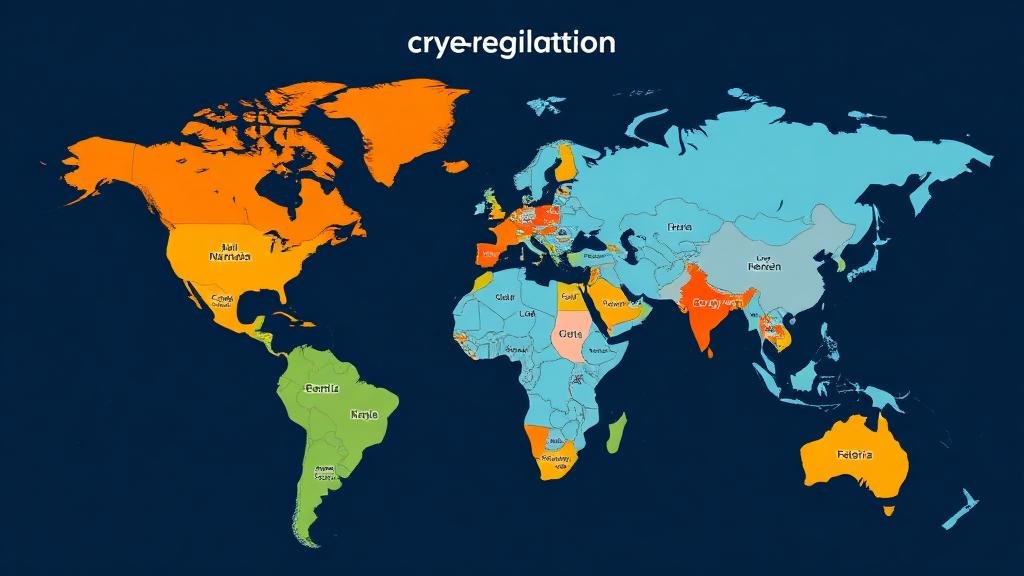
If crypto started as a technology experiment, it has now become a policy conversation. Around the world, governments are trying to answer the same difficult question: how do you regulate a borderless digital system using national laws?
Understanding global cryptocurrency regulation is not about memorizing legal codes. It’s about seeing the big picture — how different countries are approaching digital assets, what they’re trying to protect, and why regulation is shaping the future of crypto just as much as technology itself.
Table of Contents
Why Regulation Became Inevitable
In crypto’s early years, regulation was minimal largely because the market was small. As adoption grew, so did the stakes.
Digital assets began intersecting with:
Consumer protection
Financial stability
Anti-money laundering rules
Tax systems
Institutional investment
Once crypto moved from niche forums into mainstream markets, ignoring regulation was no longer realistic. Governments don’t regulate technology because it’s new — they regulate when financial risk, consumer exposure, and economic impact reach a scale that matters.
Crypto crossed that threshold.
The U.S. Approach: Cautious and Fragmented
For U.S. readers, the domestic landscape feels complex — and that’s because it is.
The United States does not have a single crypto regulator. Instead, oversight is divided among multiple agencies. Some focus on securities law, others on commodities, banking oversight, or financial crime prevention.
This creates a system that is cautious but not always clear. Enforcement actions have shaped the environment as much as formal legislation. At the same time, lawmakers continue to debate frameworks for market structure, stablecoins, and digital asset classification.
From a global perspective, the U.S. approach is influential but still evolving. It reflects a balancing act between innovation, investor protection, and maintaining financial stability.
Europe: Structured and Rule-Driven
Europe has taken a more unified approach in recent years. Rather than relying heavily on case-by-case enforcement, regulators have focused on building comprehensive rulebooks.
The European model emphasizes:
Licensing requirements for crypto service providers
Consumer protection standards
Capital and reserve requirements for certain assets
Transparency obligations
The goal is to create consistency across countries within the region. For companies, this can mean higher compliance expectations but also clearer pathways to operate legally.
Europe’s strategy shows what happens when policymakers treat crypto as a long-term part of the financial system rather than a temporary anomaly.
Asia: Diverse Strategies, Different Priorities
Asia presents a wide spectrum of regulatory approaches.
Some jurisdictions aim to position themselves as digital asset hubs, focusing on licensing frameworks, innovation sandboxes, and regulatory clarity to attract companies. Others maintain tighter controls, emphasizing capital flow management, consumer risk, and financial stability.
This diversity highlights an important truth: crypto regulation often reflects broader national priorities. Countries with strong fintech ambitions may lean toward structured inclusion. Others may prioritize control and stability over rapid innovation.
Emerging Markets: Balancing Risk and Opportunity
In many emerging economies, regulation reflects unique financial realities.
Some governments are cautious because of concerns about capital flight or currency stability. Others see crypto as a tool for financial inclusion, remittances, and digital development.
The regulatory tone in these regions often focuses on:
Protecting consumers from scams
Managing financial system risks
Exploring digital currency initiatives
Encouraging controlled innovation
For global crypto users, this means the legal environment can vary widely depending on where they operate.
Common Threads Across Borders
Despite regional differences, several themes appear again and again in global cryptocurrency regulation.
Consumer Protection
Authorities want to reduce fraud, misleading promotions, and unsafe platforms.
Anti-Money Laundering (AML)
Governments focus on preventing illicit finance through identity verification, reporting standards, and transaction monitoring.
Stablecoin Oversight
Assets designed to maintain stable value attract attention because of their potential role in payments and broader finance.
Market Integrity
Rules around custody, disclosures, and operational standards aim to reduce systemic risks.
These shared priorities show that regulation is less about stopping crypto and more about shaping how it operates within existing financial systems.
Regulation vs. Innovation: A Constant Tension
There’s a natural tension in this space.
Too little oversight can lead to scams, collapses, and loss of public trust. Too much rigidity can push innovation offshore or into less transparent channels. Policymakers are trying to find a middle path where innovation continues but risk is managed.
This is not unique to crypto. Every major financial innovation — from online banking to derivatives markets — went through periods of regulatory adjustment.
Crypto is going through that process now.
Why Clarity Matters More Than Strictness
For companies and investors, uncertainty can be more damaging than strict rules. Clear requirements allow businesses to build compliant models and attract institutional capital.
As more countries define licensing, custody standards, and reporting frameworks, crypto shifts from a legal gray area toward a regulated asset class. That transition tends to reduce wild-west conditions, even if it introduces higher compliance costs.
In the long run, clarity often supports sustainable growth.
The Role of International Coordination
Crypto doesn’t respect borders. Transactions can move globally in minutes. That makes coordination between regulators important.
International bodies and cross-border discussions increasingly focus on:
Consistent AML standards
Information sharing
Common approaches to risk management
Digital asset reporting
While global rules are unlikely to become identical, alignment on core issues helps reduce regulatory gaps that could be exploited.
What This Means for Individual Users
For everyday users, regulation can feel distant — until it affects platform access, identity verification, or product availability.
Stronger frameworks often mean:
More identity checks
Clearer disclosures
Safer custody practices
Better legal recourse in disputes
These changes can add friction, but they also signal that crypto is being treated as part of the financial system rather than outside it.
Institutional Confidence and Market Structure
Large financial institutions typically operate only where legal frameworks are defined. As global cryptocurrency regulation becomes more structured, institutional participation becomes easier to justify.
This doesn’t eliminate volatility or risk, but it does move the market toward professional standards seen in other asset classes. Over time, that can influence liquidity, product development, and market behavior.
Regulation Is Not the End of Crypto’s Story
Some people fear regulation means the end of decentralization or innovation. Others believe more oversight is the only path to legitimacy. Reality sits between those views.
Crypto networks continue to operate at a technical level regardless of national laws. What regulation shapes is the interface between these networks and the traditional financial world — exchanges, custody providers, payment systems, and institutions.
It’s about how crypto connects to society, not whether the technology exists.
A Period of Transition
We are in a transition phase.
Early crypto was lightly regulated and experimental. The next phase involves integration into financial systems with clearer rules. This doesn’t happen overnight, and it doesn’t look the same everywhere.
But the overall direction is visible: from uncertainty toward structured participation.
The Big Picture
Looking at global cryptocurrency regulation shows that digital assets are no longer treated as a temporary trend. They are being folded into financial policy discussions worldwide.
That process involves debate, adjustment, and learning on both sides — regulators and industry participants. It’s not about choosing between freedom and control, but about defining how a new financial technology coexists with established systems.
For readers trying to understand crypto’s long-term trajectory, regulation is not a side topic. It’s one of the main forces shaping what the ecosystem becomes.